


Apr 20 2026
/
Wi-Fi 6E vs Wi-Fi 7: Which Should Businesses Upgrade To in 2026?
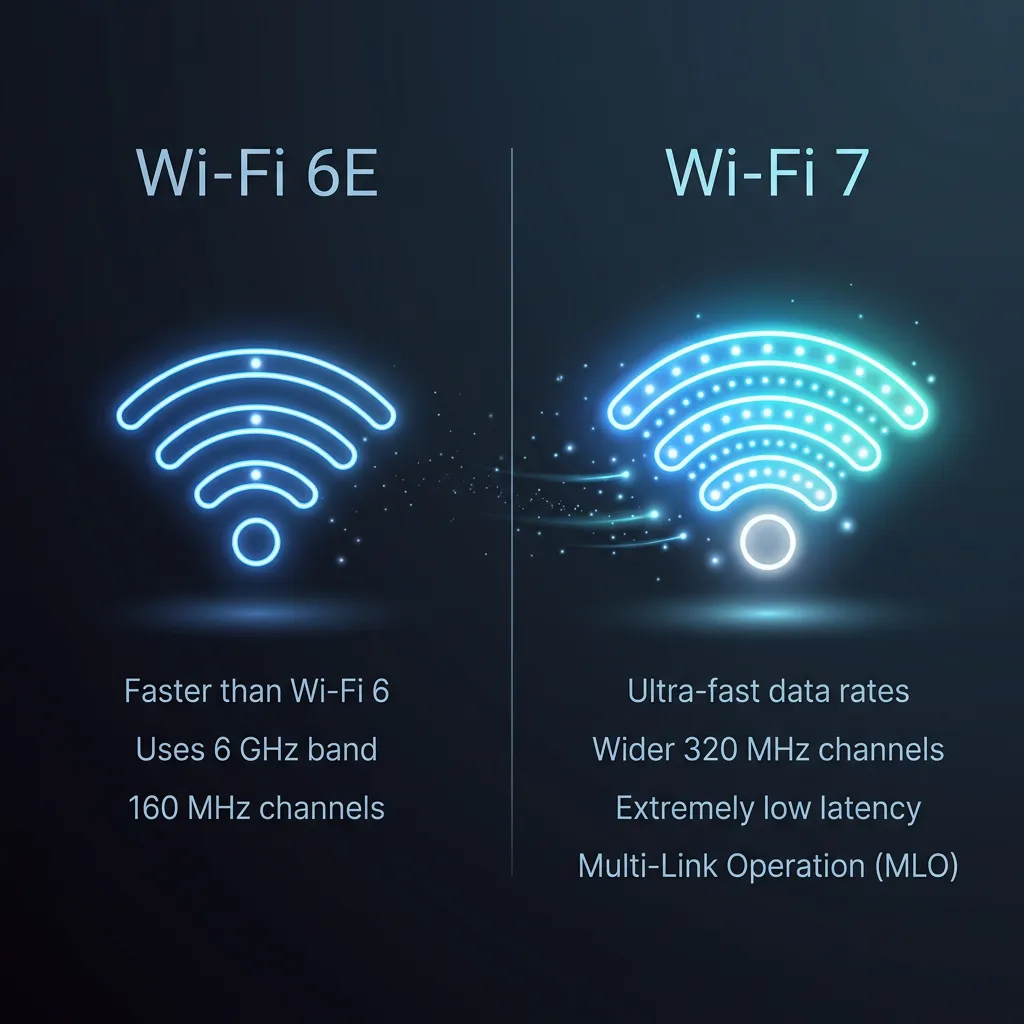
For businesses planning an infrastructure upgrade in 2026, Wi-Fi 7 is the superior choice. While Wi-Fi 6E introduced the exclusive 6 GHz band to reduce congestion, Wi-Fi 7 delivers exponentially higher throughput, ultra-low latency, and Multi-Link Operation (MLO). This ensures reliable, future-proof connectivity for demanding enterprise applications.
Evaluating network infrastructure is a critical responsibility for enterprise IT leaders. As wireless technology advances rapidly, organizations must determine the most strategic investments to support their growing operational demands. The transition to a new wireless standard requires significant capital and planning, making the decision between available technologies highly consequential.
In recent years, Wi-Fi 6E served as a foundational step forward by opening the 6 GHz spectrum, alleviating traffic on legacy bands. However, the introduction of Wi-Fi 7 represents a paradigm shift in wireless networking capabilities. By 2026, the ecosystem of compatible devices and enterprise access points will have reached maturity, presenting a compelling case for a comprehensive infrastructure overhaul.
Understanding the technical distinctions between these two standards is essential for making an informed procurement decision. This guide provides a detailed analysis of Wi-Fi 6E and Wi-Fi 7, outlining their respective capabilities to assist your organization in deploying a robust, resilient networking and wireless solution.
Technical Comparison: Wi-Fi 6E vs Wi-Fi 7
To facilitate a clear understanding of the generational leap, the following table outlines the core technical specifications and enterprise benefits of both wireless standards.
| Feature / Specification | Wi-Fi 6E (802.11ax) | Wi-Fi 7 (802.11be) |
|---|---|---|
| Maximum Data Rate | Up to 9.6 Gbps | Up to 46 Gbps |
| Channel Bandwidth | Up to 160 MHz | Up to 320 MHz |
| QAM (Quadrature Amplitude Modulation) | 1024-QAM | 4096-QAM |
| Multi-Link Operation (MLO) | Not Supported | Fully Supported |
| Latency Reduction | Moderate | Extreme (Deterministic Latency) |
| Ideal Enterprise Use Case | Reducing network congestion | High-density VR, AR, and automated IoT |
The Case for Wi-Fi 6E in the Modern Enterprise
Wi-Fi 6E was engineered to address a specific bottleneck: spectrum congestion. By utilizing the 6 GHz band, it effectively bypassed the crowded 2.4 GHz and 5 GHz frequencies. This allowed supported devices to operate on a clean, interference-free spectrum.
For organizations that upgraded recently, Wi-Fi 6E provides highly reliable connections for standard corporate functions, video conferencing, and general cloud computing. The technology utilizes 160 MHz channels to deliver stable performance across office environments. However, as enterprise data requirements compound, the limitations of its maximum throughput and lack of multi-link capabilities become apparent. Organizations planning a new deployment in 2026 will likely find Wi-Fi 6E inadequate for long-term scalability.
The Strategic Advantage of Wi-Fi 7
Wi-Fi 7 is meticulously designed for the future of digital enterprise. It introduces 320 MHz channel bandwidths, doubling the capacity of its predecessor. Furthermore, the implementation of 4096-QAM allows for significantly denser data transmission, translating to exceptional speeds that approach 46 Gbps.
The most transformative feature of Wi-Fi 7 is Multi-Link Operation (MLO). MLO enables enterprise devices to simultaneously send and receive data across multiple frequency bands (2.4 GHz, 5 GHz, and 6 GHz). This capability ensures unparalleled reliability and deterministic latency. If interference disrupts one band, the data seamlessly routes through another without interruption. For organizations leveraging automated manufacturing, augmented reality training, or high-frequency trading platforms, Wi-Fi 7 guarantees the uninterrupted connectivity essential for mission-critical operations.
Why Choose Magnus Infotech for Your Network Upgrade
As your trusted IT distribution partner, Magnus Infotech is dedicated to delivering seamless technology solutions tailored to your organizational needs. Headquartered in the Al Tawhidi Building on Al Mankhool Street in Dubai, UAE, we serve as the premier B2B IT distribution company bridging global tech vendors with regional resellers and system integrators across the Middle East.
Our unwavering commitment is to provide you with an exceptional experience marked by a seamless blend of quality and value. We specialize in cutting-edge products within Networking & Wireless, Security Surveillance, Unified Communication, and Server & Storage domains. The extensive network of our channel partners, including Facebook Magnus Gulf, is a testament to our dedication in fostering mutually beneficial relationships. We ensure your business receives the precise, high-performance technology infrastructure it deserves to thrive in 2026 and beyond.
Securing Your Digital Future
Choosing the right wireless infrastructure requires strategic foresight and a commitment to operational excellence. While Wi-Fi 6E provided necessary relief for congested networks, Wi-Fi 7 establishes a new benchmark for enterprise connectivity. By aligning your 2026 upgrade cycle with Wi-Fi 7, you empower your workforce with the speed, capacity, and reliability necessary to maintain a competitive advantage. Partner with Magnus Infotech to navigate this transition seamlessly and secure a robust foundation for your future technological endeavors.
Frequently Asked Questions
What is Multi-Link Operation (MLO) in Wi-Fi 7?
Multi-Link Operation allows Wi-Fi 7 devices to connect over multiple frequency bands simultaneously. This reduces latency and ensures consistent network reliability, even in environments with heavy interference.
Is Wi-Fi 7 backward compatible with older devices?
Yes, Wi-Fi 7 access points are fully backward compatible with legacy devices operating on Wi-Fi 6E, Wi-Fi 6, and older standards. However, older devices will not benefit from Wi-Fi 7’s exclusive features like MLO.
Will upgrading to Wi-Fi 7 require new network cabling?
To fully realize the maximum throughput of Wi-Fi 7 access points, businesses will likely need to upgrade their backend infrastructure to multi-gigabit switches and Cat6A or Cat7 cabling. Explore our range of networking solutions and server & storage infrastructure to support your upgrade.
Why should a business skip Wi-Fi 6E and wait for Wi-Fi 7?
By 2026, Wi-Fi 7 hardware will be widely available and cost-effective. Upgrading directly to Wi-Fi 7 maximizes your return on investment by providing a longer hardware lifecycle and superior performance capabilities.
How does 4096-QAM benefit enterprise networks?
Quadrature Amplitude Modulation (QAM) dictates how much data can be packed into a signal. Wi-Fi 7’s 4096-QAM packs 20% more data than the 1024-QAM used in Wi-Fi 6E, resulting in faster file transfers and improved streaming quality.