


Apr 21 2026
/
What Is VLAN and How Does It Improve Network Performance?
A Virtual Local Area Network (VLAN) is a logical grouping of network devices that operate as if they exist on a single local network, regardless of their physical location. By segmenting traffic, VLANs significantly enhance network performance, improve security protocols, and simplify IT administration across modern business infrastructures.
Key Highlights
- Logical Segmentation: VLANs allow network administrators to group devices based on function, project, or department rather than physical proximity.
- Enhanced Security: By isolating sensitive data traffic within specific network segments, organizations can restrict unauthorized access and contain potential security breaches.
- Optimized Bandwidth: Broadcast traffic is confined to individual VLANs, reducing network congestion and ensuring maximum bandwidth availability for critical business operations.
Overview of Virtual Local Area Networks
Network performance is a critical pillar of any successful enterprise. As organizations expand, their physical network infrastructure often becomes congested with broadcast traffic, leading to reduced speeds and potential security vulnerabilities. A Virtual Local Area Network provides a sophisticated solution to this challenge. It enables IT administrators to partition a single physical network into multiple distinct logical networks.
Devices on a VLAN can communicate seamlessly with one another as if they were attached to the same physical network switch. This logical separation bypasses the constraints of physical wiring. It empowers businesses to architect their IT environments around organizational needs rather than building layouts. By mastering network segmentation through VLAN technology, enterprises can ensure scalable, secure, and highly efficient digital operations.
Types of Virtual Local Area Networks
Understanding the different classifications of VLANs is essential for deploying the right architecture for your organization.
- Default VLAN: When a network switch is initially booted up, all ports are assigned to the default VLAN (typically VLAN 1). This ensures basic connectivity before custom configurations are applied.
- Data VLAN: Specifically designed to carry user-generated traffic, this type isolates regular operational data from management or voice traffic, ensuring optimal performance for daily business applications.
- Voice VLAN: Configured exclusively for Voice over Internet Protocol (VoIP) traffic. It prioritizes voice data to ensure high-quality, uninterrupted unified communications across the enterprise.
- Management VLAN: A dedicated network segment used exclusively by IT administrators to monitor, configure, and manage network devices securely, keeping administrative traffic separate from user data.
- Native VLAN: Utilized in trunking protocols (such as IEEE 802.1Q), the native VLAN carries untagged traffic across trunk links, providing backward compatibility with legacy networking equipment.
Network Segmentation Comparison
| Factor | Physical LAN | Virtual LAN (VLAN) | Subnet |
|---|---|---|---|
| Separation Method | Physical hardware and wiring | Logical configuration on switches | IP addressing and routing |
| Cost Efficiency | High (requires more hardware) | Low (utilizes existing switches) | Medium (requires routers) |
| Security Isolation | Limited to physical access | High (isolated broadcast domains) | High (isolated via routing rules) |
| Broadcast Control | Poor (broadcasts reach all nodes) | Excellent (contained within VLAN) | Excellent (contained within subnet) |
| Flexibility | Rigid and difficult to change | Highly adaptable and dynamic | Adaptable but requires IP planning |
How VLAN Configuration Works
Implementing a VLAN involves a systematic process of configuring network switches to recognize and route traffic appropriately.
- Requirement Analysis: Network architects analyze the organization’s departmental needs, traffic patterns, and security requirements to determine the optimal number of VLANs.
- Switch Configuration: Administrators access the network switches to create the VLAN IDs and assign specific names to each logical network. Magnus distributes enterprise-grade switches from brands like Netgear and D-Link suited for advanced VLAN configuration.
- Port Assignment: Individual switch ports are assigned to specific VLANs. Devices connected to these ports automatically become members of that respective VLAN.
- Trunking Implementation: To allow VLAN traffic to travel between multiple switches, administrators configure trunk ports using protocols like 802.1Q, which tags data frames with their corresponding VLAN ID.
- Inter-VLAN Routing: Because VLANs are isolated, a router or a Layer 3 switch is configured to facilitate necessary and secure communication between different VLANs.
Core Use Cases and Applications
The versatility of VLAN technology allows it to be applied across various business scenarios.
- Departmental Isolation: Organizations frequently assign separate VLANs to different departments, such as Human Resources, Finance, and Marketing. This ensures that sensitive financial data remains inaccessible to general marketing staff. Pair this with cybersecurity solutions for comprehensive protection.
- Guest Network Provisioning: Enterprises utilize VLANs to provide internet access to visitors while keeping them strictly separated from the internal corporate network, thereby protecting proprietary information.
- VoIP Optimization: By placing all IP phones on a dedicated Voice VLAN, organizations can apply Quality of Service (QoS) policies to prioritize voice traffic, eliminating latency and dropped calls. Explore unified communication solutions from Magnus including VoIP devices from Snom and D-Link.
- Server Farm Security: Grouping critical servers into a dedicated management or server VLAN allows administrators to implement stringent firewall rules, tightly controlling which user segments can access specific databases. Explore Magnus’s server and storage solutions to complement your VLAN-secured infrastructure.
Primary Benefits of Implementing VLAN
Deploying VLANs provides substantial operational advantages for businesses seeking reliable IT infrastructure.
- Enhanced Network Performance: By breaking a large physical network into smaller logical broadcast domains, VLANs prevent broadcast storms from consuming valuable bandwidth.
- Strengthened Security Posture: Isolating traffic logically means that a compromised device in one department cannot easily spread malware or unauthorized access to other segments of the organization. Strengthen this further with cybersecurity solutions in UAE from Magnus.
- Simplified IT Administration: When an employee moves to a different physical desk, administrators can simply reassign their new switch port to their existing VLAN without needing to rewire cables.
- Cost Reduction: Organizations maximize the utility of their existing network switches rather than purchasing separate physical hardware for different network segments.
Challenges and Limitations
While highly beneficial, VLAN implementations require careful planning to avoid specific operational hurdles.
- Configuration Complexity: Managing a large number of VLANs across multiple enterprise switches requires meticulous documentation and skilled IT personnel. Magnus offers technical support to assist your team throughout the deployment process.
- Inter-VLAN Routing Bottlenecks: If too much traffic needs to cross between different VLANs, the routing device can become a performance bottleneck.
- VLAN Hopping Risks: If switch ports are not securely configured, malicious actors can exploit trunking protocols to bypass network segmentation and access unauthorized VLANs. Mitigate these risks with Magnus’s cybersecurity solutions.
- Spanning Tree Protocol (STP) Issues: Incorrectly configured VLANs can lead to network loops, requiring precise STP configuration to maintain network stability. Request support from the Magnus team for expert configuration assistance.
Future Trends in Network Segmentation
As digital transformation accelerates, the methodology behind network segmentation continues to evolve.
- Software-Defined Networking (SDN): The integration of VLANs with SDN controllers allows for centralized, automated provisioning of network segments across massive corporate infrastructures. Explore Magnus’s full networking and wireless solutions portfolio to future-proof your network.
- Micro-segmentation: Moving beyond traditional VLANs, organizations are adopting micro-segmentation to secure individual workloads in cloud environments, applying zero-trust security models. Complement this with cybersecurity solutions available through Magnus.
- AI-Driven Network Management: Artificial intelligence is being utilized to dynamically adjust VLAN configurations based on real-time traffic analysis, predicting and preventing congestion before it occurs. Discover AI-powered security and surveillance products from Holowits available through Magnus.
Visualizing Network Architecture
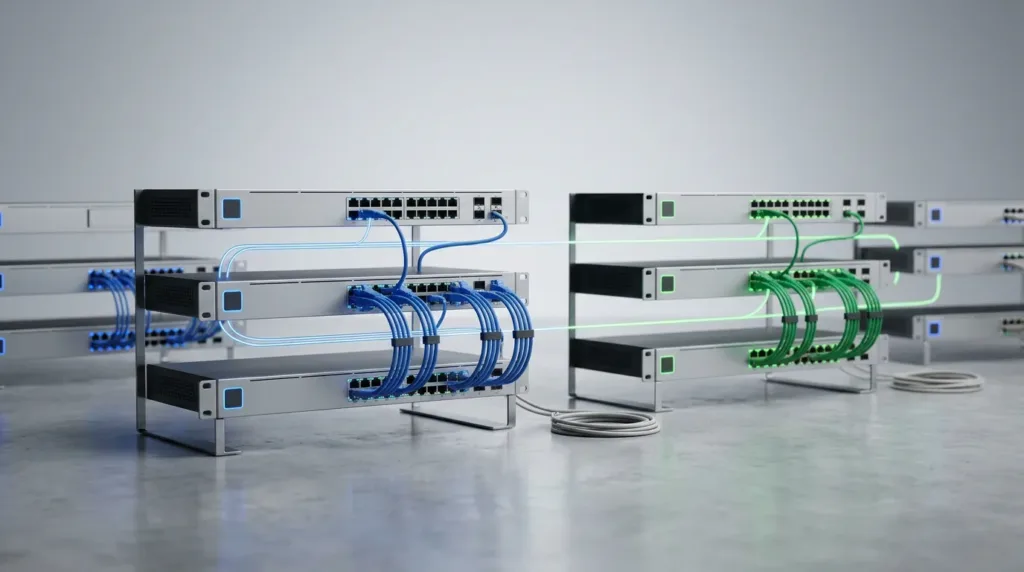
Network Diagram Concept: A standard VLAN topology illustration typically displays a central core switch connected to multiple edge switches. Different colored lines represent distinct VLANs (e.g., Blue for Finance, Green for Marketing, Red for VoIP). The diagram highlights how a single physical network switch can simultaneously support multiple colored pathways, keeping the data streams completely isolated from one another until they reach a designated Layer 3 routing device.
Why Choose Magnus Infotech
Navigating the complexities of modern network architecture requires a reliable and dedicated technology partner. Magnus Infotech stands as a premier B2B IT distribution company based in Dubai, committed to delivering seamless technology solutions.
- Extensive Regional Reach: As a leading Value Added Distributor, we serve as the vital bridge between global tech vendors and regional resellers across the Middle East. View our global locations.
- Premium Vendor Partnerships: We specialize in providing cutting-edge networking and wireless products from the world’s most trusted manufacturers. Explore our full brands portfolio including Netgear, Teltonika, Cudy, and D-Link.
- Dedicated Support: Operating from our headquarters in the Al Tawhidi Building on Al Mankhool Street, Dubai, our team provides unwavering commitment and technical expertise to ensure your infrastructure projects succeed. Learn more about us or contact us today.
Partner with Magnus Infotech today to secure the advanced networking solutions your business deserves.
Frequently Asked Questions
What is the primary difference between a LAN and a VLAN?
A LAN (Local Area Network) is a physical network of devices connected within a specific location. A VLAN (Virtual LAN) is a logical network that segments devices on the same physical LAN into separate, isolated broadcast domains. Explore Magnus’s networking solutions in UAE for both LAN and VLAN-capable hardware.
Can devices on different VLANs communicate with each other?
By default, devices on different VLANs cannot communicate. To enable communication, a Layer 3 device, such as a router or a multilayer switch, must be configured to route traffic between the isolated networks safely. Browse networking products from Magnus to find the right Layer 3 switching solution.
How does a VLAN improve network security?
VLANs improve security by isolating sensitive data traffic. Even if a user on one VLAN is compromised, the logical separation prevents the threat from easily traversing to other departments or critical server VLANs. For a complete security approach, explore cybersecurity solutions from Magnus.
What is a VLAN tag?
A VLAN tag is a small piece of data inserted into an Ethernet frame when it travels across a trunk link between switches. This tag identifies which VLAN the data belongs to, ensuring it is delivered to the correct logical network. Contact Magnus for expert advice on managed switches that support 802.1Q VLAN tagging.
Is a VLAN suitable for a small business?
Yes. Even small businesses can benefit from VLANs by separating guest Wi-Fi traffic from internal employee data, ensuring that visitors cannot access corporate resources or administrative interfaces. Magnus offers scalable networking and wireless solutions suitable for businesses of all sizes. Become a partner or visit our shop to get started.