

Apr 21 2026
/
What Is QoS (Quality of Service) and How Does It Boost Network Performance?
Quality of Service (QoS) is a set of network technologies designed to manage data traffic and guarantee optimal performance for critical applications. By prioritizing specific data packets over less important traffic, QoS minimizes latency, reduces packet loss, and ensures the seamless delivery of essential enterprise communications.
Key Highlights
- Traffic Prioritization: QoS ensures that mission-critical applications, such as voice and video, receive the necessary bandwidth to function without interruption.
- Bandwidth Optimization: Network administrators can allocate network resources efficiently, preventing non-essential applications from congesting the network.
- Enhanced User Experience: By minimizing delays and data loss, QoS provides a reliable, high-quality digital experience for employees and clients alike.
Network Optimization Overview
Modern enterprise networks must process an immense volume of data simultaneously. When network traffic exceeds the available bandwidth, congestion occurs, leading to dropped packets, severe delays, and degraded application performance. Quality of Service acts as a traffic management system, implementing rules and policies that dictate how different types of data are handled. Rather than treating all data equally, QoS identifies high-priority traffic and expedites its journey across the network infrastructure. This systematic approach guarantees that critical business operations remain uninterrupted, even during periods of peak network utilization.
Categories of Quality of Service
Network engineers typically deploy QoS through three primary models, each offering a distinct approach to traffic management:
Best Effort
This is the default operational mode for most standard networks. The Best Effort model does not apply any specific prioritization or guarantees regarding data delivery. All packets are treated equally, making it suitable for general web browsing or file transfers where minor delays do not impact the core function.
Integrated Services (IntServ)
The IntServ model reserves precise network resources for a specific data stream before the data is transmitted. Applications must request and secure bandwidth along the entire network path. While this provides a stringent guarantee of performance, it requires significant overhead and is generally less scalable for massive enterprise networks.
Differentiated Services (DiffServ)
DiffServ is a highly scalable model that classifies and manages network traffic by assigning distinct priority values to different types of packets. Network devices, such as routers and switches, inspect these values and apply corresponding forwarding behaviors. This method is the preferred standard for modern enterprise networks due to its flexibility and efficiency.
QoS Model Comparison
Factor | Best Effort | Integrated Services (IntServ) | Differentiated Services (DiffServ) |
Prioritization | None | High (Resource Reservation) | High (Packet Marking) |
Scalability | High | Low | High |
Complexity | Minimal | Very Complex | Moderate |
Ideal Use Case | General web browsing | Small networks with strict requirements | Large enterprise corporate networks |
How Quality of Service Works
Implementing QoS involves a structured process that enables network devices to identify and prioritize traffic seamlessly.
Step 1: Traffic Classification
The network must first identify the type of data entering the system. Network devices analyze incoming traffic to determine whether it is voice, video, or standard data based on port numbers, IP addresses, or application signatures. QoS-capable managed switches from brands like Netgear and D-Link support deep packet inspection for accurate traffic classification.
Step 2: Packet Marking
Once classified, the packets are marked with specific priority indicators. In the DiffServ model, this is typically achieved by altering the Differentiated Services Code Point (DSCP) value within the packet header. This marking acts as an instruction for downstream routers and switches.
Step 3: Congestion Management (Queuing)
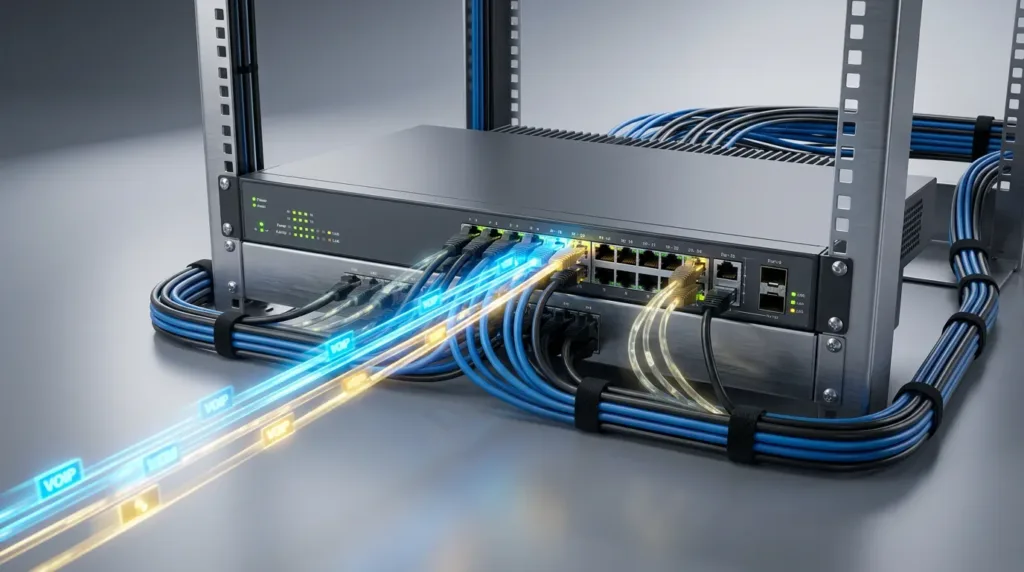
When network congestion occurs, marked packets are placed into distinct queues based on their priority level. Critical traffic, such as Voice over IP (VoIP), is assigned to a strict priority queue and transmitted immediately, while lower-priority traffic is queued for later transmission. Ensure your switching hardware is QoS-ready by exploring networking solutions from Magnus.
Step 4: Traffic Shaping and Policing
To prevent any single application from monopolizing the entire network, QoS employs shaping and policing mechanisms. Traffic shaping buffers excess data and transmits it at a steady, controlled rate. Policing strictly monitors bandwidth usage and drops packets that exceed predefined limits. Request support from the Magnus team for expert QoS policy configuration assistance.
Primary Enterprise Applications
Organizations across various sectors rely on QoS to support specific network-dependent functions:
- Voice over IP (VoIP): Voice communications require immediate, continuous data delivery. QoS prioritizes VoIP packets to eliminate echo, jitter, and dropped calls, ensuring clear and professional communication. Explore VoIP hardware from Snom and D-Link distributed by Magnus, and browse the full range of unified communication solutions to complement your QoS-enabled network.
- Video Conferencing: High-definition video meetings are susceptible to lag and pixelation. Applying QoS guarantees smooth visual and audio synchronization for reliable corporate collaboration. Discover unified communication solutions from Magnus that work seamlessly alongside QoS-configured networks.
- Financial Transactions: In the banking and finance sector, milliseconds matter. QoS ensures that critical transactional data receives absolute priority over standard corporate traffic. Pair QoS with cybersecurity solutions from Magnus to protect sensitive financial data end-to-end.
- Industrial IoT: Manufacturing facilities utilizing Internet of Things (IoT) sensors require real-time data processing. QoS prevents delays in sensor reporting, maintaining operational safety and efficiency. Explore industrial-grade networking equipment from Teltonika and AI-enabled security surveillance solutions for IoT-ready environments.
Strategic Benefits
- Predictable Performance: Network administrators can establish specific service level agreements (SLAs) for different applications, ensuring consistent functionality across the enterprise. Explore managed switch solutions from Magnus that support granular QoS SLA configurations.
- Cost Efficiency: Instead of continually purchasing additional bandwidth to solve congestion issues, organizations can optimize their existing network infrastructure through intelligent traffic management. Learn why Magnus is the right partner to help maximize your existing IT investment.
- Enhanced Security Management: QoS can assist in mitigating certain types of cyber threats, such as Distributed Denial of Service (DDoS) attacks, by limiting the bandwidth available to unclassified or suspicious traffic. Strengthen this further with cybersecurity solutions in UAE available through Magnus.
Implementation Challenges
- Network Complexity: Designing and deploying a comprehensive QoS policy requires deep technical expertise and a thorough understanding of the organization’s specific traffic patterns. Magnus’s technical support team and request support portal are available to guide your deployment from planning through to optimization.
- Hardware Limitations: Legacy routers and switches may lack the processing power required to inspect, mark, and queue packets effectively, necessitating hardware upgrades. Browse QoS-capable networking hardware from Netgear, Cudy, and Teltonika available through Magnus.
- Encrypted Traffic Visibility: As more enterprise applications utilize end-to-end encryption, it becomes increasingly difficult for network devices to classify traffic based on application signatures. Pair your QoS strategy with cybersecurity solutions from Magnus to maintain network visibility and control.
Future Trends in QoS
- Artificial Intelligence Integration: AI and machine learning algorithms are beginning to automate QoS policy creation. These intelligent systems analyze network behavior in real-time and dynamically adjust priorities without human intervention. Explore AI-powered security surveillance solutions from Holowits as an example of AI-driven network intelligence available through Magnus.
- 5G Network Slicing: The rollout of 5G introduces network slicing, a form of QoS that creates multiple virtual networks over a single physical infrastructure, each optimized for distinct performance requirements. Stay ahead with future-ready networking and wireless solutions from Magnus.
- SD-WAN Capabilities: Software-Defined Wide Area Networking (SD-WAN) simplifies QoS deployment by allowing administrators to manage routing and traffic policies from a centralized, cloud-based dashboard. Discover how Magnus’s networking solutions portfolio supports modern SD-WAN-ready deployments.
Visualizing Quality of Service
[Visual Section Idea: Include a flowchart illustrating a congested network pipeline. On the left, unorganized packets (voice, data, video) struggle to pass through a narrow bandwidth bottleneck. On the right, a QoS-enabled pipeline systematically categorizes the packets into organized lanes, allowing voice and video to bypass the standard data seamlessly.]
Explore QoS-capable managed switches and routers from Magnus to bring this architecture to life in your enterprise environment. Access technical documentation and product resources through the Magnus partner portal.
Why Choose Magnus Infotech as Your Technology Partner
As organizations strive to optimize their network infrastructure, selecting a reliable technology partner is paramount. Magnus Infotech is an authorized distributor of the world’s leading technology products, operating as a premier IT company headquartered in Dubai, UAE (Al Tawhidi Building, Al Mankhool Street).
- Regional Expertise: We act as the vital bridge between global technology vendors and regional resellers or system integrators across the Middle East. View our global locations to learn how we serve the region. Learn more about Magnus.
- Comprehensive Solutions: Our commitment to excellence allows us to provide cutting-edge solutions in Networking & Wireless, Security Surveillance, Unified Communication, and Server & Storage.
- Trusted Partnership: The extensive network of our channel partners is a testament to our dedication in fostering mutually beneficial relationships. We are committed to ensuring your business receives the cutting-edge technology solutions it deserves. Join our partner program or become a partner today.
Reach out to the Magnus Infotech team today to discover how our Value Added Distribution services can elevate your network architecture.
Frequently Asked Questions
What happens if QoS is not implemented on a network?
Without QoS, all network traffic competes equally for available bandwidth. During peak usage times, this results in congestion, leading to dropped VoIP calls, frozen video conferences, and slow application response times. Upgrade to QoS-capable managed switches from Magnus to prevent these issues.
Does QoS increase overall internet speed?
QoS does not increase the total bandwidth provided by your Internet Service Provider. Instead, it optimizes the existing bandwidth by ensuring that critical applications are processed first, creating the perception of faster performance for essential tasks. Contact Magnus to find the right QoS-capable hardware for your environment.
Can QoS be used on a wireless network?
Yes. Wi-Fi networks utilize a specific QoS standard known as Wi-Fi Multimedia (WMM). WMM prioritizes wireless traffic into four categories: voice, video, best effort, and background, ensuring reliable performance for wireless devices. Explore wireless access points from Netgear and Cudy that support WMM QoS, available through Magnus’s networking and wireless solutions.
How do I know which traffic to prioritize?
Network administrators should prioritize traffic based on the organization’s core operations. Generally, real-time applications sensitive to delay (like VoIP and video) are given the highest priority, followed by critical enterprise applications (like CRM or ERP software), with general web browsing assigned the lowest priority. Request support from the Magnus team for a customized QoS traffic prioritization consultation.
Is QoS necessary for a small business?
Yes, even small businesses benefit significantly from QoS. If a small office utilizes VoIP phones and cloud-based applications simultaneously, QoS ensures that a large file download does not disrupt a critical client phone call. Browse cost-effective networking solutions from Magnus suited for small business deployments, or visit our shop to get started.