


May 13 2026
/
OSPF Routing Protocol Explained: A Complete Guide
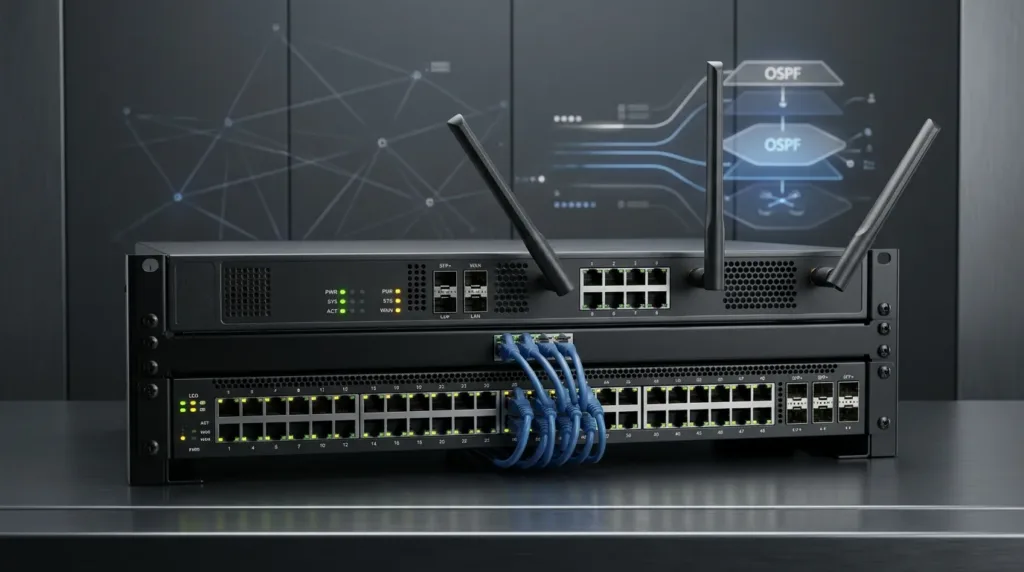
Open Shortest Path First (OSPF) is a link-state routing protocol used to find the best path for data packets within a single routing domain. By utilizing the shortest path first algorithm, OSPF ensures fast convergence, scalability, and efficient network traffic management for complex enterprise IT infrastructures.
Key Highlights
- Dynamic Adaptation: OSPF immediately detects network changes and recalculates routes to ensure uninterrupted data flow.
- High Scalability: Hierarchical design allows network administrators to divide networks into smaller, manageable areas.
- Vendor Interoperability: As an open standard protocol, OSPF works seamlessly across networking equipment from various global technology vendors.
Understanding the OSPF Routing Protocol
Building a resilient network infrastructure requires protocols that can intelligently direct data traffic. The Open Shortest Path First (OSPF) routing protocol operates as an interior gateway protocol (IGP). It is designed specifically to manage routing within a single autonomous system, such as a large corporate network or a university campus.
Network engineers rely on this protocol because it maintains a complete map of the network topology. Instead of simply broadcasting routing tables to neighboring routers, OSPF calculates the most efficient path for data packets using the Dijkstra algorithm. This mathematical approach guarantees that data travels along the fastest, most reliable routes available.
Maintaining network stability is a significant responsibility for any IT department. By deploying OSPF, organizations commit to a networking standard that prioritizes speed and reliability. When a link fails, the protocol immediately updates the network topology and reroutes traffic, ensuring seamless communication and minimizing costly downtime.
Core Types of OSPF Routers
To maintain efficiency in large networks, OSPF divides the infrastructure into specific areas. This division introduces distinct classifications for the routers operating within the system:
- Internal Routers: These devices have all their active interfaces within the same OSPF area. They maintain a topology database specific to their designated area.
- Backbone Routers: Positioned within the backbone area (Area 0), these routers serve as the core transit hub for data moving between different OSPF areas.
- Area Border Routers (ABR): These routers connect one or more peripheral areas to the backbone area, summarizing routing information before passing it along.
- Autonomous System Boundary Routers (ASBR): These routers connect the OSPF network to external networks utilizing different routing protocols, facilitating communication beyond the internal domain.
A Routing Protocol Comparison
When designing a network infrastructure, IT professionals must choose the protocol that best aligns with their operational requirements. Here is how OSPF compares to other standard protocols:
Factor | OSPF (Open Shortest Path First) | RIP (Routing Information Protocol) | EIGRP (Enhanced Interior Gateway Routing Protocol) |
|---|---|---|---|
Algorithm Type | Link-State | Distance-Vector | Advanced Distance-Vector |
Scalability | High (Hierarchical design) | Low (Max 15 hops) | High |
Convergence Speed | Very Fast | Slow | Extremely Fast |
Vendor Support | Open Standard (All Vendors) | Open Standard (All Vendors) | Primarily Cisco (Now open standard, but limited adoption) |
How the OSPF Routing Protocol Works
Implementing OSPF involves a structured, logical sequence of operations. This protocol ensures reliable data delivery through the following steps:
Step 1: Establishing Neighbor Adjacencies
Routers send out “Hello” packets to discover other OSPF-enabled routers on the same local network. Once a neighboring router is identified, they establish an adjacency, forming a trusted connection to share network data.
Step 2: Exchanging Link-State Advertisements
After forming adjacencies, routers share Link-State Advertisements (LSAs). These packets contain detailed information about the router’s interfaces, connected links, and the current state of those links.
Step 3: Building the Topology Database
Every router collects the LSAs and stores them in a Link-State Database (LSDB). This database provides the router with a complete, precise map of the entire network topology within its designated area.
Step 4: Executing the Shortest Path First Algorithm
Using the information stored in the LSDB, each router independently runs the Dijkstra algorithm. This calculation determines the shortest, most efficient path to every possible destination, which is then added to the router’s active routing table.
Primary Use Cases and Applications
The robust architecture of OSPF makes it an essential component for various enterprise networking scenarios:
- Enterprise Local Area Networks (LANs): Large corporations utilize OSPF to route traffic efficiently across multiple floors, departments, and campus buildings, ensuring high availability for critical business applications.
- Wide Area Network (WAN) Integrations: Organizations with multiple branch offices rely on OSPF to manage complex topologies and optimize data transfer over secure, long-distance network links.
Key Benefits of OSPF Implementation
Committing to an OSPF architecture provides organizations with substantial operational advantages:
- Loop-Free Routing: By maintaining a comprehensive view of the network topology, the protocol inherently prevents routing loops that can cripple network performance.
- Efficient Bandwidth Utilization: Unlike older protocols that broadcast entire routing tables periodically, OSPF only sends updates when a topology change occurs.
- Enhanced Security: The protocol supports robust authentication mechanisms, guaranteeing that routing updates are only accepted from trusted, authorized devices.
Potential Challenges and Limitations
While highly reliable, organizations must be aware of the operational requirements associated with this protocol:
- Resource Intensive: Maintaining a detailed topology database and executing complex algorithms requires routers with significant processing power and memory capacity.
- Configuration Complexity: Designing a hierarchical, multi-area OSPF network demands a high level of technical expertise and careful planning by seasoned network administrators.
Future Trends in Network Routing
The networking landscape is continually evolving to meet the demands of modern business operations:
- Integration with Software-Defined Networking (SDN): Modern architectures are combining traditional protocols with centralized SDN controllers to achieve dynamic, programmable traffic engineering.
- Automation and Intent-Based Networking: Network administrators are increasingly using automated tools to deploy and manage OSPF configurations, reducing human error and accelerating network provisioning.
Visual Representation of an OSPF Network
A properly structured OSPF network relies on a hierarchical design centered around a backbone.
Diagram Concept: The Core Network Hierarchy
- Area 0 (Backbone): The central hub connecting all other areas. Contains Backbone Routers.
- Area 1 (Sales Department): Connects to Area 0 via an Area Border Router (ABR).
- Area 2 (Engineering Campus): Connects to Area 0 via a separate ABR.
- External Internet: Connects to Area 0 via an Autonomous System Boundary Router (ASBR).
This structured approach ensures that routing updates in Area 1 do not unnecessarily consume bandwidth in Area 2, highlighting the protocol’s efficient scalability.
Partner with Magnus Infotech for Your IT Distribution Needs
Building a reliable, high-performance IT infrastructure requires access to world-class technology and a partner you can trust. Magnus is an authorized distributor of the world’s leading technology products, headquartered in the Al Tawhidi Building on Al Mankhool Street in Dubai, UAE. We operate as the definitive bridge between global tech vendors and regional resellers or system integrators across the Middle East.
Our unwavering commitment is to provide you with an exceptional experience. We specialize in delivering cutting-edge solutions in Networking & Wireless, Security Surveillance, Unified Communication, and Server & Storage. Our partners are at the center of everything we do, and this deeply ingrained policy has strengthened our market position as a premier Value Added Distributor.
Contact Magnus Gulf today to discover how our dedicated partnership can secure the cutting-edge networking solutions your enterprise deserves.
Frequently Asked Questions
What does OSPF stand for?
OSPF stands for Open Shortest Path First. It is an open standard routing protocol designed to find the most efficient path for data packets within a single routing domain.
Is OSPF a distance-vector or link-state protocol?
It is a link-state routing protocol. Instead of relying solely on hop counts, it builds a complete map of the network topology to calculate the best route based on link cost and bandwidth.
What is the default administrative distance of OSPF?
In standard Cisco networking environments, the default administrative distance for OSPF is 110. This metric helps routers determine the reliability of the routing information compared to other protocols.
How does OSPF prevent routing loops?
Because every router in an OSPF area maintains a complete and synchronized Link-State Database (LSDB), it has a full, accurate map of the network. The Dijkstra algorithm uses this map to calculate precise, loop-free paths.
Can OSPF support IPv6?
Yes, OSPF version 3 (OSPFv3) was specifically designed to support IPv6 networks, providing the same high-performance routing capabilities for modern, expanded IP addressing schemes.