

Security & Surveillance · UAE Compliance
SIRA CCTV Requirements in Dubai: 2027 Compliance Guide
SIRA requires CCTV systems in Dubai to use cameras of at least 1080p Full HD, retain recordings for a minimum of 31 days, run on a dedicated network separate from business IT, and meet a defined field-of-view class for every monitored area. These rules come from Administrative Resolution No. (13) of 2025, which approved the current Preventive Systems Manual.
Much of what circulates online about SIRA is inaccurate. Guides claiming mandatory 4K, or a fixed 4MP-and-8MP rule, do not reflect the published Manual. This guide works from the regulation itself.
Key takeaways
- Minimum camera resolution is 1080p Full HD, not 4K. The Manual sets this as a floor, and SIRA states these are minimum specifications throughout.
- Field of view, not megapixels, is the real design constraint. Each area of a building is assigned a class — Identification, Recognition, Observation, Detection or Monitoring — with a measurable target-size requirement.
- General retention is at least 31 days. ATM cameras at financial institutions require at least 75 days.
- Surveillance must run on its own dedicated network, separate from other business networks, with backbone redundancy.
- Copper-clad aluminium cable is explicitly prohibited. Twisted pair must be genuine copper, CAT 6 minimum.
- Compliance obligations extend to UPS runtime, storage headroom, monitor specifications and an annual maintenance contract.
What law governs CCTV in Dubai?
Surveillance in Dubai is regulated by the Security Industry Regulatory Agency under Law No. (12) of 2016 Regulating the Security Industry in the Emirate of Dubai and its amendments, together with Board of Directors Resolution No. (1) of 2018, which issued the Implementing Bylaw.
The technical detail sits in the Preventive Systems Manual, approved by Administrative Resolution No. (13) of 2025, issued by SIRA’s Chief Executive Officer on 14 April 2025. Article 3 of that Resolution repeals any provision in any other administrative resolution or manual that contradicts it, which is why older specification documents should not be used as a reference.
The Manual applies to establishments specified in Board Resolution No. (1) of 2018. It is published in both Arabic and English, and SIRA notes that the Arabic text prevails in the event of conflict.
One line in the Manual governs how every other requirement should be read: everything specified is a minimum, and equipment or installation below those minimums is not permitted under any circumstances without official SIRA approval.
What camera specifications does SIRA require?
The Manual’s digital (IP) camera requirements are specific and testable.
| Requirement | SIRA minimum |
|---|---|
| Resolution | 1080p Full HD |
| Colour | Colour cameras required |
| Signal-to-noise ratio | At least 48 dB |
| Outdoor rating | IP66 minimum, camera or enclosure |
| Wide Dynamic Range | At least 110 dB where facing a light source |
| Bit rate | Variable bit rate only; fixed bit rate not accepted |
| Infrared | Required, with automatic switch to monochrome |
| Auto iris | Required where lighting varies by time of day |
| Cameras above 4 m | Remote zoom and focus required |
| Visibility | Cameras must be clearly visible, not concealed |
Two of these deserve attention because they are commonly missed at specification stage.
Fixed bit rate is not accepted. Variable bit rate must be enabled with no maximum transfer speed set. Systems configured with CBR to make storage planning simpler will fail on this point.
Wide Dynamic Range is not optional at entrances. Any camera facing a natural or artificial light source — including light reflected off polished surfaces — requires WDR of at least 110 dB. In a Dubai retail or hotel entrance with glass frontage and strong daylight, this applies to almost every entrance camera. The Manual separately requires WDR on all cameras used for identification, regardless of where they are installed.
Field of view: the requirement most specifications miss
This is where SIRA compliance is genuinely decided, and where most published guidance is silent.
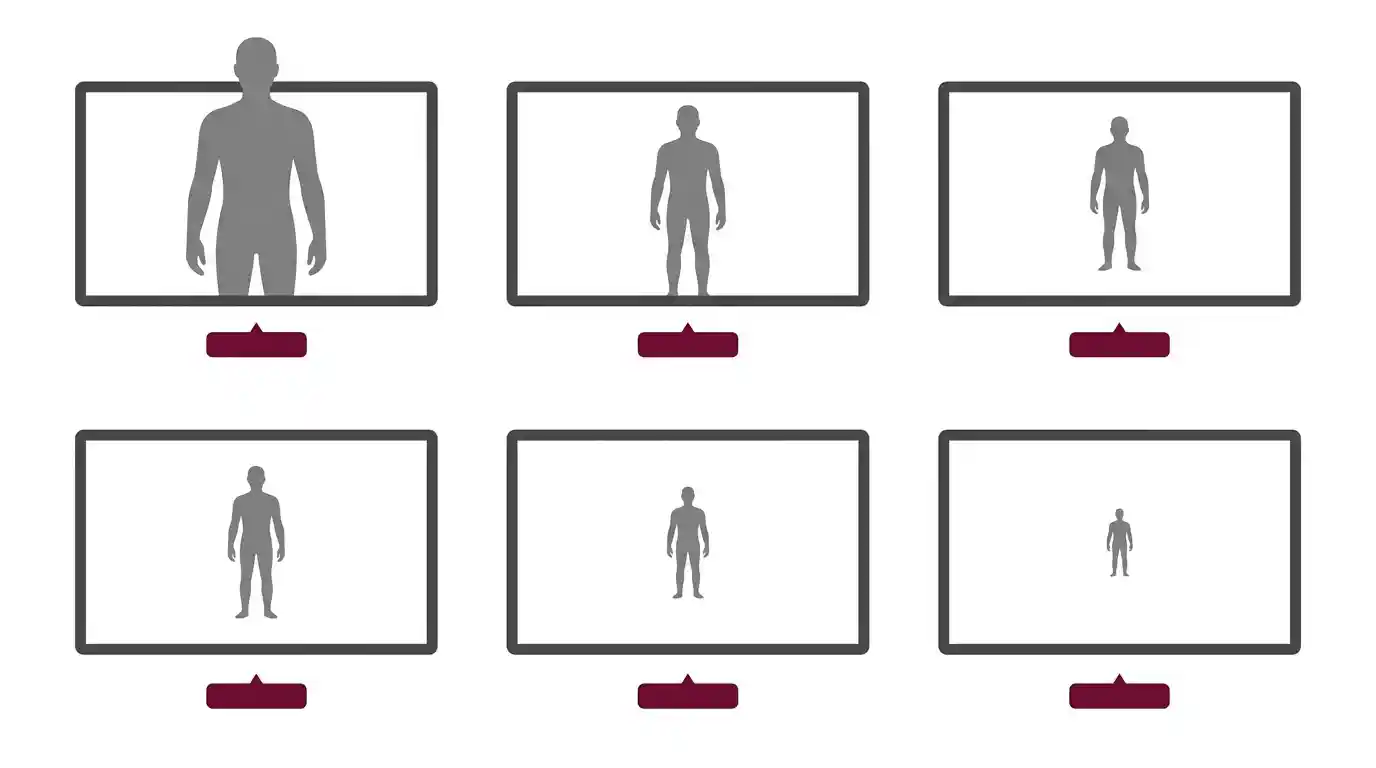
The Manual defines six viewing classes based on how large a “standard target” — a person 1.6 metres tall — appears on the display. Each monitored area in a building is assigned a class. Meeting the class is what determines whether a camera is adequate, far more than its megapixel count.
| View class | Target size | Relative | Pixel density | Purpose |
|---|---|---|---|---|
| Inspection | ≥ 400% | ≥ 1000 px/m | Analysing facial expressions | |
| Identification | ≥ 120% | ≥ 300 px/m | Identifying unknown people | |
| Recognition | ≥ 50% | ≥ 125 px/m | Recognising known individuals | |
| Observation | ≥ 25% | ≥ 62.5 px/m | Crowd control and direction | |
| Detection | ≥ 10% | ≥ 30 px/m | Movement, direction, appearance | |
| Monitoring | ≥ 5% | ≥ 12.5 px/m | Presence detection, early warning |
Vehicle plate recognition has its own class: the plate characters must occupy at least 20% of the display, or 400 pixels per metre in exceptional cases, with the camera mounted no more than 30 degrees above the horizon and no more than 30 degrees horizontally.
Mounting angles are constrained per class. Identification cameras allow no more than 45 degrees horizontally and 20 degrees vertically from the subject. Inspection is tighter still at 10 degrees in both planes.
The pixel-density figures are described in the Manual as applying in exceptional cases with prior SIRA approval — they are not a default alternative to the target-size rule.
Where each class applies
The Manual assigns view classes area by area, for each establishment type. The pattern is consistent across building types:
| Area | Typical required class |
|---|---|
| Establishment entrances | Identification |
| Cashier and reception desks | Recognition |
| Vehicle entrances and exits | Recognition |
| Electrical and water tank room entrances | Recognition |
| Lift lobbies, stairs, inside lifts | Observation |
| Emergency exit doors between floors | Observation |
| Corridors and parking pathways | Detection |
| Main lobby areas | Detection |
| Passenger drop-off and pick-up | Monitoring |
| Building perimeter | Monitoring |
Cameras inside lifts carry an additional condition: the angle must show the floor number, and several establishment types require a wide-angle lens covering all parts of the lift car.
Plate recognition deserves separate planning. Many establishment types require an ANPR system approved by SIRA at vehicle entrances and exits, and our guide to ANPR and LPR camera systems covers how these differ from standard cameras.
Requirements differ by establishment. The Manual runs to more than forty chapters covering hotels, malls, residential and commercial complexes, warehouses, schools, healthcare facilities, gold and jewellery retail, financial institutions, data centres and others. Anyone specifying a system should work from the chapter matching the licensed activity, not from a generic checklist.
How long must footage be retained?
The Manual sets a general retention floor: recordings must be kept for at least 31 days, at high quality, at a frame rate of at least 10 frames per second.
For motion-activated recording, the minimum configuration is at least 70% of the day per camera, at least 10 frames per second per camera, and not less than 31 days.
Sector rules go further in specific cases. Financial and monetary institutions must retain at least 31 days for on-site cameras and at least 75 days for ATM cameras. Jewellery and precious goods exhibitions must retain recordings for one month after the exhibition closes.
The widely repeated claim that banks and high-security sites require 90 days does not match the published Manual. Where a sector has an extended requirement, it is stated in that sector’s chapter.
Recording devices must also be sized with 20% extra capacity beyond the calculated requirement, and must accept external storage expansion.
Storage sizing on a compliant project is therefore driven by four variables at once: camera count, the resolution needed to satisfy each area’s view class, the 31-day floor, and the 20% headroom rule. Our server and storage solutions team can work through the calculation on a specific camera schedule.
Recording device and VMS requirements
The Manual specifies recorder behaviour in unusual detail. Selected requirements:
- Recording resolution at least 1080p Full HD
- Live view at least 1080p on single-camera display; at least 2CIF per camera in multi-screen mode
- At least 25 frames per second live view per camera
- Simultaneous live view, recording and playback with no degradation
- At least 10 seconds of pre- and post-event footage on motion-triggered recording
- ONVIF 2.0 compatibility
- RTSP support for live streaming
- NTP support, with system time synchronised to SIRA’s systems
- Alarm on storage disk failure, and on disk-full when overwrite is disabled
- Status notifications for recording start/stop, schedule changes, camera malfunction, user login and a running heartbeat signal
- SDK to be made available to SIRA on request
RTSP and ONVIF appear as explicit named requirements, which is worth noting when evaluating recorders — proprietary or partially-implemented stacks can create problems at inspection. Our guide to RTSP and RTSP cameras covers how the protocol works in practice.
Video Management Software is mandatory for any system with 64 or more cameras or 4 or more recording devices.
Network and cabling requirements
This is the section most often overlooked, and the one with the largest procurement consequences.
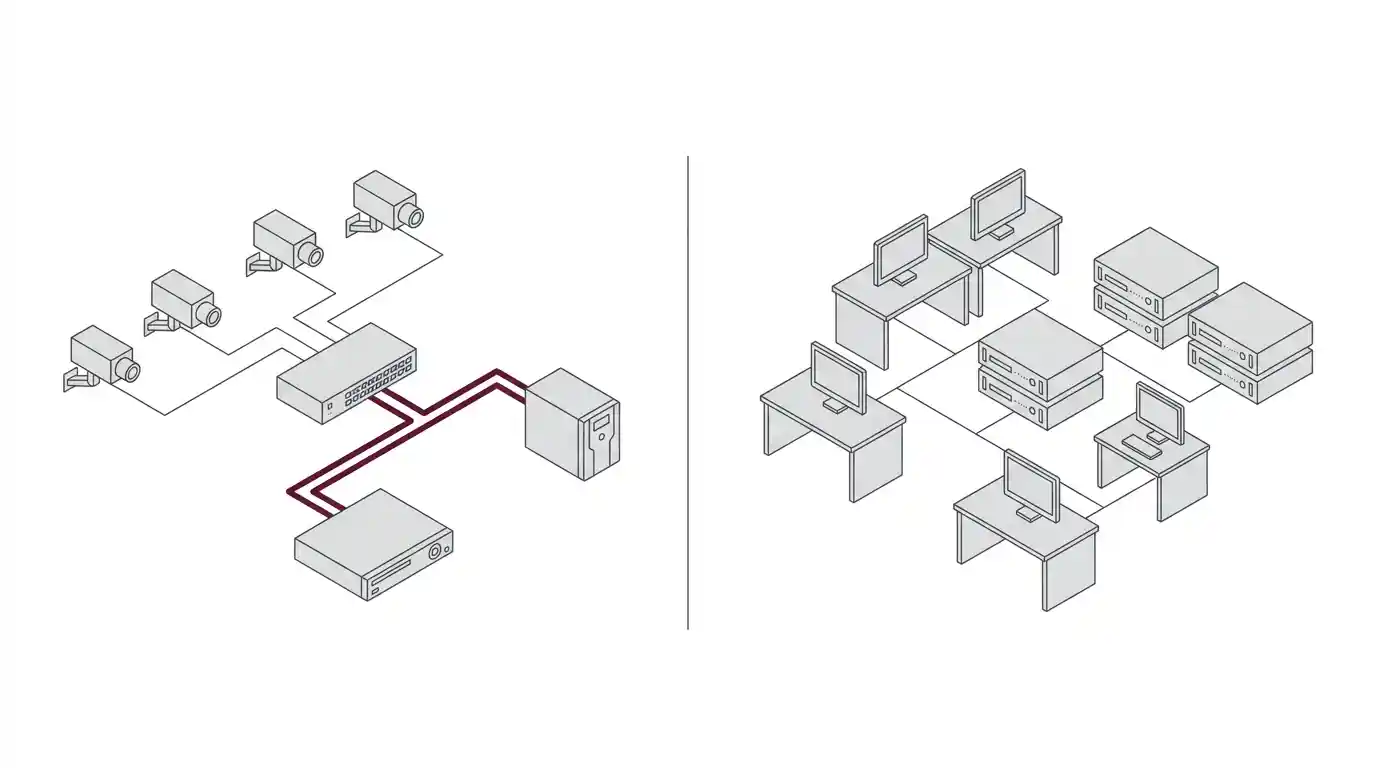
A dedicated private network
Security systems must run on a separate network created solely for them. Connections may not form part of an external network. Where integration is genuinely required, a firewall must be provided and prior written SIRA approval obtained.
Redundancy in the backbone
The network must avoid single irreplaceable points of failure, and the backbone must have a secondary backup line ready to take over on interruption.
Genuine copper, CAT 6 minimum
Twisted pair must be high-quality copper of at least CAT 6. Copper-clad aluminium and copper-clad iron cables are explicitly not allowed.
Segmentation above 200 devices
Networks exceeding 200 connected devices must be divided into segments and clusters to avoid a large flat network, and must be equipped with a network management system.
UPS with 30-minute runtime
Security systems must be powered by UPS capable of running autonomously for at least 30 minutes during an outage. All recording devices must be on UPS.
20% capacity headroom
Both recording devices and network systems must be calculated with an additional 20% of total capacity.
The CAT 6 and copper-clad prohibition matters commercially. Copper-clad aluminium is common in low-cost cable supply and will not pass. Magnus stocks Premium-Line solid copper CAT 6 and CAT 6A structured cabling, and D-Link managed and PoE switching for the dedicated surveillance network described above.
Both network and cabling design should be settled before equipment is ordered — retrofitting a separate network after a shared one has been installed is the expensive way to reach compliance. Our networking and wireless solutions team can review a design at the drawing stage.
Monitors and control rooms
Display requirements are specified rather than left to the integrator:
- Monitor resolution at least Full HD 1080p
- Purpose-built surveillance monitors, not television screens
- Rated for continuous 24/7 operation for at least three years
- At least two monitors per operator, each at least 21 inches
- Wall monitors in control rooms, with each camera image no smaller than 12 × 6.7 cm
- Wall monitor bezels no thicker than 4 mm
- Critical cameras — entrances, reception, drop-off areas, lift lobbies, main stairwells, main lobby — displayed continuously in the centre of the wall display
- Standard cameras cycled in sets, with total cycle time not exceeding 60 seconds and no more than six sets
There is a practical exemption: establishments whose activity does not require an operations room, and which have fewer than 64 cameras or fewer than 4 recording devices, may use a single screen with a KVM device.
Beyond the hardware
Several obligations sit outside equipment selection but determine whether a system stays compliant.
Remote connection to SIRA monitoring
The VSS system must be connected to the system integrity monitoring service approved by SIRA. Alarm and intruder detection systems, and vehicle plate registration systems, have equivalent connection requirements to their respective SIRA-approved monitoring systems.
Annual maintenance contract
Establishments must hold an annual maintenance contract with a company registered with SIRA, including a preventive maintenance programme of no fewer than four visits per year. Technical crews must be licensed by SIRA.
Notification of changes
Any change affecting the system must be recorded and notified to SIRA. The Manual lists eleven categories, including changes to system design, device programming, lighting levels, building layout, entrances and exits, business activity, and adjacent projects that affect the system.
Image acceptance
Images must be stable and free of distortion. An image is unacceptable if obstruction exceeds 5% of the total image area, and the centre of the image must be unobstructed.
Physical protection
Equipment installed below 2.5 metres and within reach must have anti-tamper and vandal-resistant features rated at least IK10.
Signage and lighting
SIRA-approved warning signs must be placed at all main entrances and inside lifts. Scenes within camera range must be fully lit with no dark areas; infrared may be used in secondary perimeter areas.
Common compliance mistakes
- Specifying by megapixel alone. A high-resolution camera at the wrong angle or distance still fails the required view class. Design to the class first.
- Using copper-clad aluminium cable. Explicitly prohibited, and difficult to remediate once installed.
- Sharing the corporate network. The Manual requires a dedicated network. This is an architecture decision, not a configuration one.
- Configuring fixed bit rate. Not accepted.
- Sizing storage to exactly 31 days. The 20% headroom requirement is separate and additional.
- Omitting WDR at entrances. Required wherever a camera faces a light source, and on all identification cameras.
- Treating the Manual as generic. Requirements differ substantially by establishment type across more than forty chapters.
Planning a compliant system
Working in this order avoids most rework:
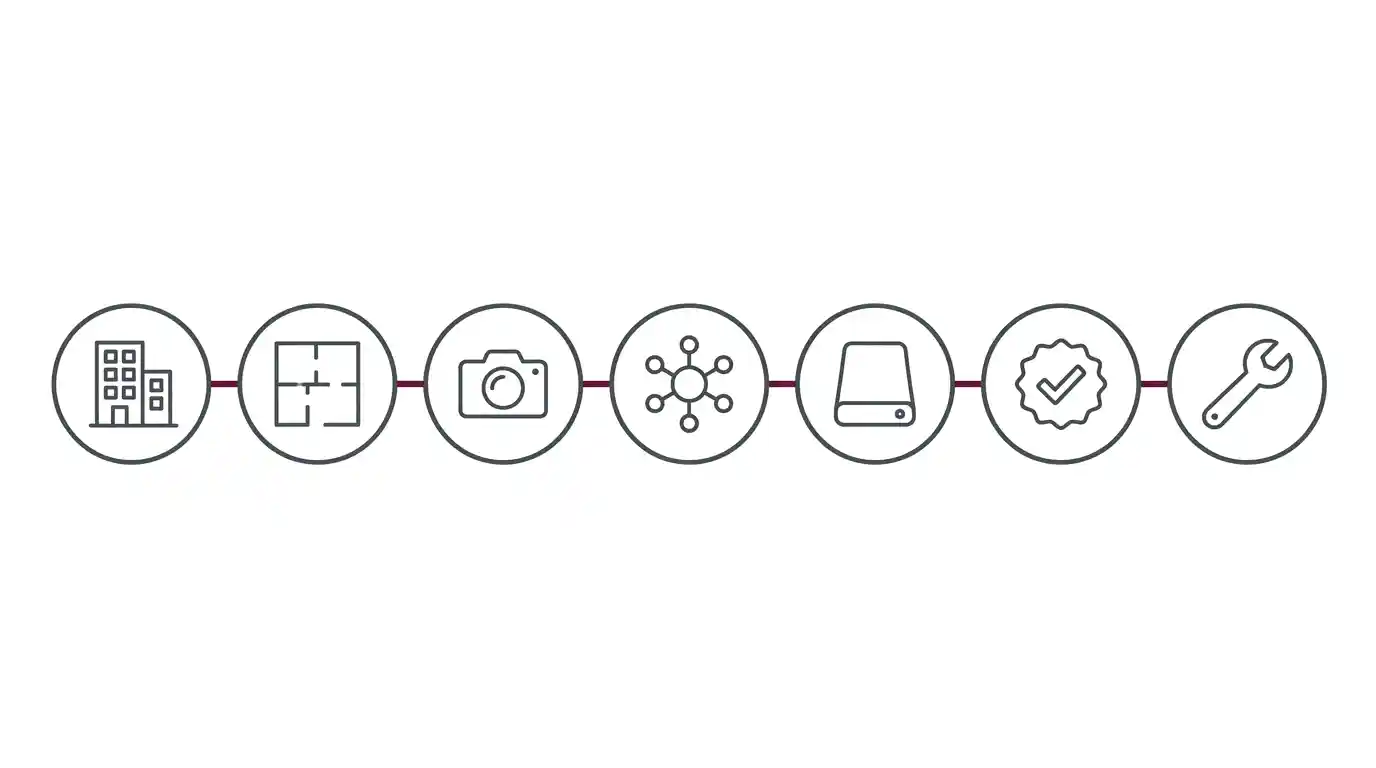
Identify your establishment type
Find the chapter in the Manual matching your licensed activity. Multi-activity premises apply the maximum requirements to shared areas.
Map areas to view classes
Produce a camera schedule listing every area and its required class before selecting any hardware.
Select cameras against the class
Work from mounting position, distance and angle to determine the resolution and lens needed to satisfy the class — not the other way round.
Design the dedicated network
Separate network, redundant backbone, CAT 6 copper minimum, segmentation and NMS if above 200 devices, 20% headroom.
Size storage and power
31 days minimum plus 20% headroom; UPS with 30-minute runtime covering all recording devices.
Confirm equipment approval status
Where the Manual requires SIRA-approved components, confirm approval at model level before ordering.
Engage a SIRA-registered installer
Installation and certification must be handled by a registered company, with an annual contract covering at least four preventive visits.
Frequently asked questions
Does SIRA require 4K cameras in Dubai?
No. The Preventive Systems Manual approved by Administrative Resolution No. (13) of 2025 sets a minimum camera resolution of 1080p Full HD. Claims that 4K is mandatory do not reflect the published Manual. Higher resolution is often needed in practice, but that is driven by the field-of-view class required for each area, not by a blanket resolution rule.
How long must CCTV footage be kept in Dubai?
At least 31 days, at high quality and at a minimum of 10 frames per second. Financial and monetary institutions must retain at least 31 days for on-site cameras and at least 75 days for ATM cameras. Some sectors carry their own extended requirements, so check the chapter matching your establishment type.
Can CCTV share the existing office network?
No. The Manual requires a separate, dedicated private network created and installed solely for security systems, and states these connections may not form part of an external network. Where integration with other systems is genuinely required, a firewall must be provided and prior written SIRA approval obtained.
What cable is required for SIRA-compliant CCTV?
Twisted pair must be high-quality copper of at least CAT 6. Copper-clad aluminium and copper-clad iron cables are explicitly not permitted. Cables must be numbered and labelled at both ends, and routed in plastic conduit indoors or purpose-made metal conduit outdoors.
What is a field-of-view class?
It is how SIRA defines the level of visual detail required in a given area, measured by how large a 1.6-metre standard target appears on the display. The classes run from Monitoring at 5% of display size up to Inspection at 400%. Each area of a building is assigned a class, and the camera must be selected and positioned to satisfy it.
Is Video Management Software mandatory?
It becomes mandatory for any system connected to 64 or more cameras or 4 or more recording devices. Below that threshold, establishments whose activity does not require an operations room may use a single monitor with a KVM device instead of a full control room setup.
Do the requirements differ by business type?
Substantially. The Manual contains more than forty sector chapters covering hotels, malls, residential and commercial complexes, warehouses, schools, healthcare, gold and jewellery retail, financial institutions, data centres and others. Where premises host more than one activity, the maximum requirements apply to shared areas.
Are the specifications minimums or targets?
Minimums. The Manual states that everything it specifies is the minimum that must be adhered to, that equipment and installation may not fall below it under any circumstances without official SIRA approval, and that SIRA may impose additional requirements based on the security situation.
Getting the specification right
SIRA compliance is decided before installation begins. The requirements that cause the most rework — the dedicated network, CAT 6 copper minimum, storage headroom, UPS runtime and the field-of-view class for each area — are all procurement decisions made at design stage. Cameras alone do not determine whether a system passes.
Magnus distributes IP surveillance from VIVOTEK and HOLOWITS, structured cabling from Premium-Line, and networking and storage infrastructure across our IP surveillance solutions range. Send us your camera schedule and area list, and our pre-sales team can specify the infrastructure alongside it.
Get a quoteSource
All specifications in this article are taken from Administrative Resolution No. (13) of 2025 Approving the Preventive Systems Manual, Security Industry Regulatory Agency, Government of Dubai, issued 14 April 2025. SIRA publishes amendments on its website; verify against the current Manual before finalising any specification. Where the English translation conflicts with the Arabic text, the Arabic prevails.
This guide is provided for general information and is not legal advice.