


Networking & Wireless · Structured Cabling
Cable Shielding Types Explained: Essential 2027 Guide
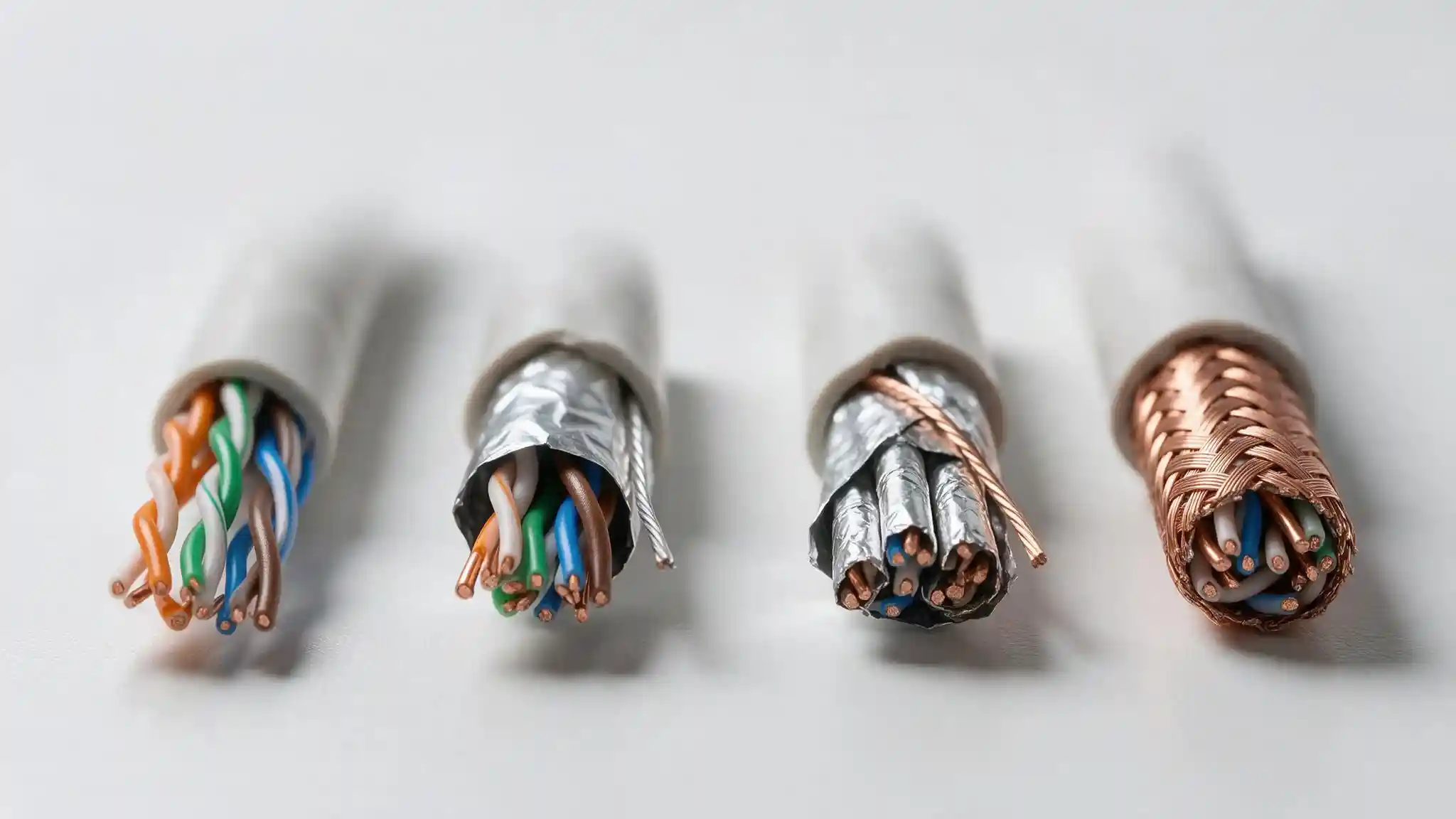
Cable shielding types are defined by ISO/IEC 11801 using a two-part code — overall shield before the slash, per-pair shield after it. U/UTP has none, F/UTP has an overall foil, U/FTP has foil on each pair, and S/FTP has both a braid and per-pair foil. The everyday labels “STP” and “FTP” are not precise enough to order from, which is where most specification errors begin.
Key takeaways
- The slash carries the meaning.
S/FTPandSF/UTPare different cables. Writing “SFTP” without the slash is ambiguous. - “STP” on a purchase order is not a specification. It is applied loosely to at least three different constructions, so what arrives depends on the supplier’s stock.
- An ungrounded shield is worse than no shield. It stops draining interference and starts behaving like an antenna.
- Foil gives full coverage; braid gives mechanical strength. S/FTP combines both, which is why it sits at the top of the range.
- Cat7 and Cat8 have no unshielded version. Shielding is built into what those categories are.
- Shielded is not automatically better. In a quiet office, well-installed U/UTP outperforms badly grounded S/FTP.
The naming system that defines cable shielding types
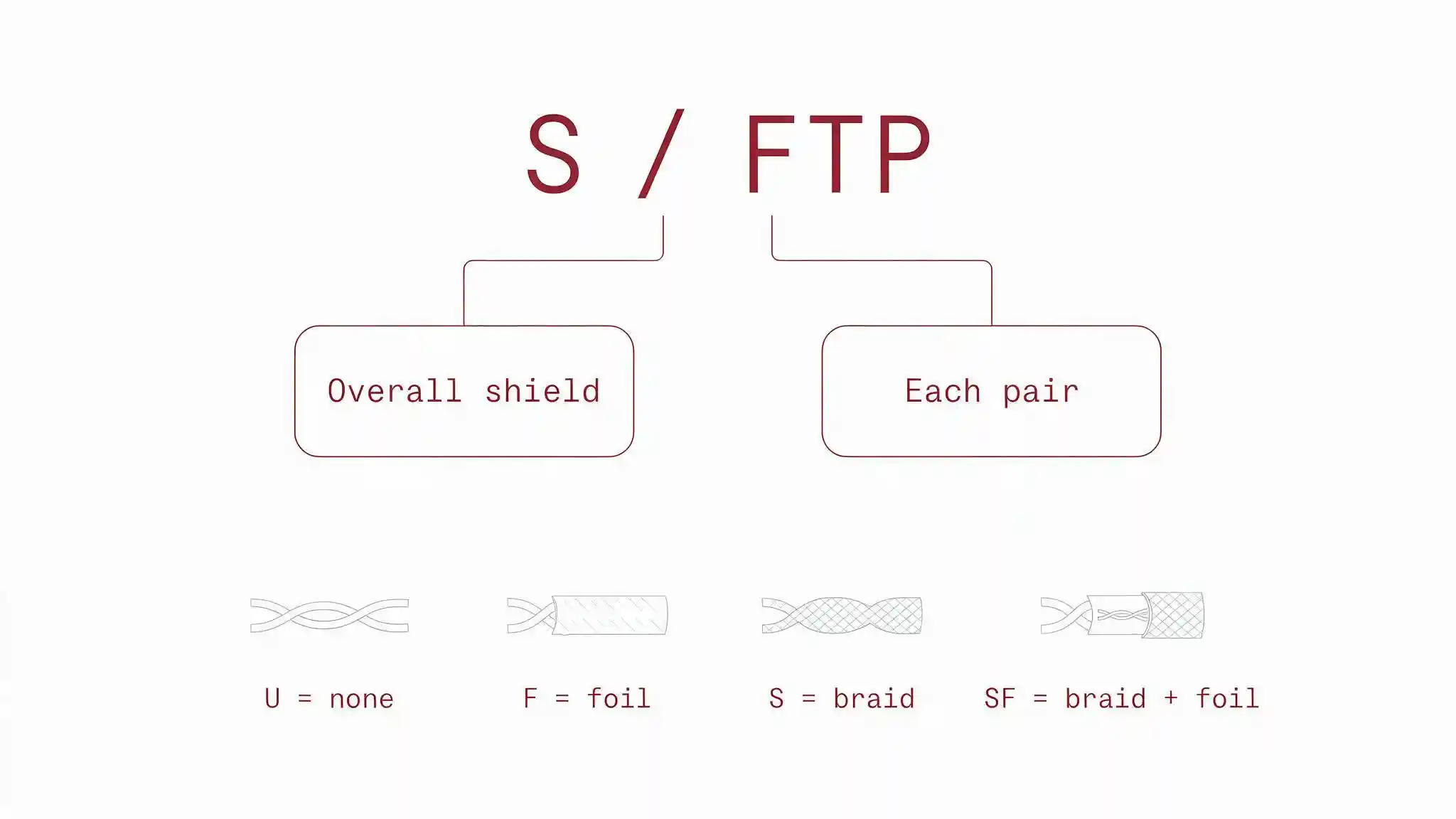
ISO/IEC 11801 Annex E sets out a two-part code. Everything before the slash describes the shield wrapping all four pairs together. Everything after describes what each individual pair has.
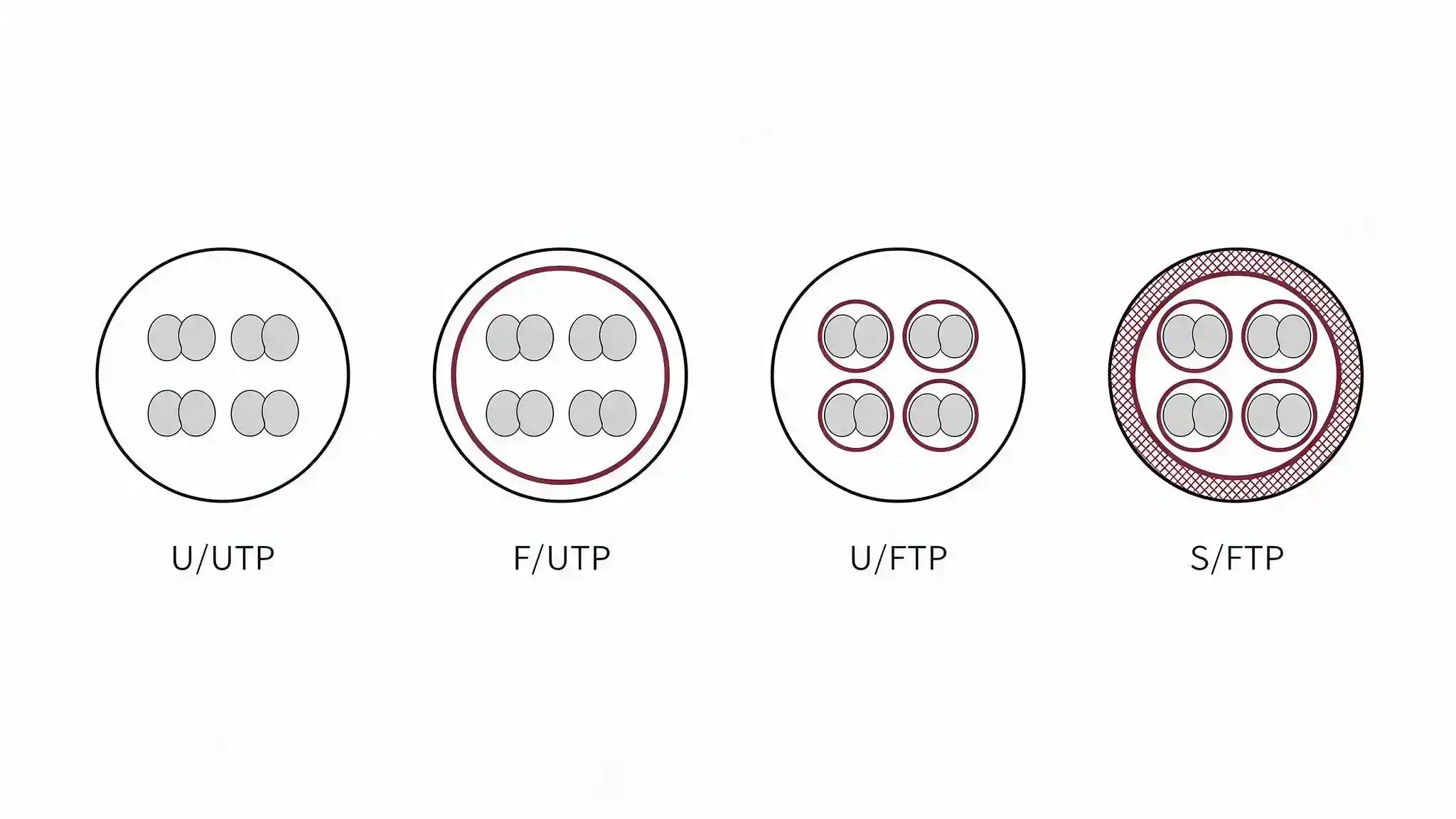
Read that way, every designation becomes unambiguous. F/UTP is an overall foil around unshielded pairs. U/FTP is no overall shield, with foil around each pair. S/FTP is a braided screen over the whole bundle plus foil on every pair.
The slash is doing real work. S/FTP and SF/UTP are genuinely different products — different cost, different termination practice, different problems solved. Written as “SFTP” with the slash dropped, the distinction disappears entirely.
The constructions compared
Four cable shielding types cover the overwhelming majority of what is actually sold and installed.
| Designation | Overall shield | Per-pair shield | Trade name | Typical use |
|---|---|---|---|---|
U/UTP | None | None | UTP | Offices, standard commercial installations |
F/UTP | Foil | None | FTP | Most “shielded Cat6A” on the market |
U/FTP | None | Foil | Often called STP | Alien crosstalk control in dense bundles |
S/FTP | Braid | Foil | Often called STP | Industrial, high-EMI, Cat7 class |
SF/UTP | Braid + foil | None | Often called STP | Heavy external interference, no pair-level need |
Notice the fourth column. Three genuinely different constructions all get called “STP” in everyday use, which is the root of the problem covered in the next section.
Why “STP” is a procurement risk
This is the part that matters commercially, and it is the reason this article exists rather than a simple shielded-versus-unshielded comparison.
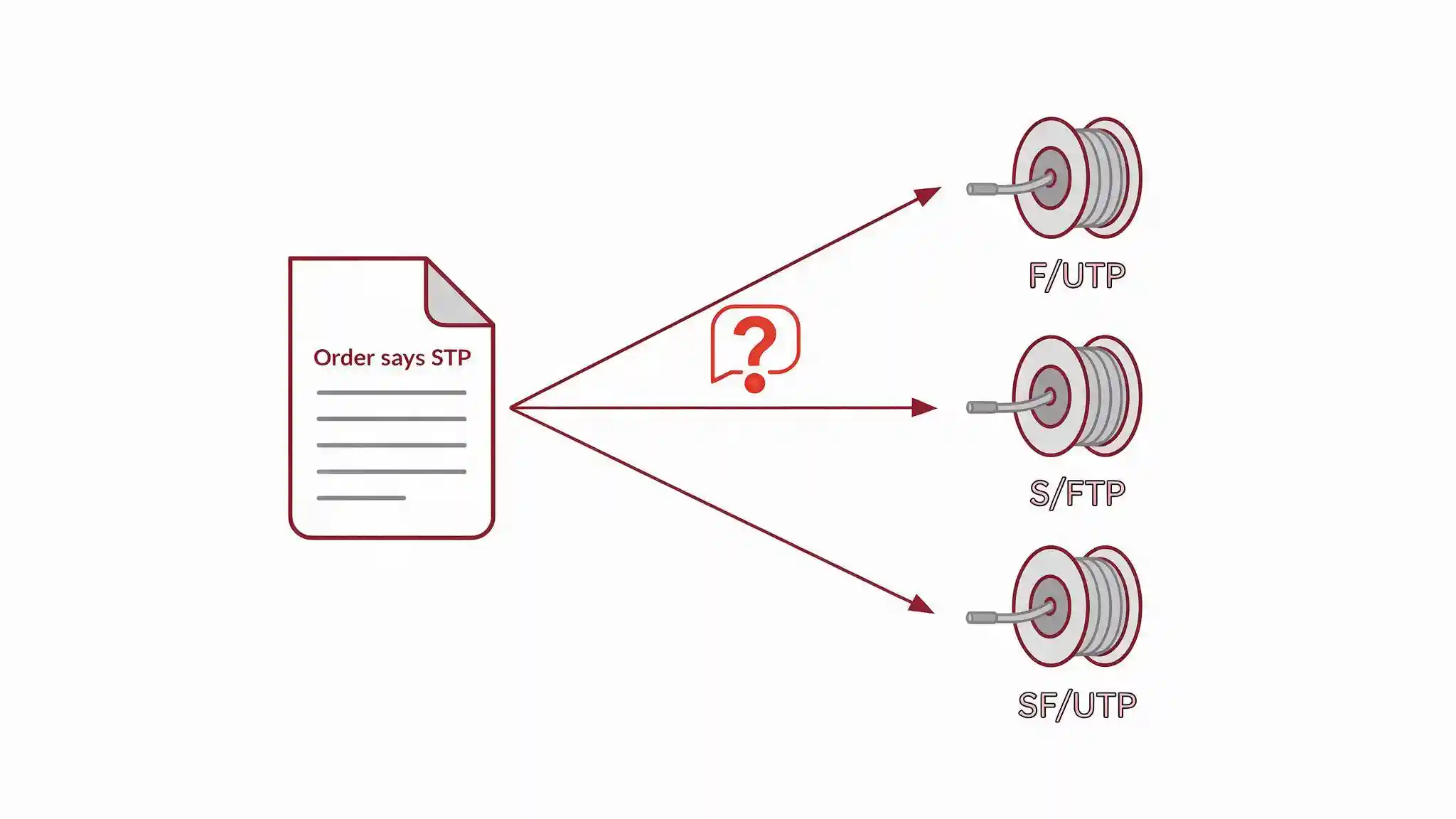
In strict ISO/IEC 11801 terms, STP would mean a braided screen around each individual pair with no overall shield — a construction almost nobody manufactures or installs. In practice, “STP” gets used as a catch-all for any cable with metal in it.
So when a specification, a bill of quantities or a purchase order says “STP Cat6A,” the supplier has to guess. Depending on what is in stock, you may receive F/UTP, U/FTP, S/FTP or SF/UTP. These differ in price, diameter, bend radius, termination hardware and grounding requirement. A project priced against one and delivered another is a genuine commercial problem, not a pedantic one.
The fix costs nothing: write the full ISO/IEC designation on every specification and order. “S/FTP Cat6A LSZH” leaves no room for interpretation. “Shielded Cat6A” leaves plenty.
Grounding: the requirement that decides everything
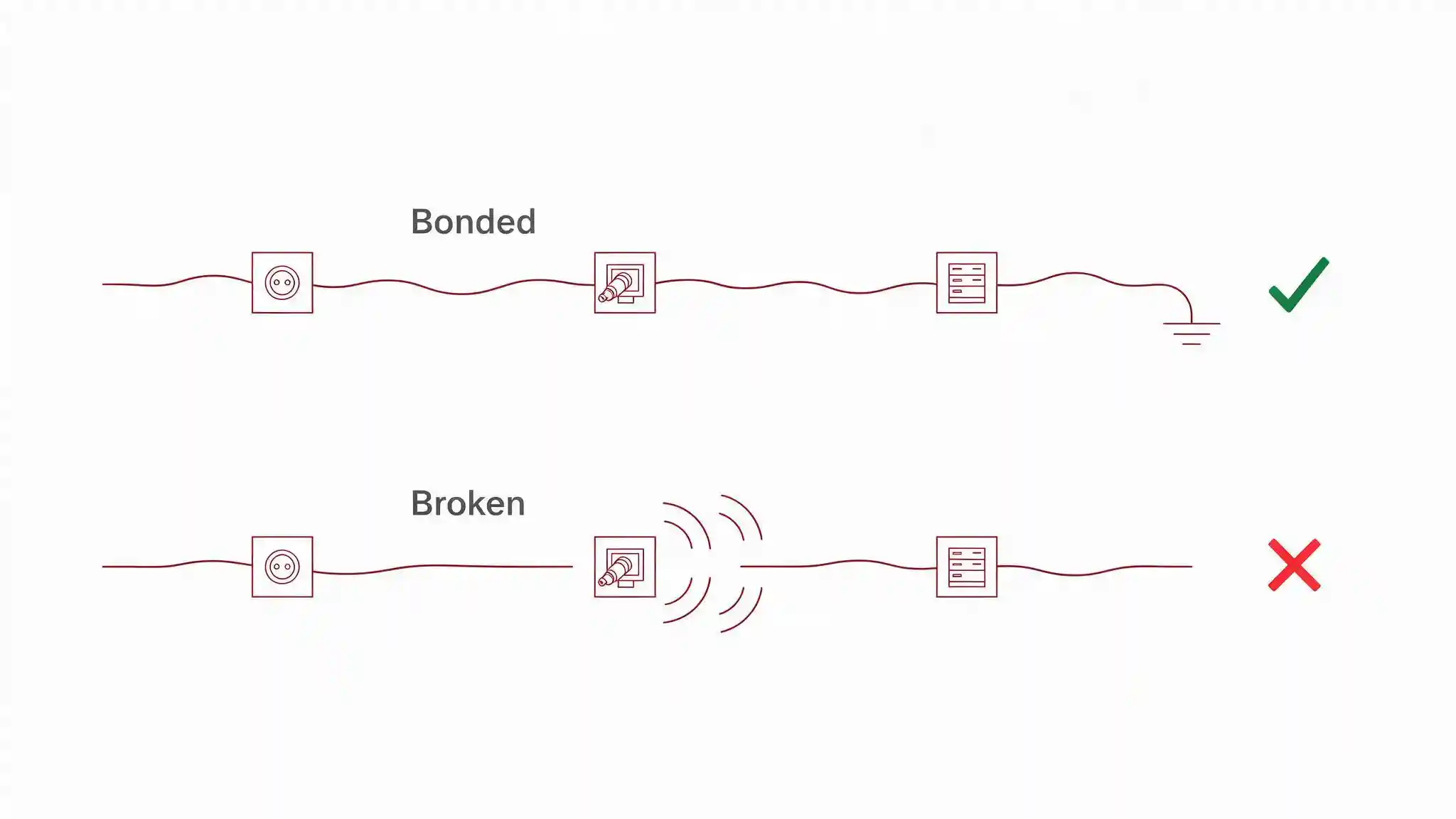
Shielding only works if the shield has somewhere to send the interference it collects. That means a continuous, bonded path to ground.
The shield must stay electrically continuous through every component in the channel — the cable, the jack, the patch panel, the patch cord — and be bonded to the telecommunications grounding busbar in line with ANSI/TIA-607. Break that path anywhere and the shield stops draining and starts collecting.
Continuous bonding
Shielded cable requires shielded jacks, shielded patch panels and shielded patch cords. Mixing a shielded cable with unshielded hardware breaks the path.
The antenna effect
An ungrounded shield picks up interference and has nowhere to discharge it. It couples that noise into the pairs it was meant to protect.
Worse than nothing
A badly bonded shielded installation typically performs below a well-installed unshielded one. The shielding budget is wasted and the performance is worse.
This is why specifying shielded cable is a system decision rather than a cable decision. If the project cannot commit to shielded connectivity throughout and proper bonding at the rack, unshielded is the better engineering choice — and the cheaper one.
Foil versus braid
The two shield materials solve different problems, which is why the highest constructions use both.
| Property | Foil (F) | Braid (S) |
|---|---|---|
| Material | Aluminium-polyester laminate | Woven tinned copper |
| Coverage | Effectively complete | Partial — woven, with gaps |
| Strength | Thin, tears easily | Mechanically robust |
| Flexibility | Stiffens the cable | More flexible than foil |
| Best against | Higher-frequency interference | Lower-frequency interference |
| Termination | Needs care — damages easily | More forgiving |
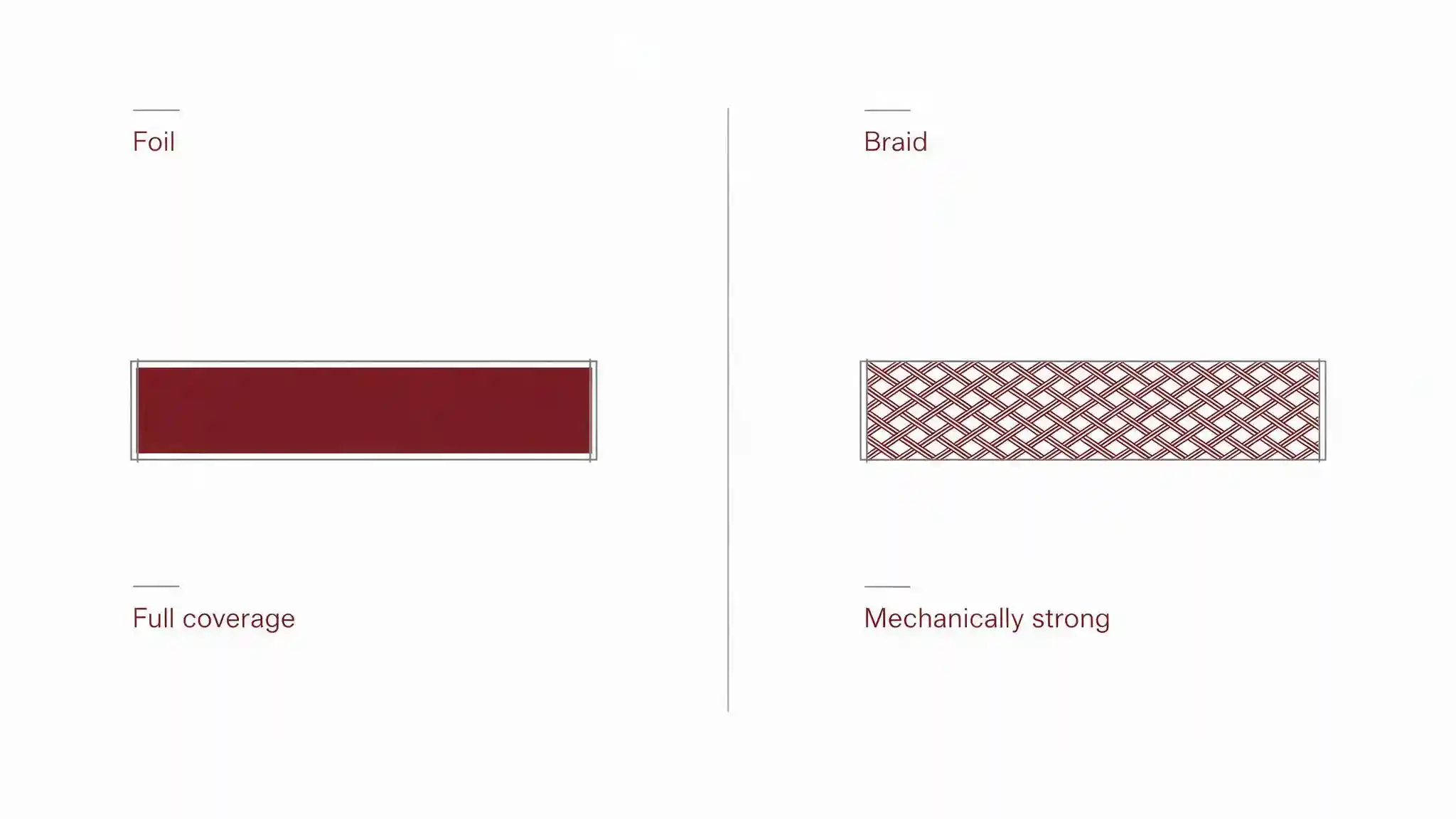
Foil gives complete coverage but is fragile and can be torn during termination without anyone noticing — producing exactly the broken-continuity failure described above. Braid is tougher and more flexible but its weave leaves small gaps. S/FTP uses foil per pair for coverage and an overall braid for robustness, which is why it sits at the top of the range in both performance and price.
What each category requires
Shielding is not always optional. Some categories only exist in shielded form.
| Category | Shielding | Connector |
|---|---|---|
| Cat5e | Usually U/UTP; shielded available | Standard RJ45 |
| Cat6 | U/UTP or F/UTP | Standard RJ45 |
| Cat6A | U/UTP, F/UTP or S/FTP | Standard RJ45 |
| Cat7 | Always shielded — S/FTP or SF/FTP | GG45 or TERA, not standard RJ45 |
| Cat8.1 | U/FTP or F/UTP minimum | Standard RJ45 |
| Cat8.2 | F/FTP or S/FTP minimum | GG45 or TERA |
Two points that catch projects out. Cat7 does not use standard RJ45 connectors for full channel performance — it requires GG45 or TERA, which changes the entire connectivity bill of materials. And Cat8 splits into two classes: Cat8.1 stays RJ45-compatible and works alongside existing Cat6A infrastructure, while Cat8.2 needs the same specialist connectors as Cat7. Our Cat6, Cat7 and Cat8 buying guide covers how those categories compare on speed and distance.
Choosing for a UAE installation
Choosing between cable shielding types is decided by environment, not by category marketing.
Standard offices and commercial fit-outs — U/UTP
Interference levels are low, and well-installed unshielded cable performs to specification. It is cheaper, thinner, easier to route and needs no bonding infrastructure.
Dense bundles and 10 Gigabit runs — F/UTP or U/FTP
Alien crosstalk between tightly packed cables is the limiting factor for 10GBASE-T over Cat6. Per-pair or overall foil addresses it directly.
Industrial, plant rooms and heavy machinery — S/FTP
Motors, VFDs, welding equipment and high-current switchgear generate serious interference. Braid plus per-pair foil is the appropriate response.
Cable routes parallel to power — shielded
Where separation from power cabling cannot be maintained through the whole route, shielding compensates for the proximity.
Outdoor and inter-building runs — consider fibre first
Shielded copper handles some of it, but fibre sidesteps interference and grounding-potential differences between buildings entirely. Our fibre optic solutions cover that path.
Anywhere bonding cannot be guaranteed — U/UTP
If shielded connectivity and a bonded busbar are not in the scope, shielded cable will underperform unshielded. Specify unshielded and install it well.
For a straightforward comparison of the shielded and unshielded options within one category, our guide to Cat6A shielded versus unshielded covers that decision in more depth.
Common specification mistakes
- Writing “STP” on a purchase order. Ambiguous across at least three constructions. Use the ISO designation.
- Dropping the slash. “SFTP” could mean
S/FTPorSF/UTP. They are different cables. - Shielded cable with unshielded jacks. Breaks continuity at the first termination and defeats the entire investment.
- No bonding to the grounding busbar. Turns the shield into an antenna.
- Specifying Cat7 with RJ45. Full Cat7 channel performance requires GG45 or TERA connectors.
- Shielding a quiet office. Spends more, gains nothing, and adds a failure mode that unshielded cable does not have.
- Damaging foil during termination. Easily torn, rarely noticed, and it breaks the continuity the design depends on.
Frequently asked questions
What is the difference between FTP and STP?
In common trade usage, FTP means a cable with an overall foil shield — properly written as F/UTP. STP is used loosely for almost any shielded cable and can refer to at least three different constructions. Under ISO/IEC 11801 the precise designations are U/UTP, F/UTP, U/FTP, S/FTP and SF/UTP, and those are what should appear on a specification.
Is S/FTP the same as SF/UTP?
No. S/FTP has a braided screen around all four pairs plus foil around each individual pair. SF/UTP has braid over foil around the bundle, with no per-pair shielding. They cost different amounts and address different interference problems, which is why the slash in the designation matters.
Does shielded cable need to be grounded?
Yes, and this is not optional. The shield must remain electrically continuous through the cable, jacks, patch panel and patch cords, and be bonded to the telecommunications grounding busbar per ANSI/TIA-607. An ungrounded shield collects interference without draining it and can perform worse than no shielding at all.
Is shielded cable always better than unshielded?
No. In a standard office with low interference, well-installed U/UTP performs to specification at lower cost and with easier installation. Shielded cable only outperforms unshielded when the environment genuinely needs it and the bonding is done correctly throughout the channel.
Can I use standard RJ45 connectors with Cat7?
Not for full Cat7 channel performance. Cat7 under ISO/IEC 11801 requires GG45 or TERA connectors. Shielded RJ45 will physically connect but does not deliver certified Cat7 performance, which is one reason Cat6A is often the more practical specification for standard horizontal cabling.
What does the U in U/UTP mean?
Unshielded. The first U indicates no overall shield around the four pairs, and UTP after the slash indicates the pairs themselves are unshielded. U/UTP is the standard unshielded cable used in most commercial installations.
Does shielding help with alien crosstalk?
Yes, and this is one of its most useful applications. Alien crosstalk is interference between separate cables bundled together, and it is the main constraint on running 10GBASE-T over Cat6. Foil shielding, whether overall or per-pair, reduces it directly.
Which shielding type should I specify by default?
For standard commercial offices, U/UTP. For dense bundles or 10 Gigabit horizontal runs, F/UTP or U/FTP. For industrial environments with motors and heavy switchgear, S/FTP. Whichever you choose, write the full ISO/IEC designation on the specification rather than a trade abbreviation.
Specifying the right construction, unambiguously
Most shielding problems are specification problems, not product problems — an ambiguous label on an order, or shielded cable installed with unshielded connectivity. Both are avoidable at design stage and expensive afterwards.
Magnus supplies Premium-Line structured cabling in both unshielded and shielded constructions, with matching shielded jacks and patch panels, across our networking and wireless solutions range. Tell us the environment and our pre-sales team will specify the construction and the connectivity to match it.
Get a quoteSource
Shielding designations follow ISO/IEC 11801 Annex E, which defines the two-part xx/xTP acronym system for balanced twisted-pair cables, using U for unshielded, F for foil and S for braided screening. Shield bonding requirements reference ANSI/TIA-607. Category shielding and connector requirements, including the Cat8.1 and Cat8.2 class distinction, follow ISO/IEC 11801 and TIA-568 category specifications. Where common trade usage of terms such as “STP” and “FTP” differs from the standards terminology, that difference is stated in the text. Cross-checked against independent structured-cabling technical references. Actual performance depends on installation quality, bonding continuity, termination and environment.