


Networking & Wireless · Structured Cabling
Cable Fire Ratings Explained: Essential 2027 Guide
Cable fire ratings split into two separate systems that are routinely confused. Plenum and riser are North American fire ratings describing how a cable burns. LSZH is a material specification describing what it releases when it burns. They measure different things — and a plenum-rated cable usually contains halogens, so it can fail an LSZH requirement outright.
Key takeaways
- Plenum and riser are fire ratings. LSZH is a material specification. They are independent properties, not points on one scale.
- Most plenum cable contains halogens. The fluoropolymer jackets that pass the plenum test are fluorinated, and fluorine is a halogen.
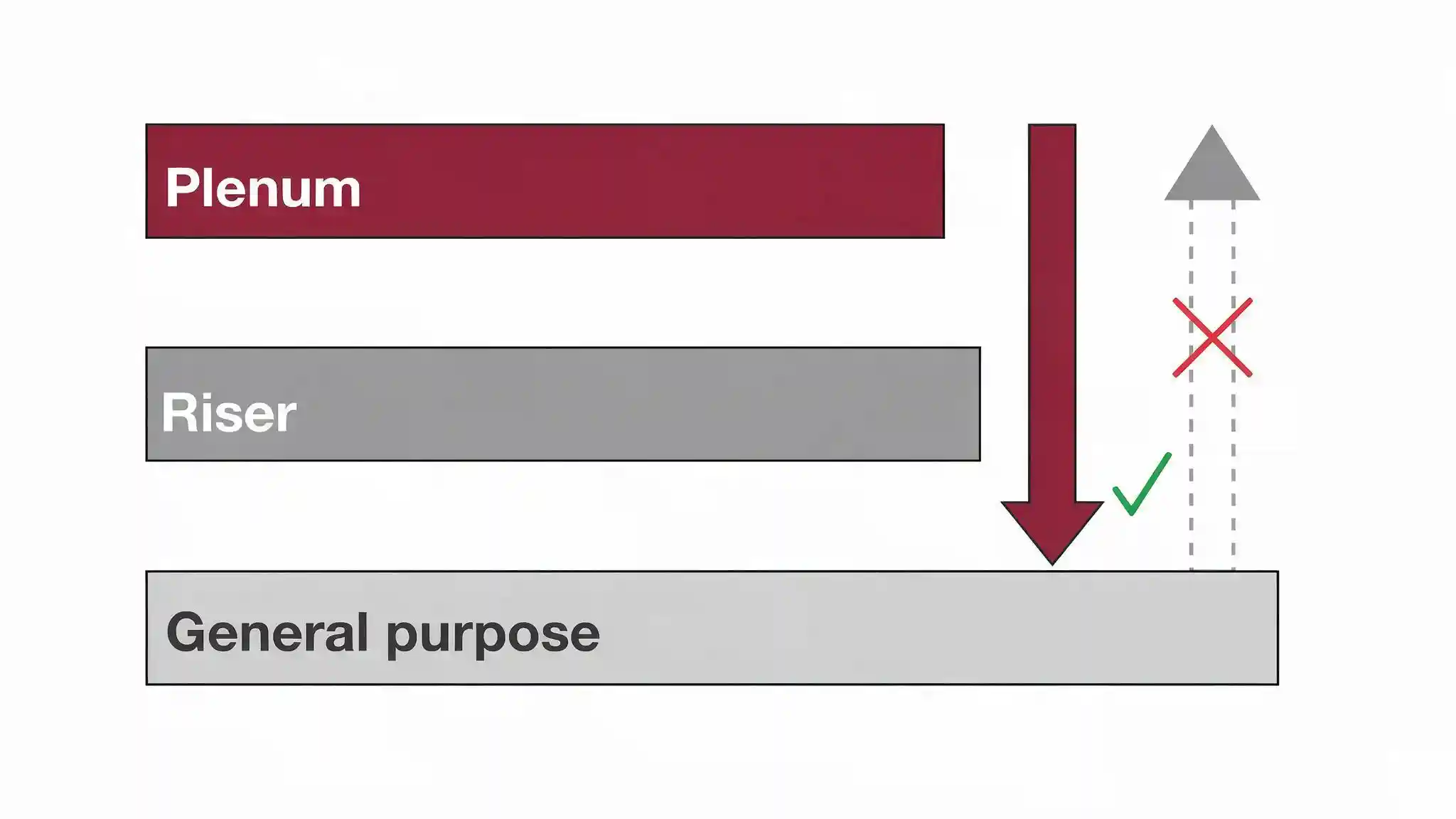
- Substitution runs one way only. Plenum can replace riser; riser can never replace plenum.
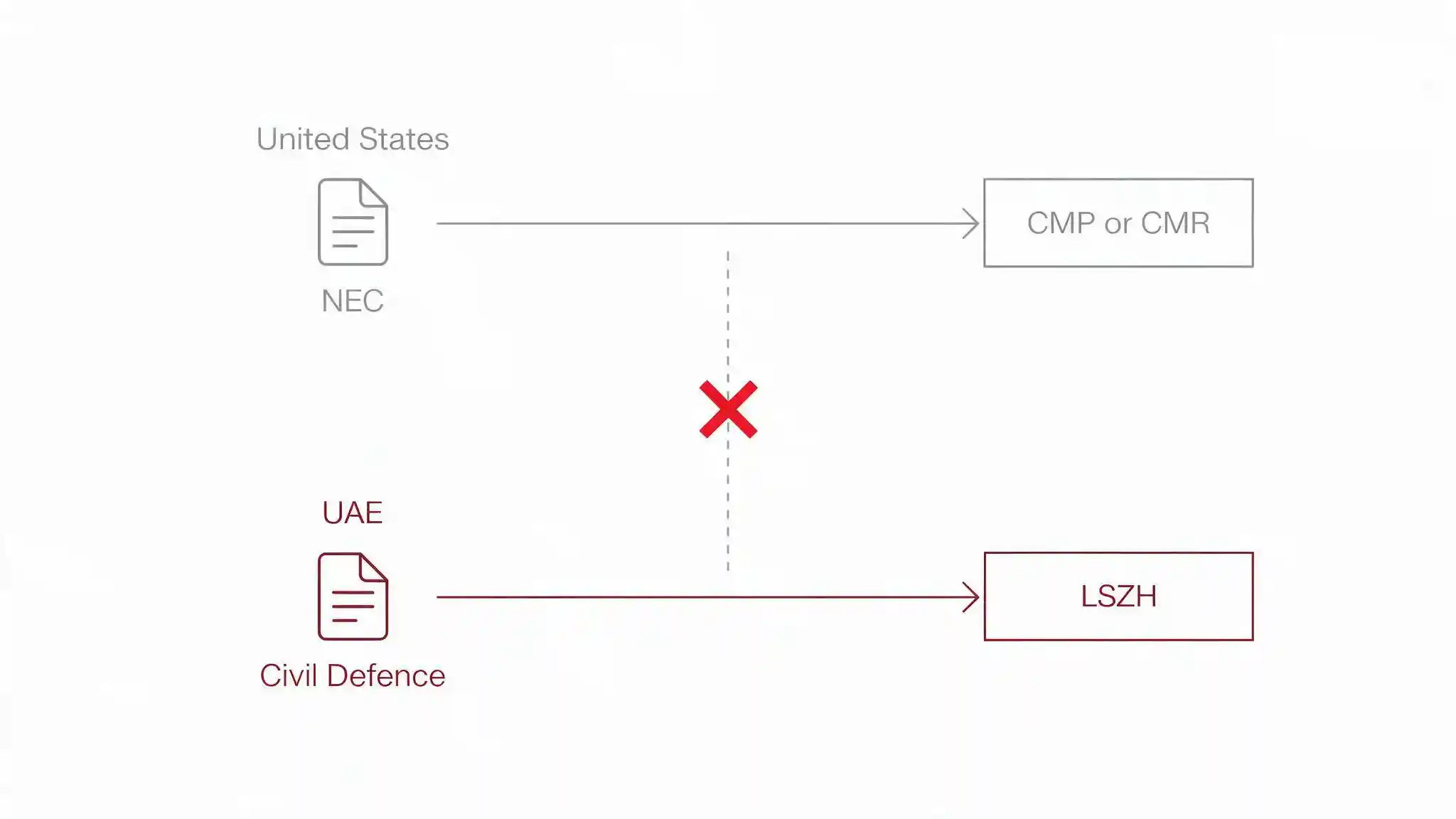
- Plenum and riser are North American classifications. The UAE does not follow the NEC, so a US-template specification may not describe what the project actually needs.
- If a specification requires both, ask for both test reports. One certificate does not demonstrate the other.
Cable fire ratings: two systems, not one scale
The most common error with cable fire ratings is to treat them as a single ladder from worst to best, with LSZH somewhere near the top. They are two parallel systems asking different questions.
Plenum, riser and general purpose come from the US National Electrical Code. They classify a cable by where in a building it may be installed, based on how flame and smoke behave in a standardised burn test.
LSZH describes what the jacket is made of and what it emits when it burns — specifically that it produces little smoke and no halogen gases.
A cable can hold a plenum rating and not be LSZH. A cable can be LSZH with no plenum rating at all. Understanding that these are independent axes is the whole point of this guide.
Plenum (CMP)
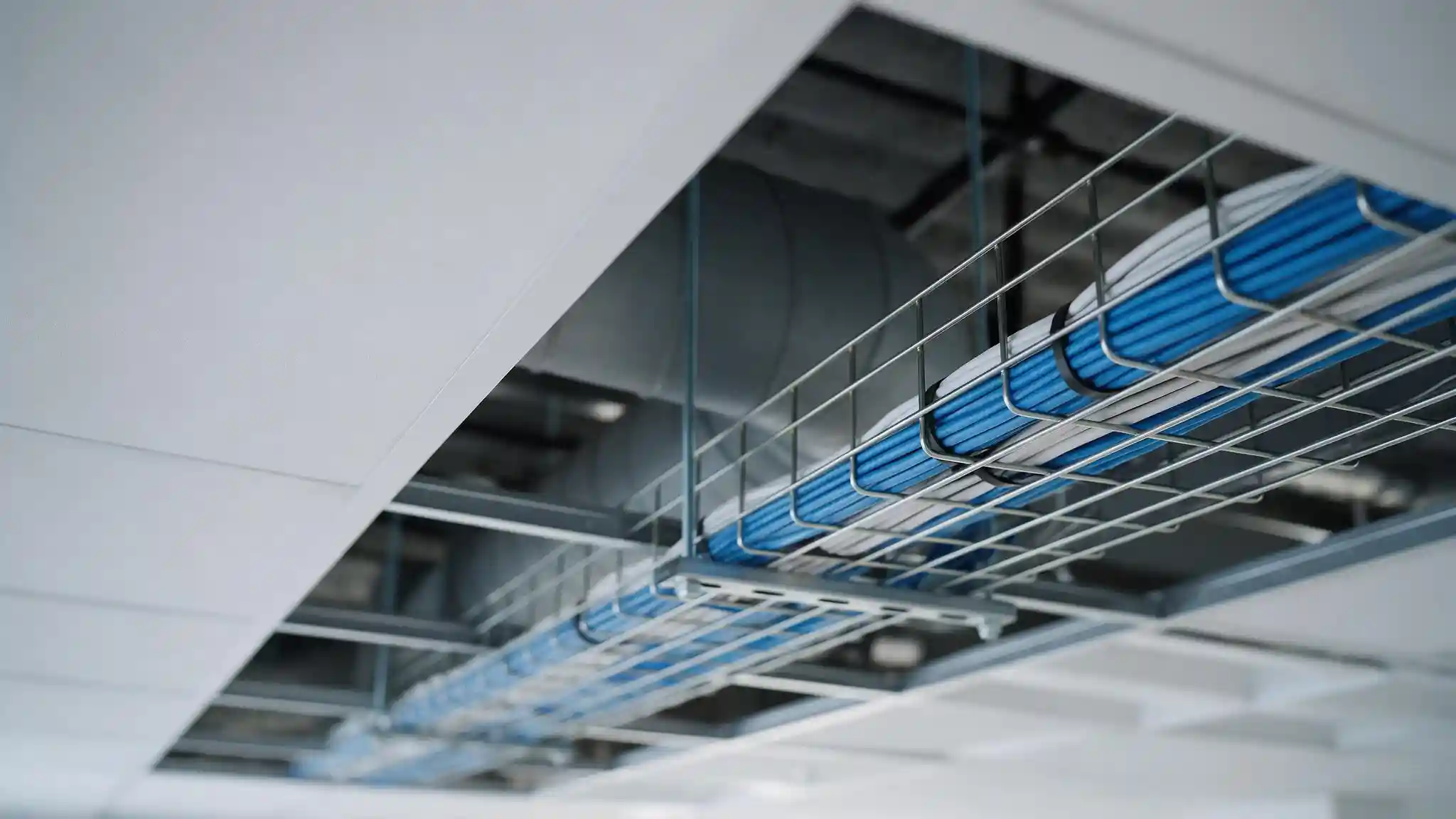
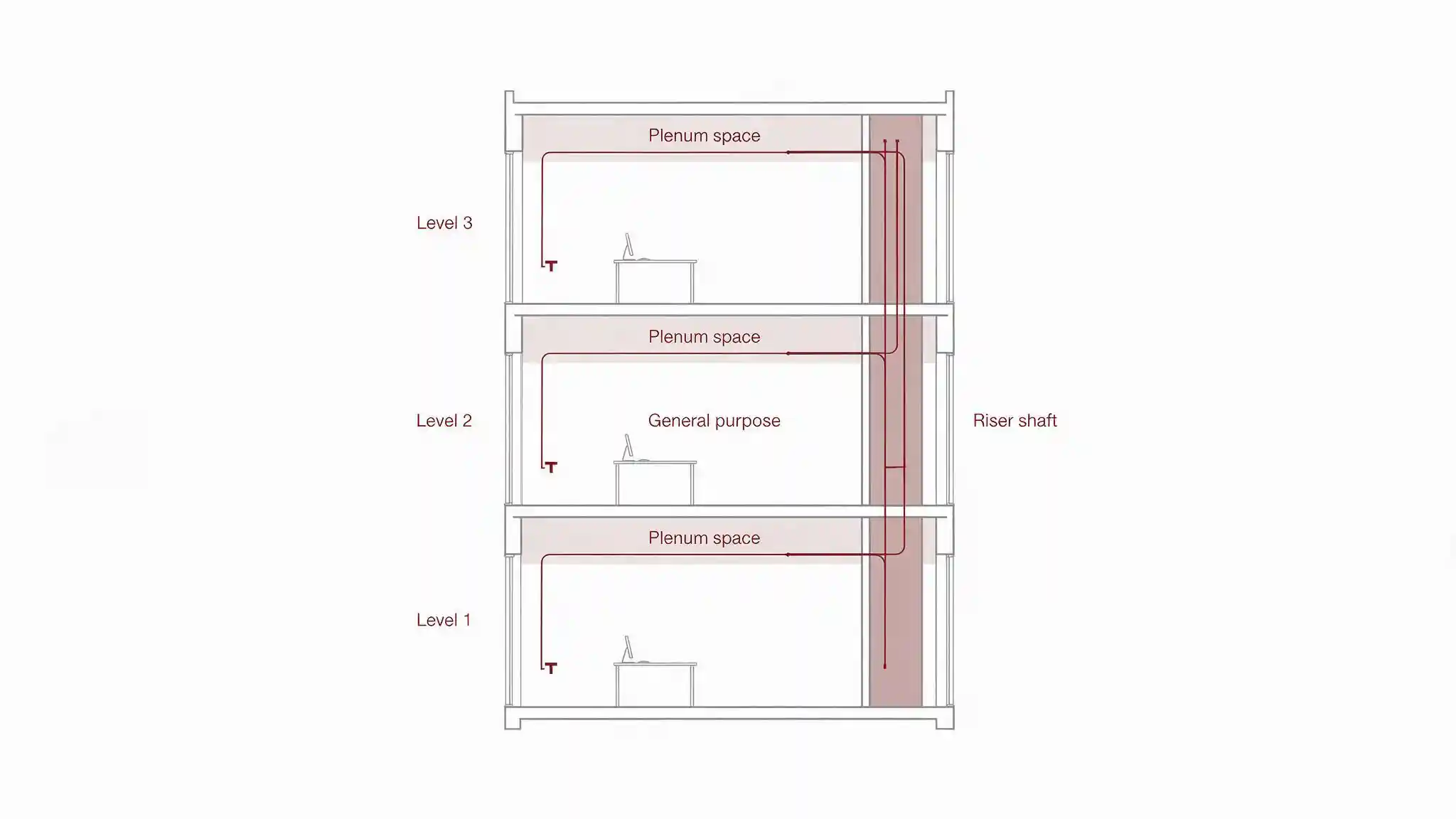
A plenum is any space used to circulate air as part of the building’s HVAC system — typically the void above a suspended ceiling used for return air, or an underfloor supply plenum.
These spaces are dangerous in a fire for two reasons: they contain few fire barriers, and they move air actively through the building. A cable burning in a plenum can propagate flame along its length and push smoke into occupied areas through the ventilation system.
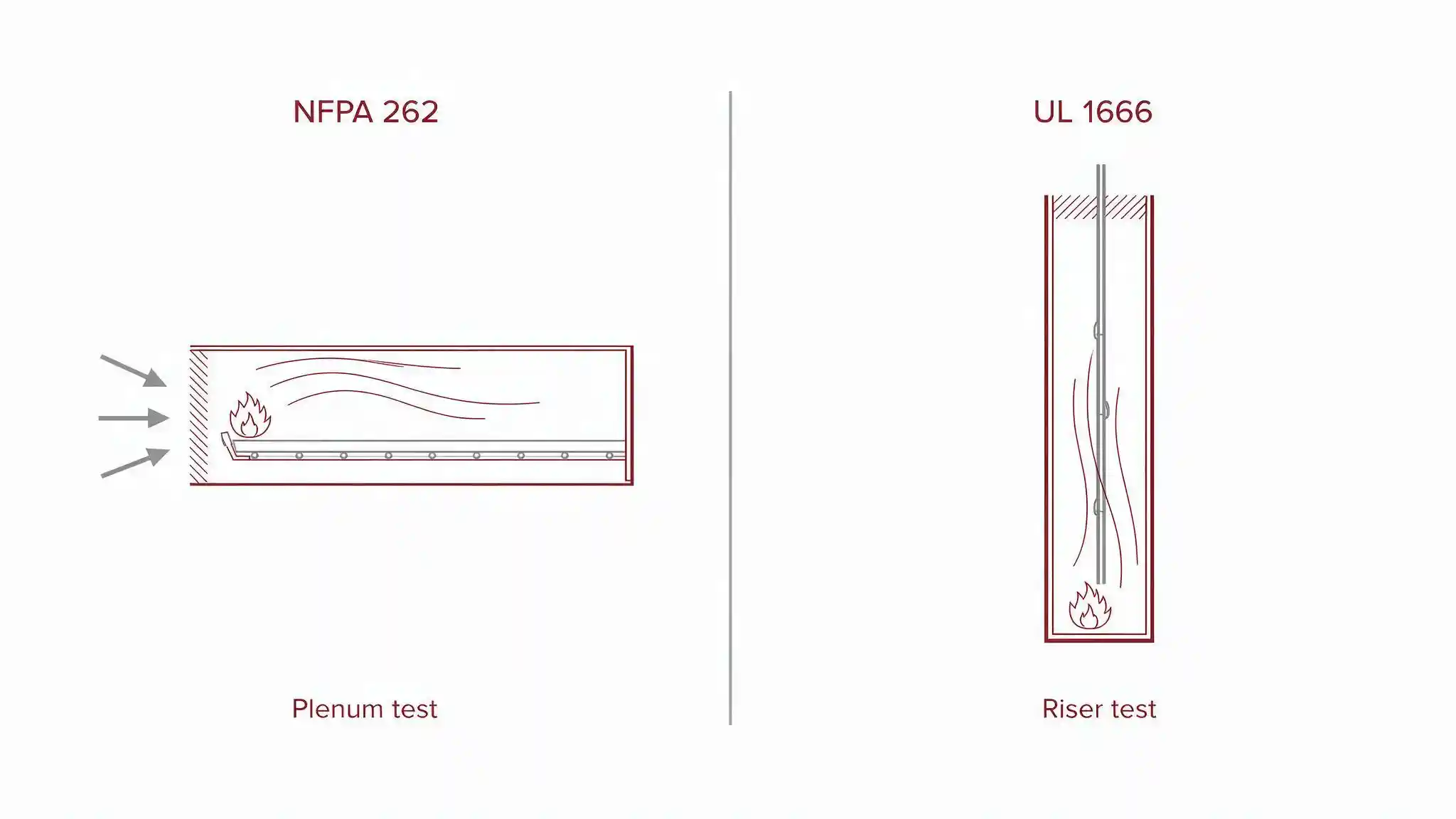
Plenum-rated cable is tested under NFPA 262, also published as UL 910 and adopted in Canada as CSA FT-6. The test is a Steiner Tunnel: cables are laid in a horizontal tray inside an enclosed tunnel roughly 25 feet long, subjected to a large sustained flame under forced airflow, and measured for how far flame travels and how dense the smoke becomes. It is the most demanding of the standard communications cable fire tests.
Passing it generally requires a fluoropolymer jacket — commonly FEP — which is where the halogen issue discussed below originates.
Riser (CMR)
A riser is the vertical shaft running between floors that carries services through a building — the backbone pathway for structured cabling.
The fire concern here is different. There is no forced airflow, but a vertical shaft acts as a chimney: flame can climb the cable from one floor to the next. Riser-rated cable is therefore tested under UL 1666, a vertical shaft test measuring whether flame propagates upward between floors.
The test is less severe than the plenum test, and riser cable will produce more smoke and, depending on jacket material, toxic fumes. That is acceptable in a sealed shaft in a way it is not in an air-handling space.
LSZH
Low Smoke Zero Halogen is a material specification rather than an installation rating. It addresses what happens to people, not just to the building.
Conventional PVC cable jackets contain chlorine. When they burn, they release dense black smoke and hydrogen chloride gas, which is both toxic to breathe and corrosive — it damages electronic equipment well beyond the fire itself. In an enclosed environment, smoke obscuring an escape route is frequently a greater threat than the flame.
LSZH compounds are formulated without halogens. Performance is typically assessed against the IEC 60332 series for flame propagation, IEC 60754 for halogen acid gas content, and IEC 61034 for smoke density.
LSZH is the prevailing expectation across Europe, the Middle East and much of Asia, particularly in public buildings, airports, transport infrastructure, hospitals and any occupancy where evacuation conditions are a primary design concern.
Why plenum is not LSZH
This is the point that causes real, expensive procurement errors, and it is worth stating plainly.
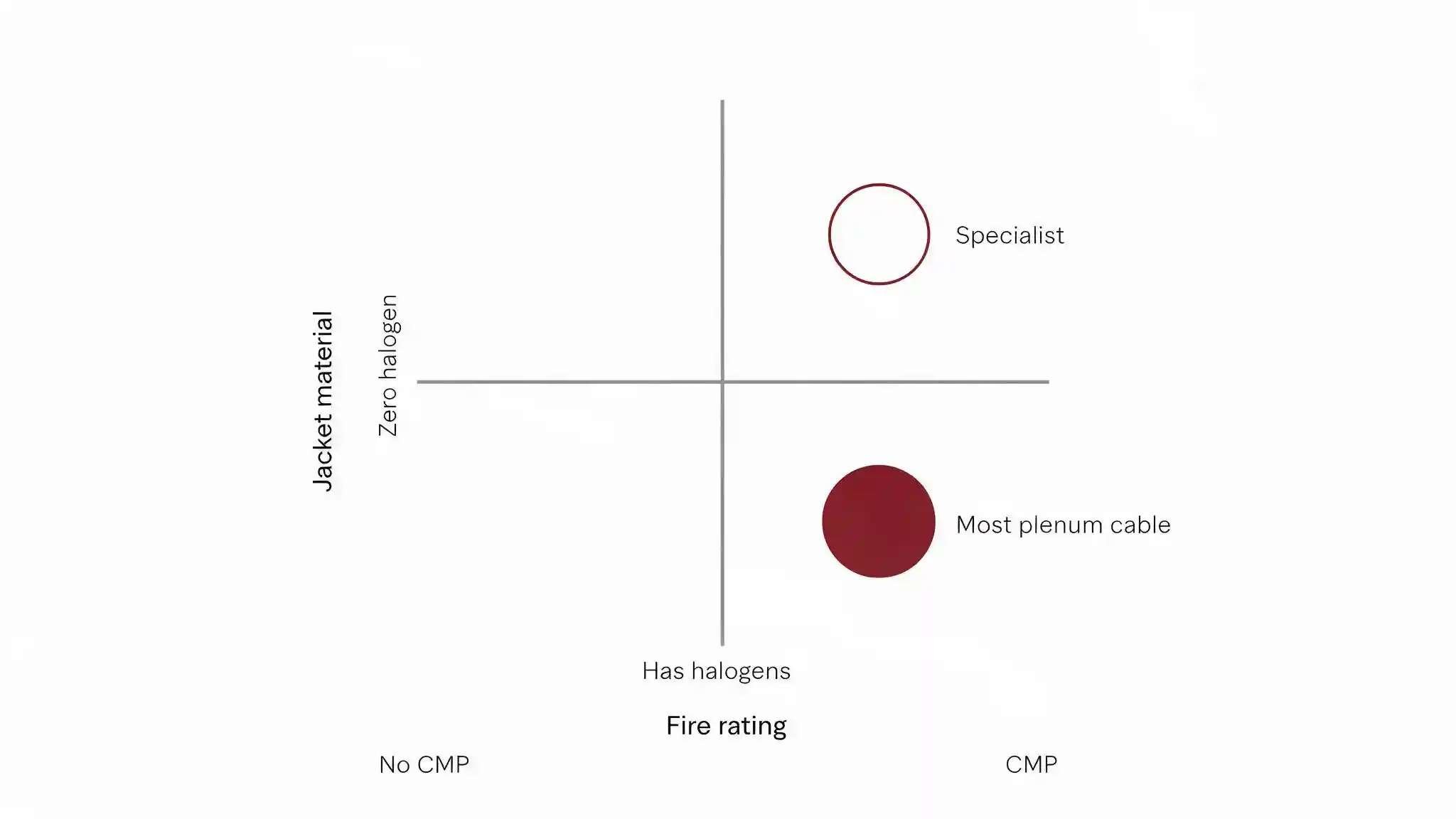
Plenum cable passes its fire test largely because of fluoropolymer jacket materials such as FEP. Fluorine is a halogen. A plenum-rated cable with an FEP jacket is, by definition, not zero-halogen — it will not satisfy an LSZH requirement no matter how good its flame and smoke performance is.
The two properties are independent:
| Cable | Fire rating | Halogen content | Satisfies LSZH spec? |
|---|---|---|---|
| Standard plenum | CMP | Contains halogens (FEP) | No |
| Standard LSZH | Often no CMP rating | Zero halogen | Yes |
| LSZH plenum | CMP | Zero halogen | Yes — specialist product |
| Standard PVC | CM or CMR | Contains halogens (PVC) | No |
Cables achieving both a plenum rating and genuine LSZH construction exist, but they are specialist products at a premium, not the default. If a specification demands both, that needs to be understood as a deliberate and costly requirement rather than an assumed baseline.
The practical rule: ask for both test reports separately. A plenum listing does not evidence halogen content, and an LSZH declaration does not evidence plenum flame performance.
The substitution hierarchy
Within the NEC rating system, substitution runs in one direction only.
Upward is allowed
Plenum cable may be installed in riser and general-purpose spaces. It exceeds the requirement in both.
Downward is not
Riser cable may never be used in a plenum space. General-purpose cable may not be used in either riser or plenum pathways.
Cost consequence
Plenum is the most expensive of the three. Specifying it everywhere for simplicity is a real budget decision, not a free safety margin.
Some projects do standardise on plenum throughout to remove the risk of the wrong cable ending up in the wrong pathway. That is a defensible choice, but it should be made knowingly — and it does nothing for an LSZH requirement.
What applies on a UAE project
Here is where a great many specifications go wrong. The cable fire ratings called plenum and riser are North American classifications tied to the National Electrical Code, and the UAE does not adopt the NEC.
UAE projects fall under the UAE Fire and Life Safety Code of Practice, issued by the Directorate General of Civil Defence, with approval handled by Civil Defence for the relevant emirate. In practice, LSZH is very widely specified on UAE commercial, public and infrastructure projects, reflecting the same evacuation-safety priorities that drive its use across Europe and Asia.
The recurring problem is specification templates. A consultant working from a US or international template writes “CMP plenum rated” into a UAE tender. The contractor prices imported plenum cable at a premium, and it may still not satisfy what Civil Defence actually expects on halogen content — because the two requirements are unrelated.
Confirm the governing code first
Establish what the authority having jurisdiction requires for the specific building and occupancy before any cable is priced. Do not infer it from a template.
Separate the two requirements in writing
If the project needs a fire rating and a material specification, state both, and require test evidence for each independently.
Check the pathway, not just the building
Air-handling ceiling voids carry a different requirement from sealed riser shafts, even within the same building.
Verify jacket marking on delivery
Ratings are printed on the cable jacket. Confirm the marking matches the specification before installation begins, not after.
Involve the fire consultant early
Cable jacket selection is a life-safety decision subject to approval. It is cheaper to confirm at design stage than to re-pull an installed building.
Because requirements vary by emirate, occupancy and project type, and codes are periodically updated, confirm the current position with your fire consultant and the relevant Civil Defence authority rather than relying on any general guide — including this one.
Common cable fire ratings mistakes
- Assuming plenum implies LSZH. It usually implies the opposite, since fluoropolymer jackets contain fluorine.
- Using a US template on a UAE project. Plenum and riser are NEC classifications. The UAE follows its own code.
- Specifying riser cable for a ceiling void. If that void handles return air, it is a plenum space and riser cable is not permitted under the NEC system.
- Accepting one certificate for two requirements. Fire rating and halogen content need separate test evidence.
- Treating LSZH as a fire rating. It describes emissions, not permitted installation pathways.
- Ignoring cost when standardising on plenum. It is materially more expensive and rarely required across an entire building.
- Not checking the jacket marking. The rating is printed on the cable; verifying it on delivery takes minutes and prevents rework.
Cable fire ratings are one of several specification decisions that interact. Conductor construction and shielding both change what is available in a given jacket type — our guides to solid versus stranded cable and cable shielding types cover those alongside this one. For fibre backbone in the same pathways, our guide to armoured fibre optic cable covers the equivalent OFNP and OFNR ratings.
Frequently asked questions
Is LSZH cable plenum rated?
Usually not. LSZH describes jacket material and emissions; plenum is a fire rating from a specific flame and smoke test. Standard LSZH cable does not normally carry a plenum listing. Cables achieving both exist but are specialist products at a premium, so if a project needs both, that has to be stated explicitly and evidenced with separate test reports.
Can I use riser cable in a plenum space?
No. Under the NEC system, riser cable is never permitted in an air-handling space. Substitution only runs upward: plenum cable can be used in riser and general-purpose pathways, but nothing substitutes upward into a plenum. The plenum test is significantly more demanding for good reason.
Does plenum cable contain halogens?
Typically yes. The fluoropolymer jackets that allow a cable to pass the plenum test — commonly FEP — contain fluorine, which is a halogen. This is precisely why a plenum rating does not satisfy an LSZH specification, and why the two requirements need separate verification.
Do plenum and riser ratings apply in the UAE?
They are North American classifications tied to the National Electrical Code, which the UAE does not adopt. UAE projects fall under the UAE Fire and Life Safety Code of Practice issued by the Directorate General of Civil Defence, and LSZH is widely specified. Confirm the requirement with your fire consultant and the relevant Civil Defence authority for the specific project.
What is the difference between LSZH and PVC?
PVC jackets contain chlorine and release dense smoke and corrosive hydrogen chloride gas when burning. LSZH compounds are formulated without halogens, producing far less smoke and no halogen acid gases. The difference matters most for occupant escape conditions and for corrosion damage to equipment after a fire.
How do I identify a cable's fire rating?
The rating is printed on the cable jacket alongside the category and other markings — CMP for plenum, CMR for riser, CM or CMG for general purpose, with LSZH indicated separately where applicable. Check the marking on delivery against the specification before installation, since correcting it afterwards means re-pulling cable.
Is plenum cable worth the extra cost everywhere?
Rarely. Plenum is materially more expensive, and most pathways in a building do not require it. Some projects standardise on it to eliminate the risk of the wrong cable in the wrong pathway, which is defensible — but it should be a deliberate budget decision, and it does nothing to satisfy an LSZH requirement.
What tests are LSZH cables assessed against?
Typically the IEC 60332 series for flame propagation, IEC 60754 for halogen acid gas content, and IEC 61034 for smoke density. These are material and emissions tests, distinct from the NFPA 262 and UL 1666 installation-rating tests used for plenum and riser classification.
Getting the jacket specification right before the order
Jacket rating is a life-safety decision subject to authority approval, and it is one of the few cabling errors that cannot be corrected without re-pulling the installation. Confirming it at design stage costs nothing.
Magnus supplies Premium-Line structured cabling in LSZH and standard jacket constructions across our networking and wireless solutions range, alongside fibre optic backbone. Send us the pathway schedule and the approved specification, and our pre-sales team will confirm the jacket rating against what the project actually requires.
Get a quoteSource
Plenum and riser classifications derive from the US National Electrical Code. Plenum cable is tested under NFPA 262 (also published as UL 910, and CSA FT-6 in Canada), a Steiner Tunnel flame-travel and smoke-density test conducted under forced airflow. Riser cable is tested under UL 1666, a vertical shaft flame-propagation test. LSZH performance is assessed against the IEC 60332, IEC 60754 and IEC 61034 series. The halogen content of fluoropolymer plenum jackets is a material property of those compounds. UAE requirements fall under the UAE Fire and Life Safety Code of Practice, issued by the Directorate General of Civil Defence; this article does not cite clause-level requirements for data cabling jackets, and readers should confirm current obligations with their fire consultant and the relevant Civil Defence authority. Cross-checked against independent cabling and fire-testing technical references.
This guide is provided for general information and is not a substitute for fire engineering advice or authority approval.