


Networking & Wireless · Structured Cabling
Solid vs Stranded Ethernet Cable: Essential 2027 Guide
The solid vs stranded Ethernet cable decision is not a preference — it is determined by where the cable goes and how it terminates. Solid conductor belongs in the walls, punched down into keystone jacks and patch panels. Stranded belongs in patch cords, crimped into RJ45 plugs. Getting it backwards produces links that pass a basic wire map test and then fail intermittently for years.
Key takeaways
- Solid conductor is one continuous wire per conductor. Stranded is many thin wires twisted together to form each conductor.
- Termination method decides the choice. IDC punch-downs on keystone jacks and patch panels are built for solid. Crimped RJ45 plugs are built for stranded.
- TIA allows 20% more attenuation for stranded, which is precisely why patch cords are limited to 10 metres combined across a 100-metre channel.
- Standards require solid for horizontal permanent links. This is not a recommendation — both TIA and ISO/IEC specify it.
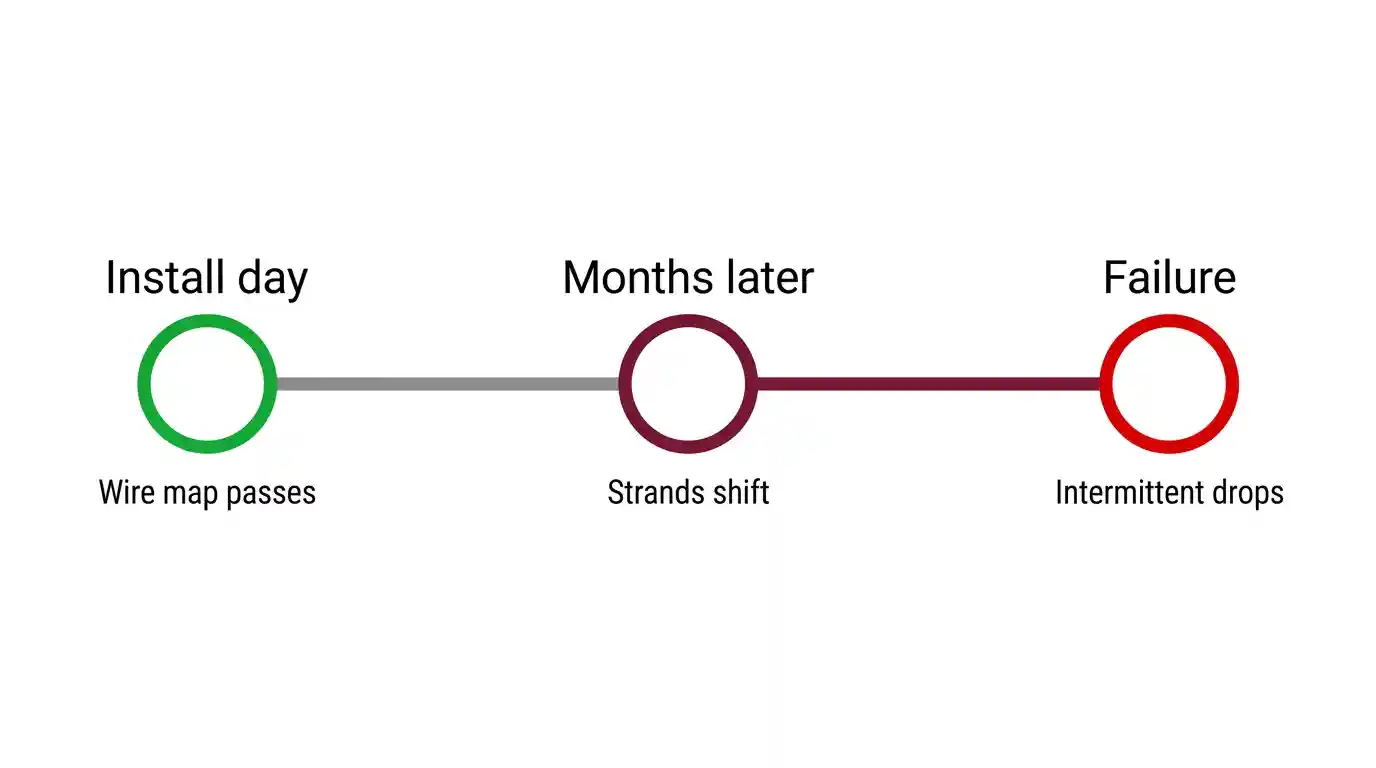
- The mismatch failure is intermittent, not immediate. A wire map test can pass while the connection degrades over months.
Solid vs stranded Ethernet cable: the core difference
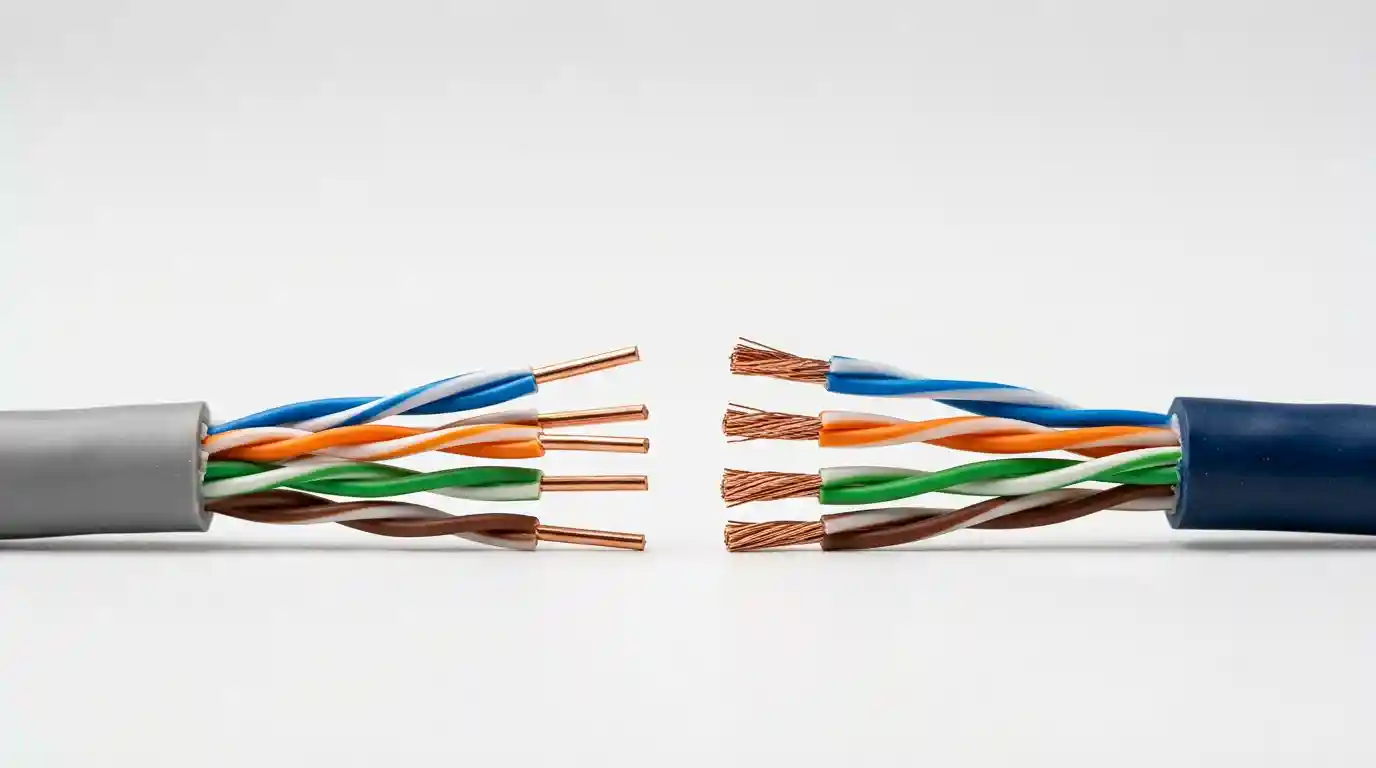
Inside every Ethernet cable are eight conductors arranged in four twisted pairs. The difference between solid and stranded is what each of those eight conductors is physically made of.
Solid conductor uses a single continuous piece of copper for each of the eight conductors. Stranded conductor bundles multiple thin copper strands together, twisted, to form each conductor. Same eight conductors, same colour code, same connectors — completely different mechanical and electrical behaviour.
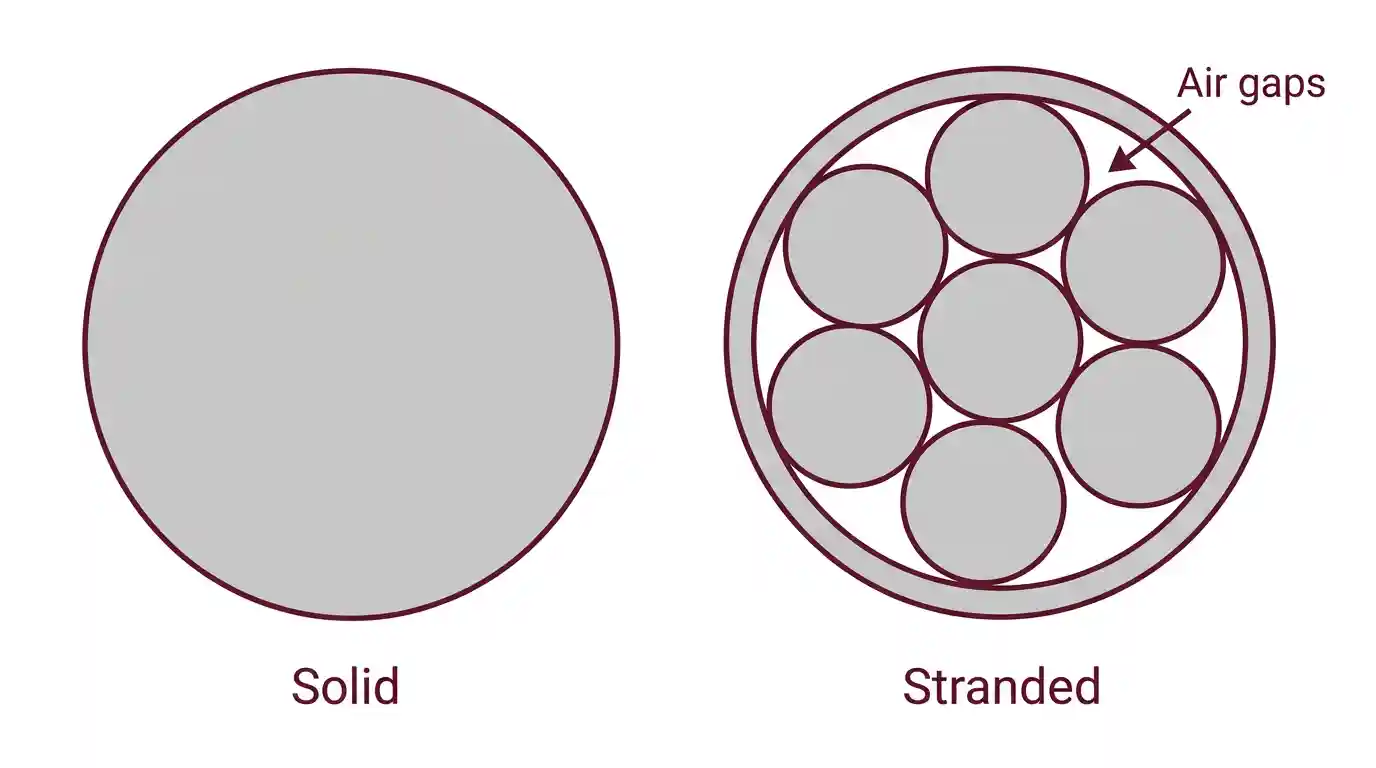
That structural difference cascades into everything else: how the cable bends, how it terminates, how much signal it loses, and how long a run it can support.
Side-by-side comparison
| Property | Solid conductor | Stranded conductor |
|---|---|---|
| Construction | One continuous copper wire per conductor | Multiple thin strands twisted per conductor |
| Attenuation | Lower | Higher — TIA allows +20% |
| Flexibility | Stiff; resists repeated bending | Flexible; tolerates repeated flexing |
| Termination | IDC punch-down (keystone jacks, patch panels) | Crimped RJ45 plugs |
| Typical use | Horizontal runs inside walls, ceilings, conduit | Patch cords at the desk and in the rack |
| Typical length | Up to 90 m per run | A few metres; 10 m combined per channel |
| Durability in place | More resistant to corrosion and abrasion | More resistant to fatigue from movement |
| Standards position | Required for horizontal permanent link | Used for patch cords and equipment cables |
Termination is the deciding factor
If you take one thing from the solid vs stranded Ethernet cable question, it is this: the termination hardware decides, not the run length or the category.
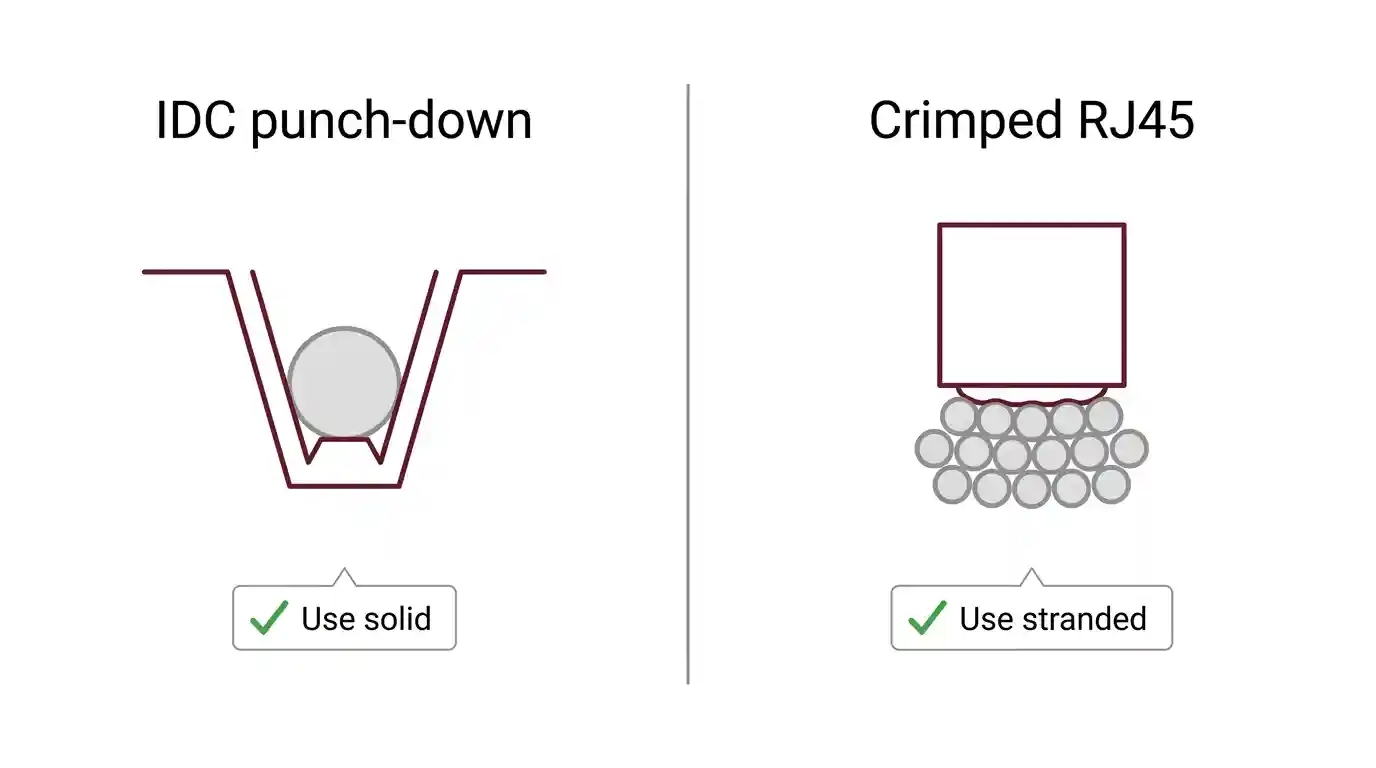
IDC needs solid
Insulation displacement contacts on keystone jacks and patch panels are designed to cut through insulation and grip a single round conductor that holds its shape.
Crimp plugs suit stranded
RJ45 contacts press down into the conductor bundle. Multiple strands deform slightly and make broad contact across the blade.
The mismatch risk
Stranded conductors punched into an IDC can spread aside, miss the contact slot, or be severed by the blade — producing a connection that tests fine and degrades later.
Some RJ45 plugs are sold as suitable for both, and some manufacturers make separate solid-only and stranded-only variants with differently shaped contacts. If a project uses both cable types — which almost every project does — confirm the plug matches the conductor in hand rather than assuming one plug fits all.
Why stranded loses more signal
Two physical effects work against stranded construction at Ethernet frequencies.
Air gaps. Twisted strands cannot fill the conductor cross-section completely — small voids remain between them. Air does not conduct, so the effective conducting cross-section is slightly smaller than a solid conductor of the same nominal gauge.
Skin effect. At higher frequencies, current travels increasingly along the outer surface of a conductor rather than through its centre. A single solid conductor presents one clean continuous surface. A bundle of strands presents a fragmented one, with current crossing between strands.
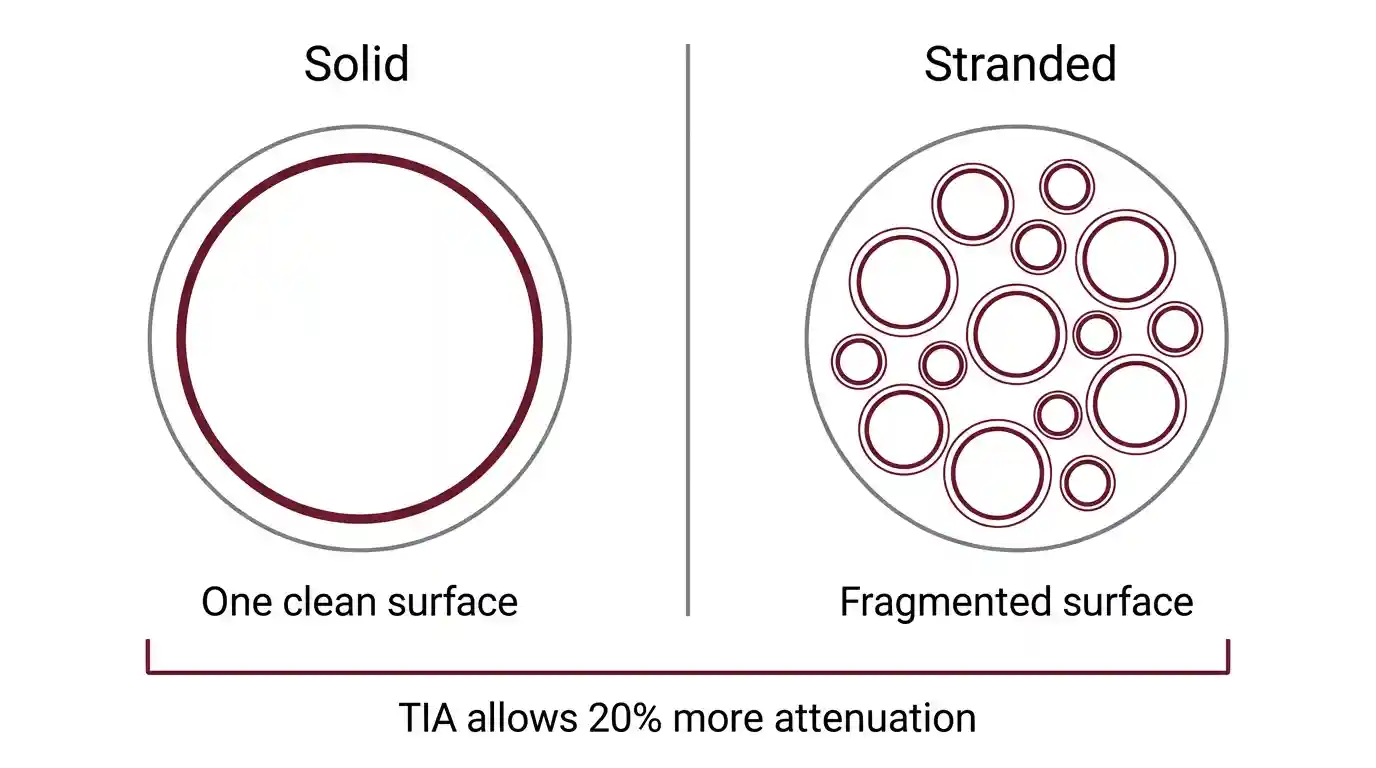
The result is measurably higher attenuation per metre. TIA quantifies this by permitting a 20% higher attenuation allowance for stranded construction, which is the direct technical reason a compliant 100-metre channel budgets only 10 metres of patch cord. Our guide to Ethernet cable distance limits covers how that 90/10 channel budget works in full.
Note this is separate from conductor thickness. A 24 AWG solid and a 24 AWG stranded conductor share a nominal gauge but behave differently — gauge and construction are two independent variables. Our guide to Ethernet cable gauge covers the thickness side.
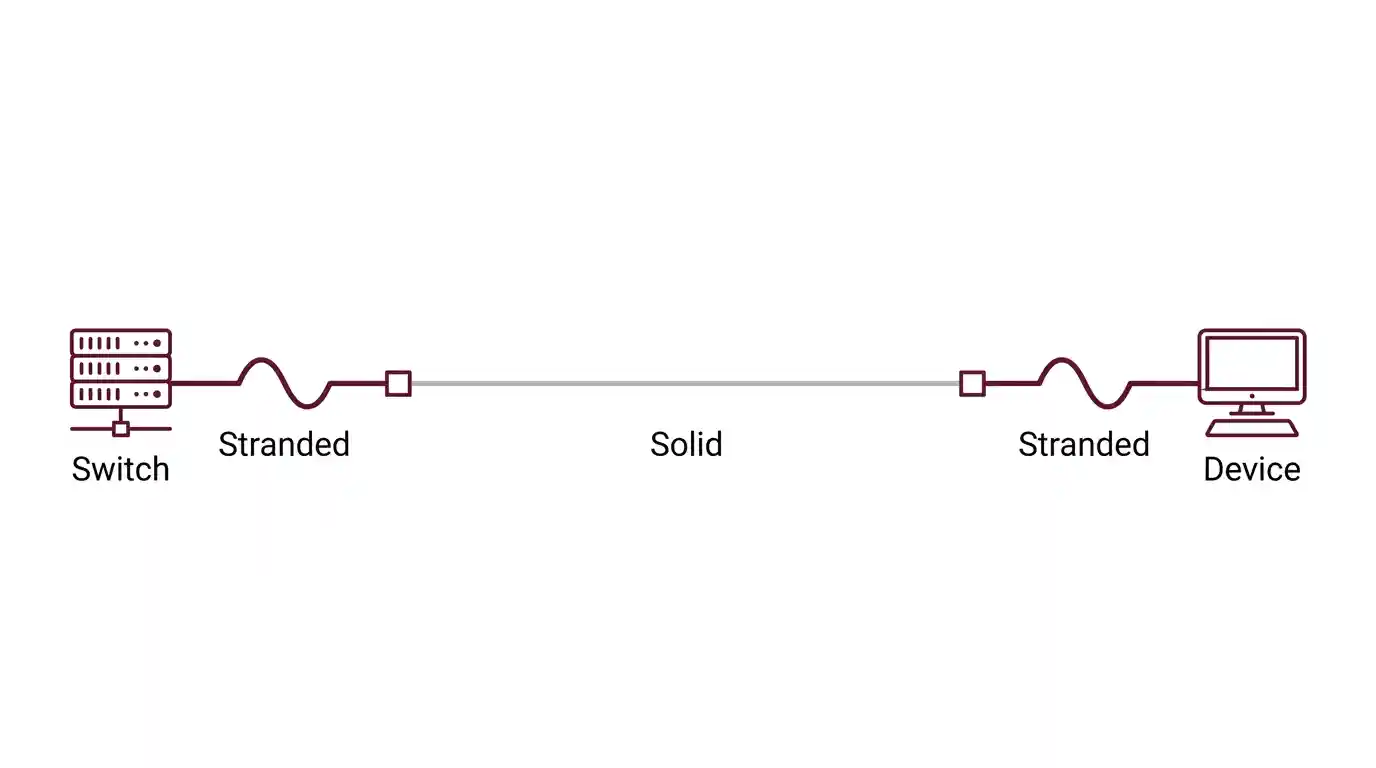
Which to use where
Horizontal runs in walls, ceilings and conduit — solid
Required by TIA and ISO/IEC for the permanent link. Terminates into patch panels at the rack end and keystone jacks at the outlet end. Up to 90 metres.
Rack patch cords, panel to switch — stranded
Short, frequently re-patched, and constantly flexed during moves and changes. Flexibility matters more than the marginal attenuation over one or two metres.
Desk cords, wall outlet to device — stranded
Gets moved, coiled, trodden on and pulled. Solid conductor would fatigue and eventually fracture under that treatment.
Outdoor and direct-burial runs — solid
Fixed installation with no movement, plus better resistance to corrosion and abrasion. Use cable rated for the environment as well as the correct conductor.
Runs to cameras and access points — solid
Fixed horizontal infrastructure. Solid also has lower DC resistance, which matters for PoE power delivery over longer runs.
Anything that will move repeatedly — stranded
Robotics, adjustable workstations, portable equipment, anything on a cable reel. Repeated flexing is exactly what stranded construction exists for.
What happens when you get it wrong
The reason this matters commercially is that a solid/stranded mismatch rarely fails cleanly. It fails slowly.
Stranded conductor punched into an IDC may make contact on installation day and pass a wire map test. Over the following months, thermal cycling, building vibration and cable movement let the strands shift within the contact. The link starts dropping packets intermittently, renegotiating to a lower speed, or failing entirely under load — long after the installer has left site, and with no obvious cause at the outlet.
Solid conductor crimped into a plug intended for stranded has a similar profile: the contact may seat adequately at first, then loosen as the stiff conductor resists the deformation the contact was designed around.
Either way, the failure is intermittent, hard to trace, and appears well outside any installation warranty conversation. It is a materially more expensive problem than buying the correct cable at the outset.
The copper-clad aluminium warning
One issue sits alongside the solid vs stranded question and causes more failures than either: copper-clad aluminium, sold as CCA.
CCA is aluminium wire with a thin copper coating. It looks like copper, costs noticeably less, and is widely sold as budget Ethernet cable. It has higher DC resistance than bare copper, performs poorly under PoE loads, and is more brittle at terminations. TIA-568 requires solid copper conductors for structured cabling — CCA does not comply, and CCA installations frequently fail certification testing.
This applies to both solid and stranded construction. Specify cable labelled bare copper or BC, and treat any listing that does not state the conductor material as suspect. Magnus supplies Premium-Line solid bare-copper Cat6 and Cat6A structured cabling and matching stranded patch cords.
Frequently asked questions
Can I use stranded cable for a wall run?
You should not. Both TIA and ISO/IEC require solid conductor for the horizontal permanent link. Beyond the standards position, stranded terminates unreliably into the IDC punch-downs on keystone jacks and patch panels, and its higher attenuation may cause a full-length run to fail insertion loss on a certification test.
Can I use solid cable to make a patch cord?
It is possible for a short, fixed cord that will not be moved, but it is not advisable. Solid conductor fatigues and eventually fractures under repeated flexing, and standard crimp plugs are designed around stranded conductor geometry. Factory-made stranded patch cords are more reliable and usually cheaper than field-terminated alternatives.
Is stranded cable slower than solid?
Not in speed rating — both support the same category speeds. Stranded has higher attenuation per metre, which TIA quantifies as a 20% allowance, so it loses more signal over the same distance. Across the few metres of a patch cord this is negligible, which is why the standard permits 10 metres of it in a 100-metre channel.
How can I tell solid from stranded by looking?
Strip a short length of the outer jacket and examine one conductor. Solid shows a single round copper wire. Stranded shows several fine wires twisted together. Stranded cable also feels noticeably more flexible and drapes rather than holding a shape when bent.
Do solid and stranded use different RJ45 connectors?
Often yes. Many manufacturers produce separate plugs with contact geometry optimised for each, and some plugs are rated for both. Since most installations use both cable types, confirm the plug matches the conductor rather than assuming a single plug works universally.
Which is better for PoE?
Solid, for the fixed horizontal run. It has lower DC resistance, so less power is lost as heat over distance — which matters increasingly at higher PoE classes and longer runs. Stranded still handles the short patch cords at each end without issue.
Is stranded cable more expensive?
Typically yes per metre, since more strands mean more complex manufacturing. But stranded is only used for short patch cords while solid covers the long horizontal runs, so it rarely dominates the cable budget on a structured cabling project.
Specifying the right cable for each part of the run
Most cabling projects need both: solid for the horizontal infrastructure, stranded for the patch cords at each end. The failures come from mixing them up, or from CCA sneaking in on price.
Magnus supplies Premium-Line solid bare-copper Cat6 and Cat6A cabling, matching stranded patch cords, keystone jacks and patch panels across our networking and wireless solutions range. Send us your run sheet and our pre-sales team will specify the right conductor for each part of the channel.
Get a quoteSource
The requirement for solid conductors in horizontal permanent links is specified in ANSI/TIA-568 and ISO/IEC 11801. The 20% attenuation allowance for stranded construction is a TIA standards provision, cross-checked across independent structured-cabling technical sources including field-test instrumentation and cabling industry publications. CCA non-compliance with TIA-568 structured cabling requirements is likewise drawn from published industry technical guidance. Actual performance depends on installation quality, termination method, bundle conditions and environment.