


Server & Storage · UAE Compliance
Data Residency UAE: 7 Essential Questions to Ask
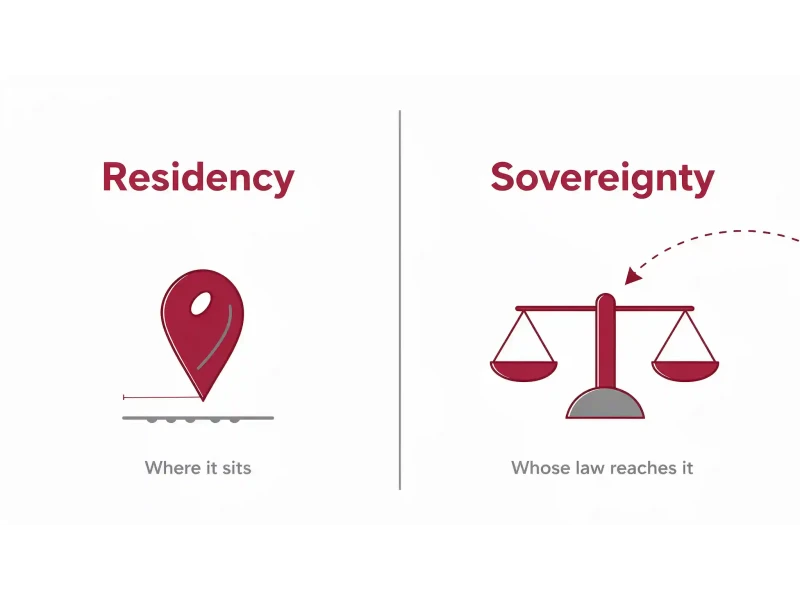
Data residency UAE requirements are usually satisfiable in cloud — several major providers now operate UAE regions. But residency and sovereignty are not the same thing. Residency answers where data is physically stored. Sovereignty answers whose laws can reach it. An organisation can meet the first entirely and still fail the second, and that gap is where most compliance surprises live.

Key takeaways
- Residency and sovereignty are different requirements. Meeting one does not deliver the other.
- Hosting in a UAE region is necessary but not always sufficient. Foreign statutes can reach data a foreign-headquartered provider controls, regardless of where it is stored.
- Cloud satisfies residency for most workloads. This is not an argument against cloud — it is an argument for asking the right question.
- Backups, logs, telemetry and the control plane are where residency claims most often fail, not primary storage.
- Sovereignty only binds specific data classes. Applying it to everything is expensive and unnecessary.
- Ask for evidence, not assurances. Residency is a verifiable fact about a system, not a statement in a brochure.
Residency is not sovereignty
Every data residency UAE decision turns on this distinction, and it is routinely collapsed into a single idea.
Data residency is a physical fact: which country the servers holding your data are in. It is measurable, verifiable, and usually straightforward to satisfy.
Data sovereignty is a legal question: which government has authority over that data and the organisation controlling it. It follows the provider's corporate domicile as much as the data's location.
The gap between them is concrete. Consider an organisation storing data in a UAE data centre operated by a provider headquartered abroad. The residency requirement is met — the data is physically in the UAE. But the provider remains subject to the laws of its home jurisdiction. The best-known example is the US CLOUD Act, which permits US authorities to compel US-based providers to produce data under their control irrespective of where that data is physically stored.
So residency is satisfied and sovereignty is not. Physical location did not create legal insulation, because the legal question was never about location.
Three terms, three different requirements
A third term appears in regulation and is stricter than either.
| Term | Question it answers | What satisfies it |
|---|---|---|
| Residency | Where is the data stored? | Infrastructure physically located in the required country |
| Sovereignty | Whose laws govern it? | Control resting with an entity subject only to the required jurisdiction |
| Localisation | May the data leave at all? | Data never crossing the border, including copies, processing and backups |
Residency permits copies or processing elsewhere unless the contract or regulation says otherwise. Localisation does not — it is the strictest of the three, and where it applies, cross-border replication for disaster recovery becomes a compliance problem rather than a resilience measure.
Establishing which of the three your obligation actually is, before designing anything, saves considerable money. Organisations frequently build to sovereignty when the requirement was residency.
Where data residency UAE claims break down
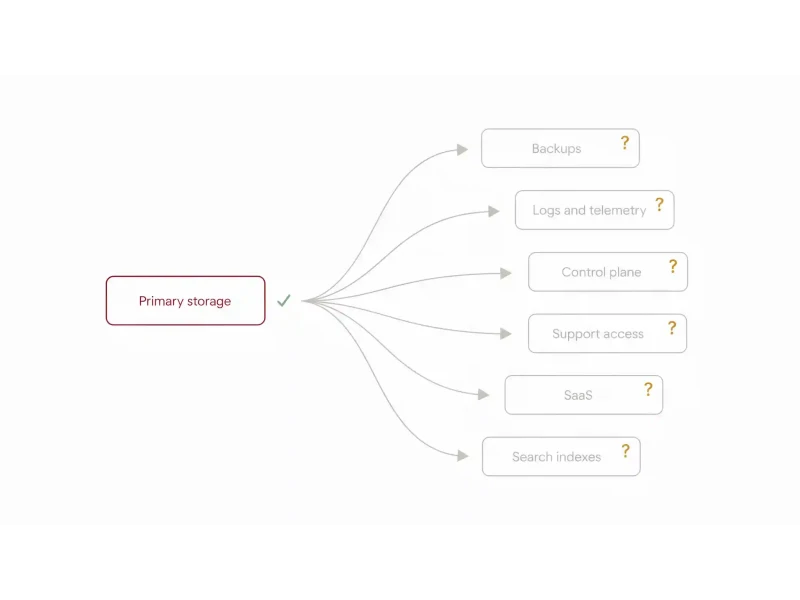
Primary storage is the easy part of data residency UAE planning, and it is the part everybody checks. The failures are elsewhere.
Backups and replicas
Disaster recovery copies are frequently placed in a different region by default, for exactly the resilience reasons that make DR worth having. Each copy sits under the laws of wherever it lands.
Logs and telemetry
Operational logging, monitoring data and usage telemetry often flow to a provider's central systems abroad, and frequently contain personal data.
The control plane
Data may sit in-country while the management layer that governs it runs elsewhere. Whoever operates the control plane has effective access.
Support and admin access
Where are the administrators and support engineers who can reach the system physically located, and under whose employment law?
SaaS integrations
Every connected SaaS platform inherits the legal domicile of its own parent company. A compliant core system feeding a non-compliant integration is a gap.
Search indexes and caches
Derived data — indexes, caches, analytics extracts — are copies too, and they are rarely enumerated in a residency review.
The practical test is simple and uncomfortable: can you produce a list of every location your personal data exists, including derived and backup copies, with evidence? Most organisations cannot, and that is the actual finding rather than any particular provider being unsuitable.
On-premise, cloud and sovereign cloud
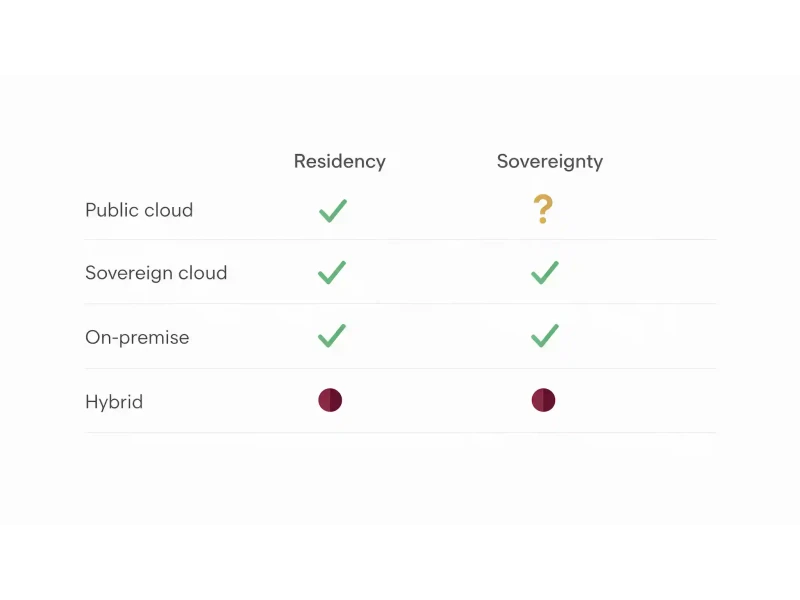
Three architectures answer data residency UAE requirements differently. None is universally correct.
| Residency | Sovereignty | Trade-off | |
|---|---|---|---|
| Public cloud, UAE region | Satisfied for primary data | Depends on provider domicile | Best elasticity and managed services; residency of derived data needs verifying |
| Sovereign cloud | Satisfied | Designed to satisfy | Local operation and locally held keys; narrower service catalogue, higher cost |
| On-premise | Satisfied by definition | Satisfied by definition | Full control; you carry the capex, the resilience and the operational burden |
| Hybrid | Per workload | Per workload | Sensitive data held locally, everything else in cloud; adds architectural complexity |
Sovereign cloud emerged specifically to close the residency-sovereignty gap. The defining characteristics are operation by a locally domiciled entity, administrative access restricted to locally based personnel, and encryption keys held by the customer or a local key management service rather than the provider.
For most organisations and most workloads, public cloud in a UAE region is the right answer. The elasticity, managed services and operational maturity are genuinely hard to replicate. The question worth asking is narrower: which specific data classes, if any, carry a sovereignty requirement rather than a residency one — and can those be isolated rather than driving the whole architecture.
Hybrid is frequently the sensible landing point. Regulated or sensitive data on infrastructure you control, everything else in cloud. Our server and storage solutions cover the on-premise side of that split, including Fibrenetix storage platforms.
Seven questions to ask a provider
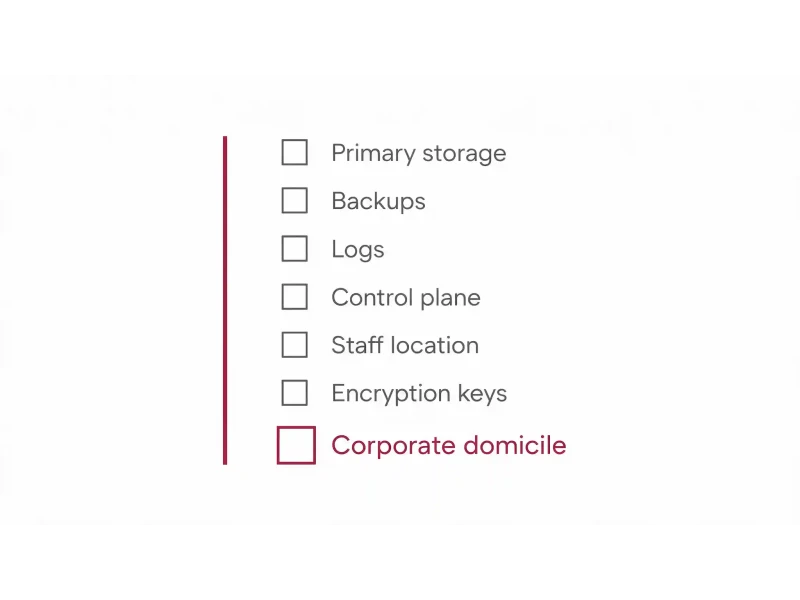
Each has a verifiable answer. Vagueness is itself informative.
Where is primary storage, and can you evidence it?
Named facility or region, with documentation. This is the easy question and the only one most procurement processes ask.
Where do backups and replicas physically sit?
Including disaster recovery copies and any automatic cross-region replication. Ask whether it can be constrained, and what that costs in resilience.
Where are logs, telemetry and analytics processed?
Operational data often leaves the region even when customer data does not, and frequently contains personal data.
Who operates the control plane, and from where?
Management infrastructure may sit outside the region even when storage does not. Whoever controls it has effective access.
Where are administrative and support staff located?
Human access is access. Ask which personnel can reach the environment and under whose jurisdiction they work.
Who holds the encryption keys?
Customer-held or locally-held keys materially change the sovereignty position. Provider-held keys mean the provider can decrypt on instruction.
What is the corporate domicile of the contracting entity?
This determines which government can compel disclosure. It is the sovereignty question, stated plainly, and it is the one least often asked.
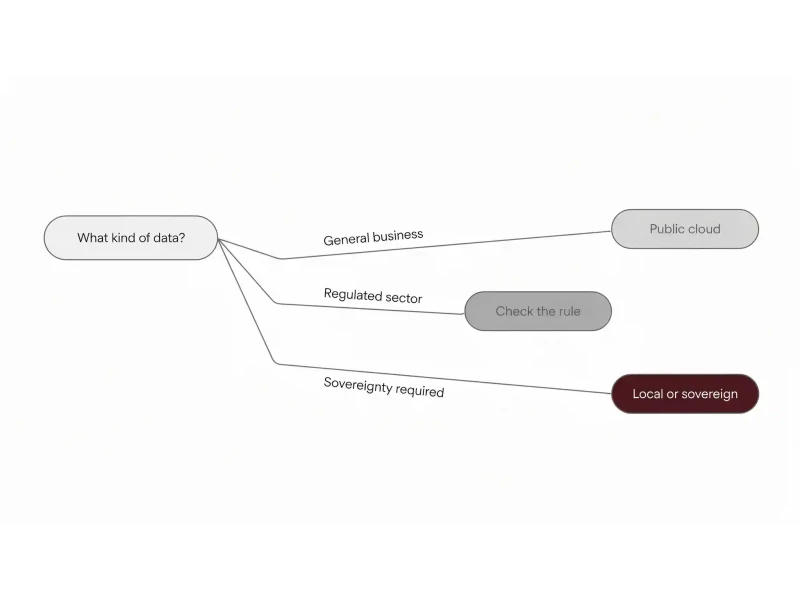
Data residency UAE by workload type
General business workloads — public cloud
Email, collaboration, most line-of-business applications. Residency in a UAE region is normally sufficient, and cloud economics and elasticity are hard to beat.
Regulated sector data — check the sector rule first
Financial, healthcare and government data frequently sit under sector-specific regimes stricter than the general position. Establish which framework binds you before designing.
Data with a genuine sovereignty requirement — sovereign cloud or on-premise
Where a foreign jurisdiction reaching the data is an unacceptable outcome, residency alone does not solve it. Isolate that data class rather than rearchitecting everything.
Surveillance footage — usually on-premise
Volume, retention rules and the requirement for a dedicated network make local storage the practical choice. Our guide to CCTV storage requirements covers the sizing side.
Backups of sensitive data — check the destination
The most common gap. Backup destination is often chosen for cost or convenience and inherits none of the care applied to primary storage.
Anything you cannot locate — find it first
Architecture decisions made without a data inventory are guesses. Discovery precedes design.
Frequently asked questions
What is the difference between data residency and data sovereignty?
Residency is a physical fact — which country the servers holding your data are in. Sovereignty is a legal question — which government has authority over that data and the organisation controlling it. You can satisfy residency completely and still not satisfy sovereignty, because the legal question follows the provider's corporate domicile as much as the data's location.
Does storing data in a UAE cloud region make it sovereign?
Not necessarily. Hosting in-country satisfies residency. Whether it satisfies sovereignty depends on the corporate domicile of the entity controlling the data, because foreign statutes can permit authorities to compel a provider headquartered in their jurisdiction to produce data it controls regardless of where that data is physically stored.
What is the CLOUD Act and why does it matter here?
It is a United States law permitting US authorities to compel US-based providers to produce data under their control, irrespective of the physical storage location. It is the clearest illustration that physical location does not by itself create legal insulation, which is why sovereignty and residency have to be assessed separately.
Is on-premise storage always more compliant than cloud?
No. On-premise satisfies residency and sovereignty by definition, but it transfers the entire burden of resilience, security, patching and physical protection to you. A poorly run on-premise environment is less secure than a well-run cloud one. The right answer depends on the data class and on whether you can operate the alternative properly.
What is a sovereign cloud?
A cloud service designed to close the gap between residency and sovereignty. Defining characteristics typically include operation by a locally domiciled entity, administrative access restricted to locally based personnel, and encryption keys held by the customer or a local key management service rather than the provider. The trade-off is usually a narrower service catalogue and higher cost.
Where do residency claims most commonly fail?
Not in primary storage, which everyone checks. The gaps are in backups and disaster recovery replicas, operational logs and telemetry, the management control plane, the location of support and administrative personnel, connected SaaS platforms, and derived data such as search indexes and analytics extracts.
What is data localisation?
A stricter requirement than residency. Localisation means data may not leave the jurisdiction at all, including copies, processing and backups. Where it applies, cross-border replication for disaster recovery becomes a compliance problem rather than a resilience measure, which materially changes the architecture.
How do I start assessing our position?
Establish which obligation actually applies — residency, sovereignty or localisation — because organisations frequently build to the strictest when a lesser one binds them. Then inventory where data actually exists, including derived and backup copies. Architecture decisions made without that inventory are guesses.
Designing for the requirement you actually have
Most residency work goes wrong in one of two directions: assuming a UAE region settles the question, or over-engineering to sovereignty when residency was the requirement. Both are expensive, in different ways.
Magnus supplies on-premise server and storage including Fibrenetix platforms, alongside the network segmentation and security controls that sit around them across our cybersecurity solutions range. Tell us which data classes need to stay local and our pre-sales team will size the local side of a hybrid design.
Get a quoteSource and limitations
The distinction between data residency, data sovereignty and data localisation described here is the standard framing used across cloud governance and data protection literature, cross-checked across multiple independent technical and legal sources. The CLOUD Act is United States legislation enacted in 2018 permitting US authorities to compel US-based providers to produce data under their control regardless of storage location; it is cited here as the clearest illustration of the residency-sovereignty gap, not as the only such statute.
Stated limitations: this article names no specific cloud provider or UAE region, and makes no claim about any named provider's ability or willingness to resist a foreign access request. Provider architectures, contractual terms and corporate structures vary and change; verify the position for the specific provider and contracting entity under consideration. Applicable obligations also vary by sector and by free zone — entities in DIFC and ADGM operate under separate data protection regimes. This is general information for infrastructure planning and is not legal advice; obtain advice from qualified counsel on your organisation's specific obligations.