


Cybersecurity · Implementation
Zero Trust Network Access: 6 Essential Rollout Steps
Zero trust network access projects rarely fail on strategy. They fail in deployment — broken application dependencies, latency that drives users to work around the controls, and service accounts nobody planned for. The predictable end state is an organisation that bought ZTNA, kept the VPN as a permanent fallback, and now runs and pays for both.

Key takeaways
- Failures cluster in deployment, not strategy. Broken dependencies, latency and unmanaged service accounts, rather than a flawed security model.
- Friction produces workarounds, not tickets. When enforcement breaks a legitimate workflow, users route around it and the policy gap widens quietly.
- Identity maturity is the prerequisite. Inconsistent MFA coverage or loose privileged roles means you are building on sand.
- Run a monitor-only period before enforcing. Skipping it is the most common avoidable cause of broken production traffic.
- VPN coexistence is correct, permanence is not. Every exception needs an owner and an expiry date.
- Decommissioning is a step, not an outcome. Without it you have added a system rather than replaced one.
How zero trust network access rollouts actually fail
The security model is sound and largely uncontested. Access granted per application on verified identity and device posture, rather than broad network reach granted by a VPN concentrator, is straightforwardly better. That is not where projects come apart.
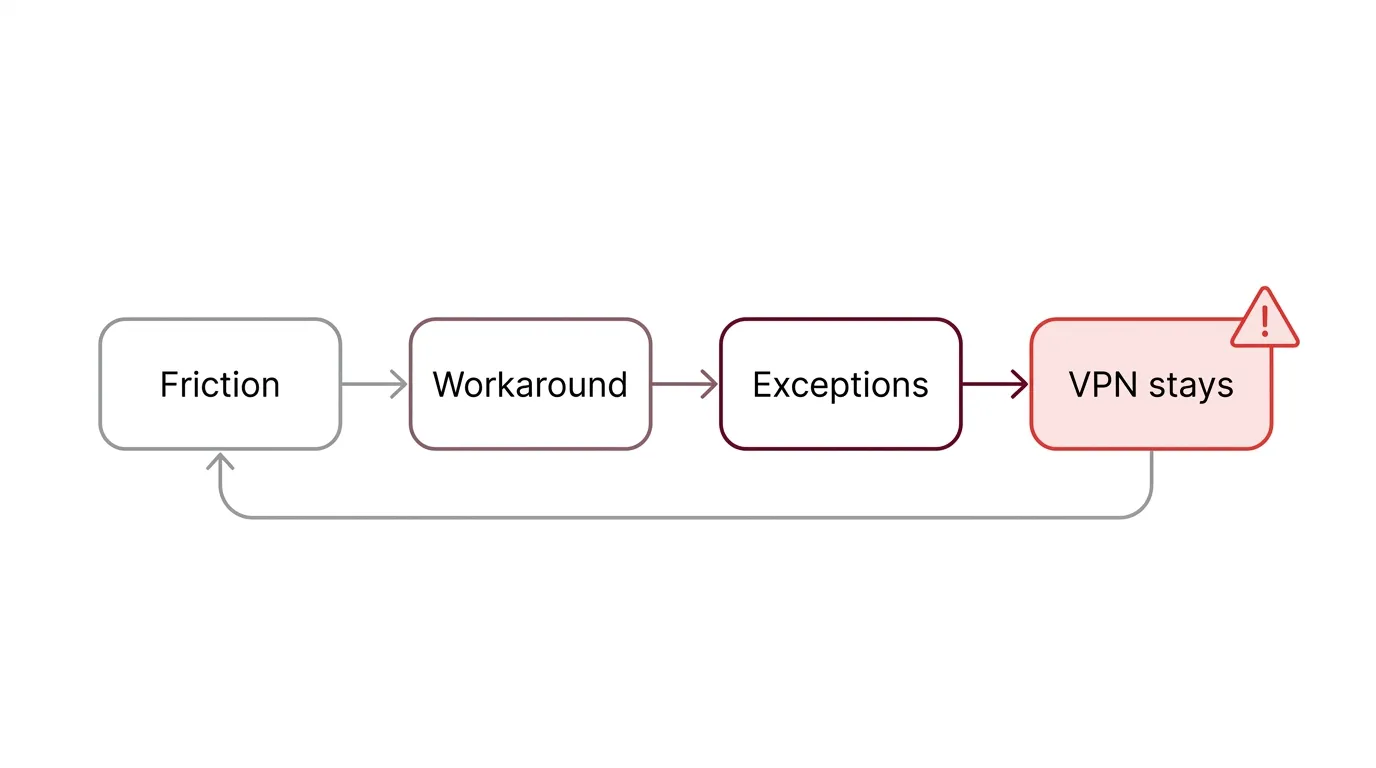
The failure sequence is behavioural, and it runs in a predictable order:
Enforcement creates friction. A policy is slightly too tight, an application is slower through the broker, an authentication prompt appears where none did before.
Users work around it rather than reporting it. This is the step most plans miss. When a control makes routine work slower or breaks a legitimate task, people do not file a ticket — they find another route. A personal device, an unsanctioned file-sharing app, a shared login.
Exceptions accumulate. The ones who do report it get an exception. Exceptions rarely expire.
The VPN stays. Because some things still only work over it, and nobody wants to be responsible for the outage that follows switching it off.
The organisation now runs two access systems, pays for both, and has a security posture no better than before — arguably worse, because the exceptions are undocumented and the assumption is that ZTNA is protecting things it is not.
Published implementation guidance reports that VPN and access issues already account for a substantial share of help desk volume in organisations with hybrid workforces — one source puts it around 30% — before stricter policy is layered on. We flag that as a single reported figure rather than a verified benchmark, but the direction is the point: friction is already there, and enforcement adds to it.
Identity is the prerequisite, not a workstream
This is the most consistent finding across published guidance, and the most commonly skipped.
Zero trust network access grants entry based on who and what device, continuously evaluated. That model collapses if the identity layer underneath it is not in order. Inconsistent multi-factor coverage, privileged roles that were never tightened, stale accounts, over-broad group memberships — each one becomes a gap that ZTNA faithfully enforces as a permission.
A tool swap without policy design recreates the VPN problem in a new interface. If the access model is still broad, moving it behind an identity broker changes where the broadness lives, not whether it exists.
What needs to be true before the first application is onboarded:
- Multi-factor authentication covering all users, not most
- Privileged and administrative roles reviewed and tightened
- Group memberships audited — broad groups are where least privilege quietly dies
- Device posture signals available: operating system version, patch level, disk encryption, security agent status
- A decision on unmanaged devices, including whether they are permitted at all for sensitive applications
That work is unglamorous and it is the actual project. Our guide to network access control covers the device-identity side, and the access control evidence expectations in the UAE IAS and DESC ISR frameworks overlap substantially with what a ZTNA rollout needs anyway.
The discovery problem
Incomplete discovery is usually the single largest risk, and there is a structural reason for it.
A legacy VPN grants broad network reach. Because everything is reachable, nobody has ever had to document what talks to what. Application dependencies, service accounts, scheduled jobs, third-party integrations and management traffic all work invisibly, and the VPN hides them.
ZTNA replaces that implicit reach with explicit entitlements. Anything undiscovered simply stops working, and it stops working at the moment of enforcement rather than during planning.
Two categories are missed most often. Non-human identities — service accounts, automation, machine-to-machine traffic — because most ZTNA tooling is designed around human login patterns. And third-party access, where a vendor or contractor connects through a route nobody in the current team established.
Six rollout steps
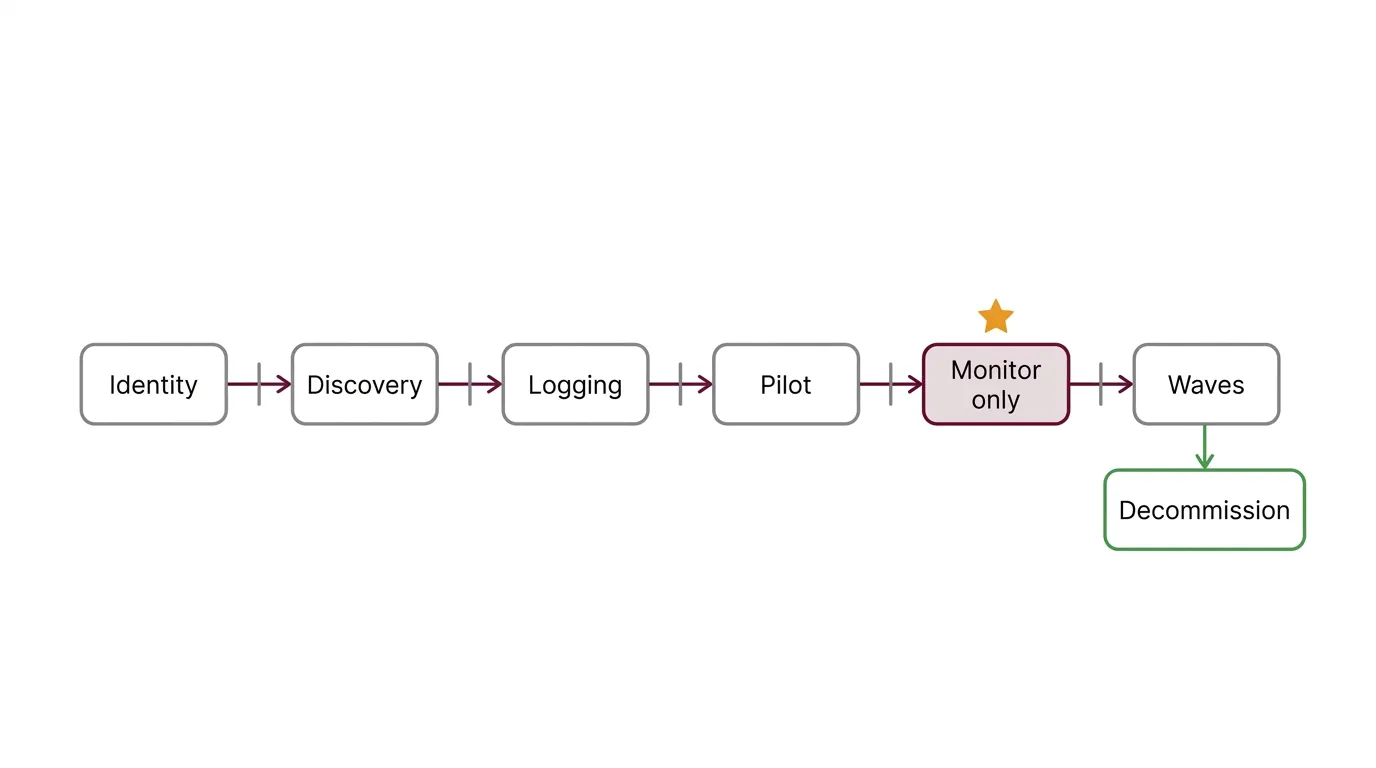
The sequence below is drawn from the phased approaches consistently recommended in published implementation guidance. The gating matters as much as the order — each phase should be validated before the next begins.
Fix identity before touching applications
MFA coverage, privileged role hygiene, group membership audit, device posture signals. If this is not in place, stop here — everything downstream inherits the gaps.
Discover what is actually behind the VPN
Map applications, dependencies, service accounts and third-party access. Assume the documented list is incomplete, because the VPN has been hiding the rest.
Stand up logging before the pilot, not after
Identity decisions, posture checks, policy matches, connector health, blocked attempts. Send events to the SIEM before the first user is onboarded so you have a baseline to compare against.
Pilot on a low-risk application with a small group
An internal read-only application — a dashboard or wiki — with a known support path. Measure login success, latency, help desk tickets and connector stability. Confirm users can complete real work, not merely reach a login screen.
Run monitor-only before you enforce
Observe what the policy would have blocked before it blocks anything. Skipping this observation period is the most commonly cited avoidable cause of broken production traffic.
Migrate in waves, then decommission deliberately
Business-critical applications next, device posture enforcement after. Before switching the VPN off, monitor its logs for residual connections — service accounts and third-party integrations surface here — and confirm zero usage for a defined period.
Useful success measures are simple and countable: applications onboarded, percentage of users migrated, reduction in broad group memberships, and remaining VPN usage. The last one is the honest measure of whether the project is finishing.
What breaks: legacy applications
Legacy application incompatibility is the most frequently cited technical blocker, and the failure modes are specific enough to check for in advance.
IP-dependent applications
Applications using IP-based session management, or embedding the client IP in application-layer headers, behave incorrectly when reached through a broker that changes the apparent source.
Certificate pinning
Applications that pin certificates break where the access path performs TLS inspection. Applications validating intermediate chains fail if the platform's certificate authority is not trusted by the application runtime.
Name resolution assumptions
Applications relying on legacy name resolution, or on discovering peers by broadcast, fail silently — which is worse than failing loudly, because nobody reports it.
One architectural mistake worth naming separately: deploying connectors as single points of failure. The resulting outages get attributed to the ZTNA platform rather than to the deployment design, which makes them harder to fix and damages confidence in the project.
The practical response is to identify these categories during discovery, test them explicitly during the pilot, and plan legacy exceptions deliberately rather than discovering them at enforcement. Some applications will need to stay on network-level access until they are replaced, and saying so early is better than pretending otherwise.
Coexistence without permanent drift
Running VPN and ZTNA together during migration is correct, expected, and where most rollouts get stuck.
The distinction that matters: coexistence should last exactly as long as it takes to validate each migration wave. It becomes a problem when it has no end date.
Three disciplines keep it bounded:
- Remove VPN entitlement as ZTNA access is accepted. If a user has both, they will use whichever is easier, and the migration never completes.
- Give every exception an owner and an expiry date. An exception without either is a permanent policy gap wearing a temporary label.
- Report on what remains, not what is done. Remaining VPN users, remaining VPN applications, remaining exceptions, and the business owner for each. Progress reporting that only counts migrations hides the tail.
Common rollout mistakes
- Big-bang cutover. Attempting to migrate everyone and everything at once, usually under pressure to retire a VPN by a date. Edge cases then derail the whole project rather than one wave of it.
- Treating ZTNA as purely a VPN replacement. It solves VPN's access problems; it does not replace threat detection, data loss prevention or the rest of the stack.
- Ignoring device posture. Connecting the right user on a compromised device solves half the problem. Posture checks are the other half.
- Skipping monitor-only. The cheapest insurance available against breaking production traffic.
- Underestimating latency. DNS resolution, TLS handshakes, policy evaluation and backhaul through centralised brokers each add delay, and poor performance is a leading reason users bypass controls.
- Staffing the rollout but not the operation. Policy tuning is continuous work. Budget for it or the policy set ossifies and exceptions become the mechanism for everything.
Frequently asked questions
Why do ZTNA projects fail if the security model is sound?
Because failures cluster in deployment rather than strategy. The common causes are broken application dependencies discovered at enforcement, latency that pushes users toward workarounds, and unmanaged service accounts that nobody mapped. The model is rarely the problem; the migration is.
What has to be in place before starting a rollout?
Identity maturity, above everything else. Multi-factor authentication covering all users, privileged roles reviewed, group memberships audited, and device posture signals available. Zero trust network access grants entry based on identity and device, so gaps in that layer become permissions rather than being caught.
Should we keep the VPN running during migration?
Yes, and that is the correct approach — but with an end date. Coexistence should last only as long as it takes to validate each migration wave. The failure mode is permanence: if users hold both entitlements they use whichever is easier, and the migration never completes. Remove VPN access as each wave is accepted.
What is a monitor-only period and why does it matter?
A phase where policies are evaluated and logged but not enforced, so you can see what would have been blocked before anything actually is. Skipping it is among the most commonly cited avoidable causes of broken production traffic, because it is the only cheap way to find dependencies the discovery phase missed.
Which applications commonly break?
Those using IP-based session management or embedding client IP in application headers, those implementing certificate pinning where the access path inspects TLS, and those relying on legacy name resolution or broadcast peer discovery. These tend to fail silently rather than loudly, which delays detection.
Does ZTNA replace our firewalls?
No. It addresses how users reach applications, particularly remote and distributed users. Local traffic that never leaves the building, operational technology and surveillance networks, and the segmentation and logging expectations in UAE compliance frameworks all still require on-premise controls. Most organisations run both.
How do we know the rollout is actually finished?
Measure what remains rather than what is done: remaining VPN users, remaining VPN applications, remaining exceptions and an owner for each. A project reporting only migrations completed can look finished while a long tail keeps the VPN alive indefinitely.
Getting the groundwork right before the tooling
Most of what decides a rollout happens before any access platform is configured: identity hygiene, honest discovery of what the VPN has been hiding, and logging that exists before the pilot rather than after the first incident.
Magnus supplies network security, access control and segmentation infrastructure across our cybersecurity solutions range, alongside the on-premise controls that continue to sit underneath a zero trust architecture. Tell us where you are in the sequence and our pre-sales team will help specify what the next phase needs.
Get a quoteSource and limitations
The rollout sequence, failure modes and legacy application incompatibilities described here reflect implementation guidance published across multiple independent sources, including access platform vendors, managed service providers and practitioner technical guides, cross-checked for consistency. The phased approach — identity first, discovery, logging, low-risk pilot, monitor-only, then waves — is consistently recommended across those sources.
Stated limitations. No vendor, product or platform is named anywhere in this article, and the failure patterns are described generically rather than attributed to any specific implementation. The help desk volume figure is reported by a single secondary source and is flagged in the text as a single reported figure rather than a verified benchmark. Application compatibility behaviour varies by platform architecture and by how TLS inspection and connector placement are configured; validate against your own application estate during a pilot rather than relying on general categories. This is general information for infrastructure planning and is not a substitute for a design assessment against your specific environment.