


Security & Surveillance · Specification
Outdoor IP Cameras: 6 Essential UAE Climate Checks
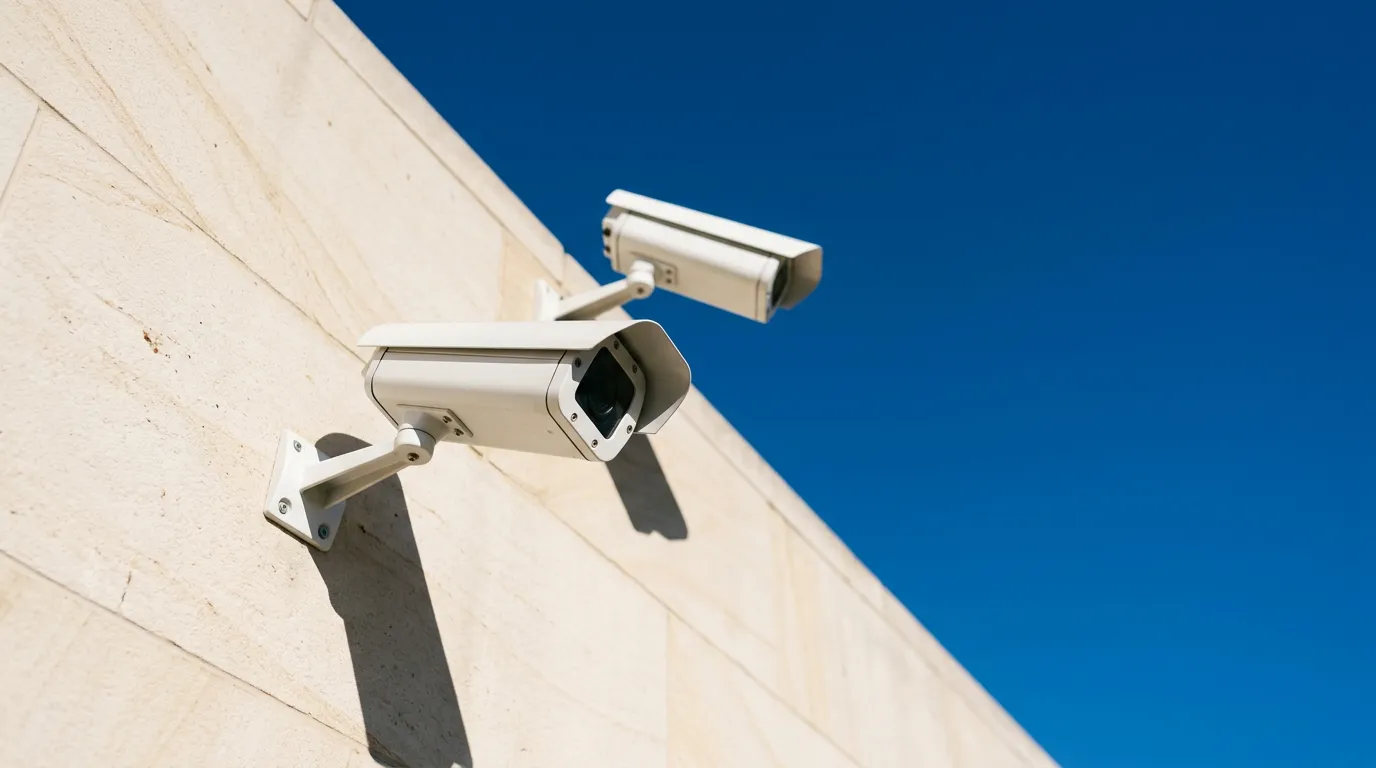
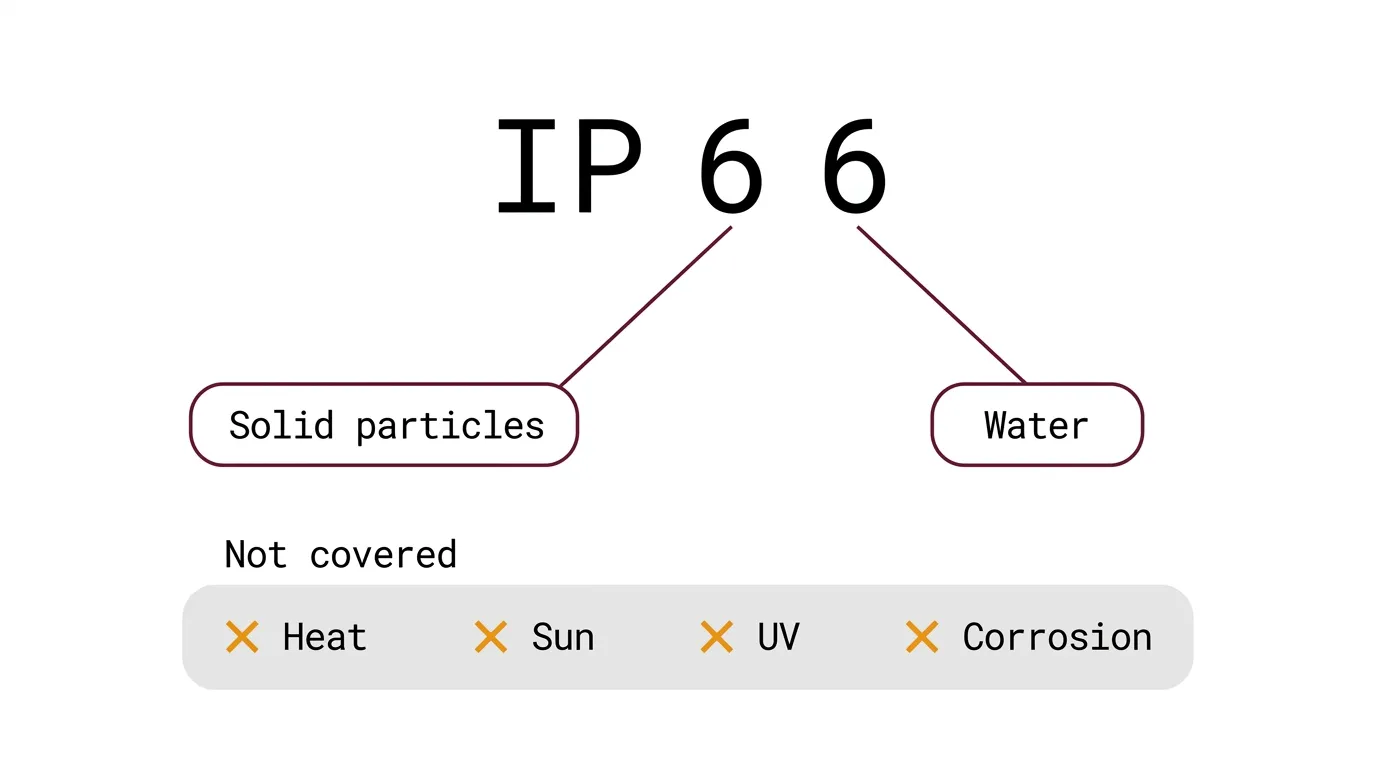
Outdoor IP cameras are almost always specified on their IP rating, and the IP rating says nothing about heat. It describes dust and water ingress only — temperature, solar load and UV exposure are not in the code at all. A camera can be rated IP67, be entirely watertight, and still cook itself on a Dubai rooftop in August.
Key takeaways
- IP ratings cover dust and water only. Heat, sun and UV are not in the code. Waterproof and heat-tolerant are unrelated claims.
- A published operating temperature range describes still, shaded air. Almost nothing outdoors sits in still shaded air at midday.
- Housing material and colour matter as much as the rating — metal with heat-dissipating design, light colours, UV-stabilised plastics.
- Heat rarely kills a camera outright. It degrades seals and components quietly, and the failure arrives months later looking like something else.
- Coastal installations need corrosion resistance, not just ingress protection. Salt attacks fixings and gaskets, and a failed gasket lets water in regardless of the IP number.
- Check the whole outdoor chain. An IP66 camera fed by a non-rated junction box or PoE injector fails upstream of the camera.
What the IP rating does not cover
The IP number is the first thing on every outdoor camera datasheet and the first thing every specification asks for. It is genuinely useful, and it answers a narrower question than most buyers assume.
Ingress Protection covers exactly two things: solid particles and water. That is the whole scope of the code. It says nothing about:
- Maximum operating temperature
- Solar heat load on the housing
- UV degradation of plastics, seals and cable jackets
- Corrosion resistance in salt air
- Humidity tolerance or internal condensation
Every one of those is a live failure mode in the UAE, and none of them is addressed by moving from IP66 to IP67. A camera can be completely sealed against dust and jets of water while its internal temperature climbs past what its components tolerate.
This matters commercially because the IP rating is the specification everyone checks and the other five are the specifications that actually decide whether the camera is still working in year three.
Reading the IP code properly
The two digits are independent scales measuring different things, which is worth understanding before comparing outdoor IP cameras against each other.
| Rating | Solids | Water | Typical use |
|---|---|---|---|
IP65 | Dust-tight | Low-pressure jets | Sheltered outdoor; marginal for exposed positions |
IP66 | Dust-tight | Powerful jets | Standard outdoor commercial specification |
IP67 | Dust-tight | Temporary immersion | Exposed, wash-down or flood-prone positions |
IP68 | Dust-tight | Continuous immersion | Submerged or permanently wet installations |
IP69K | Dust-tight | High-pressure, high-temperature wash-down | Industrial cleaning environments |
Two things follow. The first digit maxes out at 6 — dust-tight — so IP66, IP67 and IP68 offer identical particle protection and differ only in water. And IK ratings are separate again, covering impact resistance rather than ingress; SIRA requires IK10 for equipment within reach, which is an unrelated specification to the IP number.
For most UAE commercial positions, IP66 is the sensible floor and IP67 buys meaningful margin on fully exposed mounts at a modest premium. Neither helps with heat.
The temperature trap: rated ambient vs real surface
This is the single most consequential misreading on an outdoor camera datasheet.
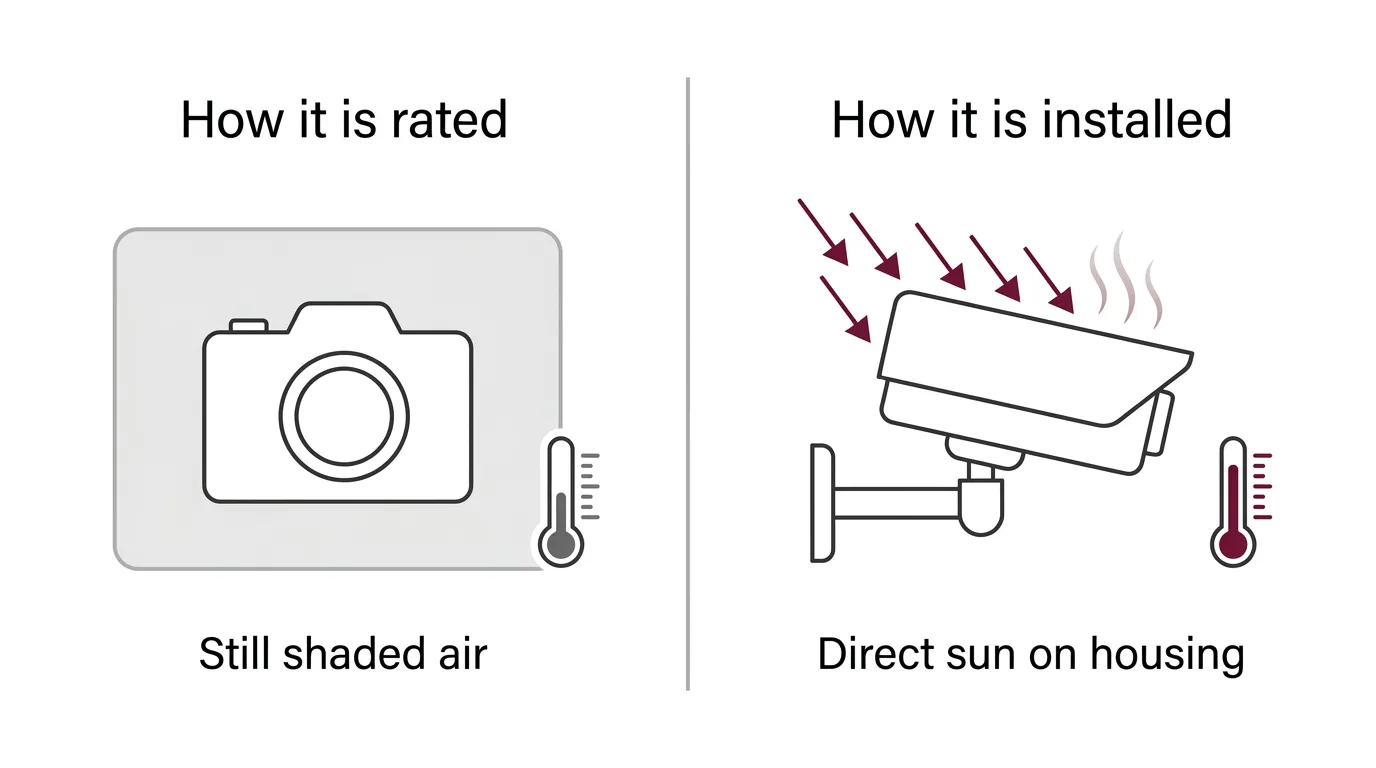
A published operating temperature range — commonly something like −30 °C to +60 °C — is a measurement of ambient air temperature: still air, in shade, around the device. It is a laboratory condition.
A camera mounted on a south-facing wall or a rooftop pole in July is not in still shaded air. It is absorbing direct solar radiation on its housing, sitting in air warmed by the surface behind it, and generating its own internal heat inside a sealed enclosure with no airflow. Industry reporting on Middle East rooftop installations describes housing surface temperatures exceeding 70 °C in direct sun — well above the ambient air temperature at the same moment.
So a camera comfortably rated for the region's ambient temperatures can still be operating outside its specification where it is actually installed.
Three design responses genuinely help, and they are visible on a datasheet if you look for them:
Metal housings with heat dissipation
Aluminium alloy bodies with integrated fins conduct heat away from the sensor board. Plastic housings with no thermal path trap it.
Light colours and UV-stable materials
Pale housings reflect rather than absorb. UV-stabilised polycarbonate resists the embrittlement that turns exposed plastic chalky and cracked.
Sun shields
A shroud standing off the body keeps direct sun off the housing and creates an air gap. Cheap, effective, and frequently omitted to save a few dirhams.
How heat actually kills outdoor IP cameras
Heat failures in outdoor IP cameras are rarely dramatic, which is why they are usually misattributed.
- Seal degradation. Repeated thermal cycling — hot afternoons, cooler nights, every day for years — hardens and shrinks gaskets. The IP rating quietly stops being true, and moisture starts entering a camera that still says IP66 on the label.
- Lens and focus drift. Heat shifts optical alignment and can affect IR-cut filter switching, so night footage goes soft or the day/night transition starts hunting back and forth at dusk.
- Silent component failure. Capacitors and power components age much faster at elevated temperature. The camera simply stops one day, months or years early, and nobody connects it to the summer it spent at 70 °C.
- Thermal shutdown. Better cameras protect themselves by throttling or shutting down, which shows up as intermittent outages during the hottest part of the day rather than as a fault.
The pattern to watch for: a site where several cameras fail in their third or fourth summer, at different times, with different symptoms. That is heat, not a bad batch.
Humidity and condensation
Coastal UAE sites carry high humidity alongside the heat, and the combination produces a specific failure that looks like a seal problem but often is not.
Warm humid air inside a housing cools overnight. When the internal surface drops below the dew point, moisture condenses on the inside of the front glass. The result is a fogged lens at dawn that clears by mid-morning — and over time, once heat cycling has degraded the seal enough to let more humid air in and out, a permanent internal haze.
Look for sealed housings with desiccant, nitrogen-purged assemblies on higher-specification models, and gaskets rated for the temperature range they will actually see rather than the one on the datasheet.
Coastal sites: salt and corrosion
Dubai Marina, the corniche developments, ports and any site within reach of sea spray present a problem the IP code does not address at all.
Salt attacks fixings, brackets and gasket surfaces. Standard aluminium corrodes; stainless fixings of the wrong grade corrode; and once a gasket seat is pitted, the housing leaks regardless of its original rating. The failure sequence is corrosion first, ingress second, electronics third — and it is frequently blamed on the camera being "not properly waterproof" when the IP rating was never the issue.
What to specify instead, or in addition:
- NEMA 4X, which explicitly addresses corrosion resistance where the IP code does not. Note that it does not confirm UV resistance or any particular temperature range — those are still separate checks.
- Marine-grade or anodised aluminium, or 316-grade stainless for the harshest positions.
- Matching fixings and brackets. A corrosion-resistant camera on a standard steel bracket fails at the bracket.
- UV-resistant outdoor-rated cable. Standard patch cable jackets crack under sun and salt, producing intermittent faults that are difficult to trace. Conduit adds a further barrier.
Six checks before you specify outdoor IP cameras
What is the maximum operating temperature, and is it ambient?
It will be. Then ask what the mounting position actually presents — direct sun, reflected heat from a facade, still air inside a shroud.
What is the housing made of, and what colour?
Metal with heat-dissipating design and a pale finish behaves very differently from dark plastic in the same position.
Is there a sun shield, and is it included?
Often an accessory rather than part of the camera. It is one of the cheapest interventions available and routinely value-engineered out.
Is corrosion resistance specified for coastal positions?
NEMA 4X, housing material and grade, and the fixings. All three, not just the camera body.
Is every outdoor component rated, not just the camera?
Junction boxes, PoE injectors, media converters and cable glands. Water entering an unrated junction box reaches the camera from behind.
Does the cable suit outdoor UV exposure?
Outdoor-rated jacket, correct category, and conduit where exposed. Our guide to cable jacket ratings covers how jacket specification is read.
None of these appear on a compliance checklist, which is why systems can pass inspection and still fail in service. The SIRA requirements set a floor; our guide to SIRA CCTV requirements covers that floor in full.
The recorder is often in a worse place
A point that gets missed because attention is all on the outdoor equipment.
The cameras outside are at least designed for weather. The recorder is frequently installed somewhere with no environmental design at all — a sealed comms cabinet in an unconditioned plant room, a riser cupboard, a ceiling void. Those spaces can exceed the recorder's operating temperature comfortably on a summer afternoon, and unlike a camera, a recorder failing takes the whole system with it.
Specify the recorder's environment as deliberately as the cameras': ventilation or cooling for the cabinet, temperature monitoring if the location is marginal, and UPS in a position that is not itself cooking. Our guide to CCTV storage requirements covers sizing the recorder; where it physically sits deserves the same attention.
Frequently asked questions
Does an IP67 camera handle heat better than IP66?
No. The IP code covers solid particle and water ingress only, and both ratings are dust-tight. The difference between them is water resistance — powerful jets versus temporary immersion. Neither digit says anything about temperature, solar load or UV exposure, so moving from IP66 to IP67 buys no additional heat tolerance whatsoever.
What operating temperature should I look for in the UAE?
Look for the widest upper limit available, then treat it as a shade figure rather than a guarantee. The published range describes still ambient air, while a housing in direct sun runs considerably hotter — industry reporting on Middle East rooftop installations describes surface temperatures above 70°C. Pair a high rating with a metal heat-dissipating housing, pale finish and a sun shield.
Why do my cameras fog up in the morning?
Internal condensation. Warm humid air inside the housing cools overnight, and when the internal glass drops below the dew point moisture condenses on it. It usually clears as the day warms. If it becomes permanent haze, heat cycling has degraded the seal enough to let humid air move in and out freely, and the housing is no longer performing to its rating.
Do I need NEMA 4X for coastal installations?
It is worth specifying, because NEMA 4X explicitly addresses corrosion resistance where the IP code does not. Note that it does not automatically confirm UV resistance or any particular operating temperature, so those remain separate checks. Housing material grade and the fixings matter as much as the rating itself.
Is a sun shield actually worth it?
Yes, and it is among the cheapest interventions available. A shroud standing off the housing keeps direct solar radiation off the body and creates an air gap that allows some convection. It is frequently supplied as an accessory rather than included, and just as frequently removed from a quotation to save cost.
My camera is IP66 but water still got in. Why?
Three common causes. The gasket has degraded through thermal cycling or corrosion, so the rating is no longer true in practice. Water entered upstream through an unrated junction box, gland or PoE injector and reached the camera from behind. Or the cable entry was not sealed correctly during installation, which no rating can compensate for.
Does SIRA specify anything about heat or corrosion?
The Preventive Systems Manual sets IP66 as the minimum for outdoor cameras or their enclosures, and IK10 for equipment within reach. Those are ingress and impact requirements. Environmental durability beyond that — temperature tolerance, corrosion resistance, UV stability — is a specification decision rather than a compliance one, which is why compliant systems can still fail in service.
Specifying for the position, not the catalogue
The same camera can be the right choice on a shaded loading bay and the wrong one on a west-facing rooftop three metres away. Mounting position, sun exposure, proximity to the coast and the recorder's own environment all change the answer.
Magnus distributes IP surveillance from VIVOTEK and HOLOWITS across our IP surveillance solutions range. Send us your camera schedule with mounting positions and exposure, and our pre-sales team will check environmental specification alongside the compliance requirements.
Get a quoteSource and limitations
Ingress Protection ratings follow the IEC 60529 standard, in which the first digit denotes protection against solid particles and the second against water; the code does not address temperature, solar load, ultraviolet exposure or corrosion. NEMA Type 4X addresses corrosion resistance and is frequently listed alongside IP ratings, but does not itself confirm UV resistance or a particular operating temperature range. The SIRA IP66 and IK10 minimums referenced are from the Preventive Systems Manual approved by Administrative Resolution No. (13) of 2025.
Stated limitations. No product model numbers or manufacturer operating temperature ranges are quoted here, because ranges vary by model and hardware generation and an out-of-date figure would be misleading on a specification page. The reference to housing surface temperatures exceeding 70 °C in direct sun reflects industry reporting on Middle East rooftop installations rather than a measured constant; actual surface temperature depends on orientation, housing material and colour, airflow and mounting substrate. No specific UAE ambient temperature figure is stated, as the argument rests on the distinction between rated ambient and actual surface conditions, which holds regardless. Confirm environmental specifications against the current datasheet for the specific model, and against the conditions at the actual mounting position.