


Networking & Wireless · Structured Cabling
Cable Certification Testing: 3 Essential Tiers Explained
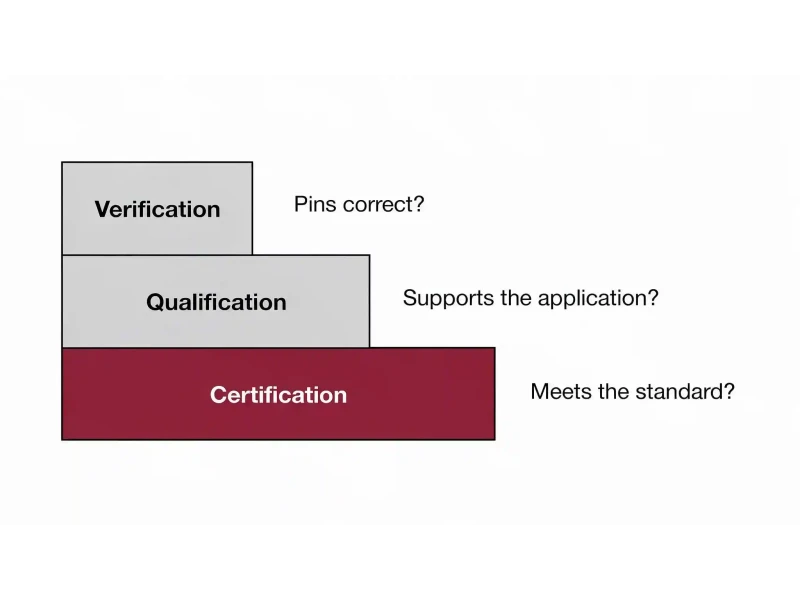
Cable certification testing sits at the top of a three-tier hierarchy. Verification asks whether the pins are connected correctly. Qualification asks whether the link can carry a specific application. Certification asks whether the installation meets TIA or ISO standards — and it is the only tier that produces documentation a cable manufacturer will accept for a warranty claim.
Key takeaways
- The three tiers are cumulative. Qualification includes verification. Certification includes both, then adds measurement against standards.
- Only certification supports a manufacturer warranty. Test with anything less and the installer carries the performance liability alone.
- Two links can both pass a wire map test and still differ enormously in what they can actually carry.
- The tester must itself meet an accuracy level defined by ANSI/TIA-1152. A certification result from a non-compliant instrument is not a certification.
- “Certified cable” sold by the box is a misuse of the term. Certification applies to an installed link, not to a product on a shelf.
The three tiers at a glance
Field test instruments fall into three hierarchical groups. Each answers a different question, and each includes the capabilities of the tier below it.
| Tier | Question it answers | Typical measurements | Supports warranty? |
|---|---|---|---|
| Verification | Are the pins connected correctly? | Wire map, continuity, toning, sometimes length | No |
| Qualification | Will this link carry a given application? | Everything above, plus bandwidth and throughput assessment | No |
| Certification | Does this link meet TIA or ISO limits? | Everything above, plus a full frequency sweep of every standard parameter | Yes |
The distinction matters commercially rather than academically. Most disputes between an installer and a client after handover come down to which tier of test was actually performed, and what it did or did not prove.
Verification testing
Verification answers one question: is this cable terminated correctly?
These are simple, low-cost tools performing basic continuity checks — wire map to confirm each pair reaches the right pin at both ends, and toning to identify a specific cable in a bundle. Some include a time domain reflectometer to report length, or the distance to a fault.
Wire mapping catches the physical installation errors: opens, shorts, reversed pairs, crossed pairs and split pairs. Those are genuine faults worth catching, and a verifier catches them quickly and cheaply.
What it cannot tell you is anything about performance. A correctly terminated link can still be too long, too noisy, or built from cable that will not carry what the project needs. Verification is the right tool for troubleshooting a dead outlet. It is not a basis for accepting a new installation.
Qualification testing
Qualification adds a performance question: will this link support a specific application?
A qualifier includes everything a verifier does, then assesses whether the cabling can carry Fast Ethernet, Gigabit, VoIP, PoE or 10GBASE-T. Rather than measuring against a cabling standard, it tests against an application requirement — often by sending real traffic or a bit-error-rate pattern across the link and observing whether it holds up.
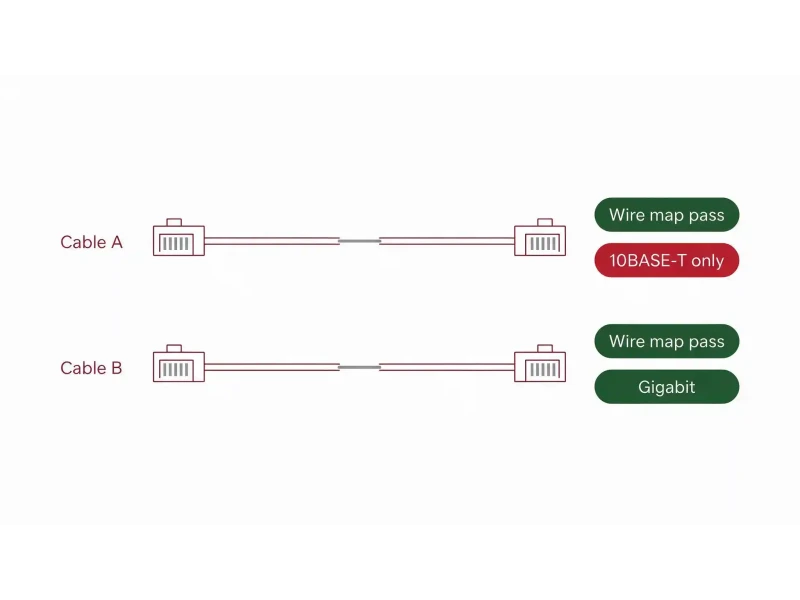
The distinction between the first two tiers is easiest to see with an example. Two links both pass a wire map test perfectly. A qualification test then shows one can carry only 10BASE-T while the other supports Gigabit Ethernet. Identical verification result, completely different practical capability.
Qualification is genuinely useful for moves, adds and changes, for checking whether existing cabling will support a planned upgrade, and for troubleshooting before committing to certification. What it cannot do is produce a standards-compliant report. It tells you a link works today; it does not tell you the link meets Category 6A, or that it will still perform after three years of thermal cycling and connector wear.
Cable certification testing
Certification answers the definitive question: does this installation comply with the cabling standard it was specified to?
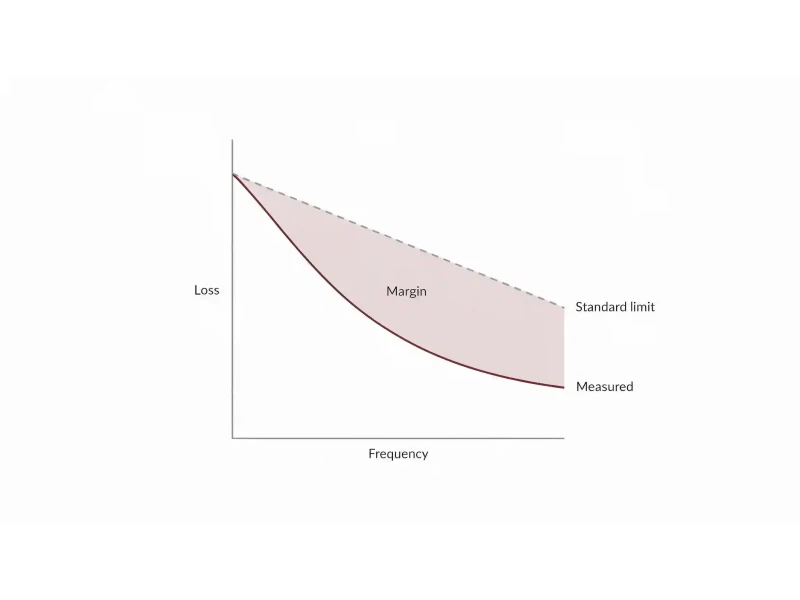
A certifier includes everything in the tiers below, then sweeps measurements across the full frequency range defined for the category and compares every result against ANSI/TIA-568 or ISO/IEC 11801 limits. The output is a documented pass or fail against a named standard.
The parameters measured typically include:
- Insertion loss — signal attenuation across the frequency band
- NEXT and PS-NEXT — near-end crosstalk, individually and summed across pairs
- ACR-F and PS-ACR-F — far-end crosstalk relative to attenuation
- Return loss — signal reflected back by impedance mismatches
- Propagation delay and delay skew — timing across and between pairs
- DC loop resistance — increasingly relevant for PoE
- Wire map and length — the verification layer, retained
The frequency range scales with the category: Category 6 is characterised to 250 MHz, Category 6A to 500 MHz, and Category 8 sweeps to 2000 MHz. That is why a certifier suitable for one category is not automatically suitable for another.
Return loss deserves a specific mention. A link can pass every other parameter and still fail on return loss, because impedance mismatches at terminations reflect signal back toward the transmitter. It is one of the parameters that only certification catches.
The warranty consequence
This is the part with real money attached, and it is the reason the distinction is worth understanding before a project rather than after.
Cable manufacturers require certification testing to grant an installation warranty. Those warranties — commonly running fifteen to twenty-five years — cover the performance of the installed system, not just the product in the box. To obtain one, the installer must certify the links with an approved certification tester and submit the results.
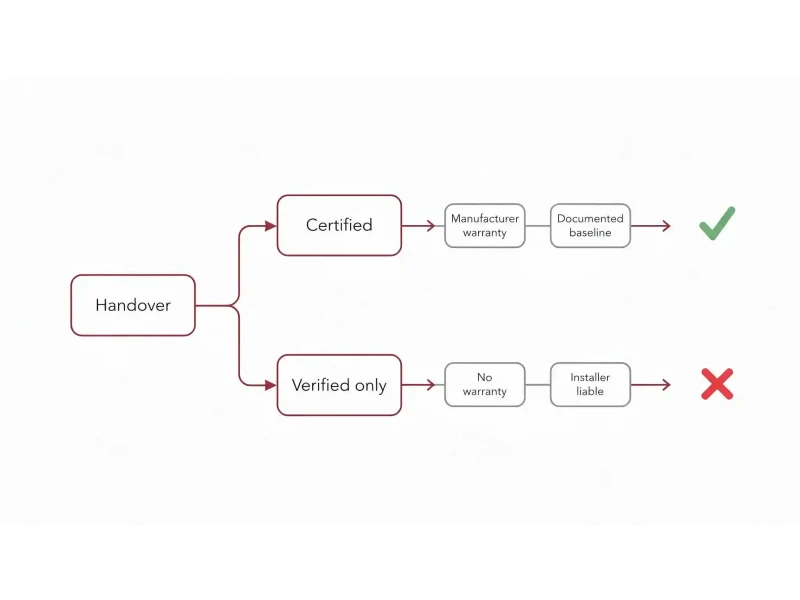
If an installation is handed over on the basis of verification or qualification testing alone, no manufacturer-backed warranty applies. The performance liability sits entirely with the installer. If a link degrades in year three, there is no manufacturer to escalate to and no documented baseline proving the link was compliant at handover.
That is a significant commercial exposure to carry for the cost of a test, and it is frequently discovered only when something fails.
Certified at handover
Documented pass against a named standard, manufacturer warranty available, and a baseline to compare against if performance is questioned later.
Verified only
No warranty, no performance baseline, and no evidence that the link met its specification on the day it was signed off.
The dispute case
When a client questions performance after handover, certification records are the only objective evidence. Without them the argument has no reference point.
The practical rule for anyone specifying a project: state the required test tier in the tender, not just the cable category. “Cat6A installed and tested” is ambiguous. “Cat6A, certified to ANSI/TIA-568 permanent link, results submitted” is not.
Why the tester itself must be certified
A point that is easy to miss: the instrument performing the certification has to meet its own accuracy standard.
Field tester accuracy is defined under ANSI/TIA-1152, which sets accuracy levels that a certifier must satisfy to produce valid results for a given category. Certifying Category 6A requires a tester meeting the appropriate accuracy level; an instrument below that level cannot produce a compliant result no matter what its display says.
This matters when reviewing test reports from a contractor. A certification report should identify the instrument, its accuracy level, the standard tested against, and the calibration status. A report that omits those is not demonstrating much.
The “certified cable” myth
Worth clearing up, because it appears constantly in product listings.
Cable and patch cords are sometimes advertised as “certified” by a test equipment brand. Test instrument manufacturers do not certify or endorse cabling products — they make the instruments installers use to certify an installed link.
Certification applies to an installed channel or permanent link, not to a product in a box. A reel of cable cannot be certified, because the certification measures the assembled link: the cable, the terminations, the patch panel and the jack, as installed, in the conditions they are installed in.
What a component can legitimately carry is third-party verification of its own performance — independent testing confirming it meets the relevant ANSI/TIA, ISO/IEC or EN performance specification. That is a genuine and useful mark, and it is a different thing from certification of an installation.
Which tier for which job
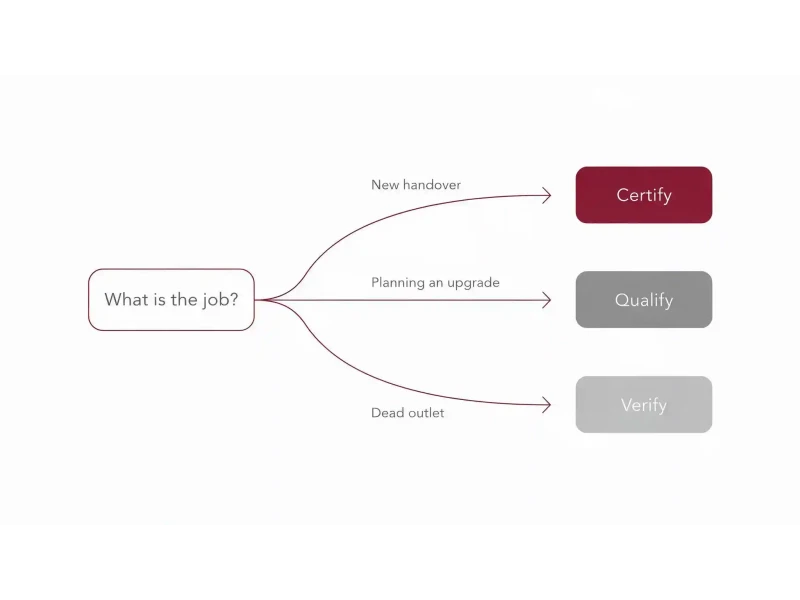
New installation handover — certification
Non-negotiable if a manufacturer warranty is required, and the only defensible basis for client acceptance. Specify the standard and the link type in the tender.
Assessing existing cabling for an upgrade — qualification
Will the installed cabling carry 10 Gigabit or PoE++ before you commit to new hardware? Qualification answers that without the cost of full certification.
Moves, adds and changes — qualification or verification
Depends on scope. A reconfigured patch usually needs verification; a repurposed link intended for a faster application warrants qualification.
Troubleshooting a dead outlet — verification
Fastest and cheapest way to find an open, short, reversed pair or split pair. Right tool for the job.
Pre-certification snagging — verification, then certify
Running a verifier across a new installation first catches termination errors cheaply, so the certification run is not consumed finding faults a wire map would have caught.
Disputed performance after handover — certification
The only tier producing evidence against a published standard. Without a certification baseline from handover, there is nothing to compare a later result to.
Test results are only as good as the installation underneath them. The specification decisions that most often cause certification failures — over-length runs, the wrong conductor construction, damaged shielding — are covered in our guides to Ethernet cable distance limits, solid versus stranded cable and cable shielding types. For the practical mechanics of running a test, see our guide to Ethernet cable testing.
Frequently asked questions
What is the difference between certification and qualification testing?
Qualification tests whether a link can carry a specific application, such as Gigabit Ethernet or PoE. Certification tests whether the link meets a published cabling standard such as ANSI/TIA-568 Category 6A, sweeping every required parameter across the full frequency band and producing a documented pass or fail. Only certification supports a manufacturer warranty.
Do I need certification testing for a manufacturer warranty?
Yes. Cable manufacturers require certification results from an approved tester before granting an installation warranty. Handing over on verification or qualification testing alone means no manufacturer-backed warranty applies and the installer carries the performance liability alone.
Can a cable be certified when I buy it?
No. Certification applies to an installed link — the cable, terminations, patch panel and jack, measured as assembled. A product on a shelf cannot be certified. Components can carry independent third-party verification of their own performance, which is a genuine mark but a different thing entirely.
What parameters does certification actually measure?
Insertion loss, near-end crosstalk including power-sum, far-end crosstalk, return loss, propagation delay, delay skew, DC loop resistance, plus the wire map and length checks from the verification tier. Each is swept across the frequency range defined for the category and compared against the standard's limit line.
Does the tester itself need to meet a standard?
Yes. Field tester accuracy is defined under ANSI/TIA-1152, and a certifier must meet the accuracy level appropriate to the category being tested. A result from an instrument below that level is not a valid certification, which is why test reports should identify the instrument and its accuracy level.
Is verification testing ever enough?
For troubleshooting a dead outlet or checking a reconfigured patch, yes — it is the fastest way to find opens, shorts and reversed or split pairs. It is not enough for accepting a new installation, because it says nothing about whether the link meets its specified performance.
Why does a link fail certification but still work?
Because certification measures margin against a standard, not simply whether traffic passes today. A link failing on return loss or crosstalk may carry current traffic acceptably and then fail when equipment is upgraded, temperature changes, or connectors age. That margin is exactly what the warranty depends on.
Specifying cabling that will certify
Certification failures are usually specification failures found late — an over-length run, the wrong conductor for the termination, or a shield that lost continuity at a jack. All of those are decided long before a tester is connected.
Magnus supplies Premium-Line structured cabling, keystone jacks and patch panels across our networking and wireless solutions range. Tell us the standard the project has to certify to and our pre-sales team will specify components to match it.
Get a quoteSource
Copper cabling performance limits are defined in ANSI/TIA-568 and ISO/IEC 11801. Field test instrument accuracy levels are defined in ANSI/TIA-1152. The three-tier classification of verification, qualification and certification testing is the standard framework used across the field test instrument industry, and the requirement for certification testing to obtain a cabling manufacturer's installation warranty is standard practice among major cabling manufacturers — confirm the specific requirement with the manufacturer whose warranty applies to your project, as terms vary. Test parameters and frequency ranges vary by category; confirm against the standard applicable to the installation. Cross-checked against field test instrument manufacturer technical documentation and independent cabling industry references.